
New Delhi
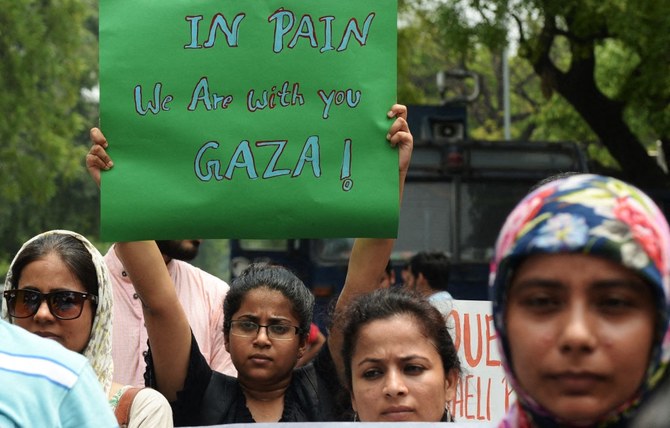
Indian journalists gathered in New Delhi on Wednesday to remember dozens of their Palestinian colleagues killed by Israeli strikes in Gaza.
At least 138 journalists are among the more than 33,800 people killed in the region since October, according to the latest figures from the Palestinian enclave’s authorities. Another 25 are missing or have been detained by Israeli forces.
The war has been the deadliest ever for journalists. Many were killed while reporting in the field, where they were clearly identifiable. Others died in strikes on their homes.
The meeting, titled “Honoring the Fallen: Remembering Palestinian Journalists in Gaza,” was organized by the Cogito Media Foundation, alongside members of the Press Club of India, Press Council of India, Indian Women’s Press Corps and representatives of the local media.
“This is the first time in any conflict in the world that so many journalists have been killed,” Shams Tabrez Qasmi, the foundation’s president, told Arab News.
“What Israel wants is to keep on committing the genocide and creating terror in Gaza … (and) it wants to present itself as a victim in front of the world. That’s why journalists are being targeted … Journalists in Gaza are showing to the world what is happening, but Israel does not want the truth to come out.”
The Indian journalists hope their voices will matter in calling for Israel to be held accountable for atrocities.
“This is our responsibility and we should raise our voice,” Qasmi said.
“Israel is the culprit and we want the world to recognize it … We invited many media representatives to send a strong message that the Indian journalists are with the people of Gaza and with journalists of Gaza.”
Qurban Ali, a senior journalist and producer who spoke at the event, told Arab News that while the meeting was not the first of its kind it was important to send a message to the Indian government.
Support for Palestinian statehood was once an integral part of India’s foreign policy, but in recent years Delhi has moved closer to Tel Aviv, despite civil society protests across the country.
“The solidarity meet is significant when the war has reached such a stage,” Ali said.
“We are the biggest democracy in the world, the biggest free media in the world. That’s why it is very significant. It is an attempt to convey our voice not only to the Zionist Israel but to the world community.
“India is in a unique position. It is the biggest democracy, a traditional supporter of the Palestine cause, so our voice matters. Despite India’s nuanced approach to Israel now, New Delhi cannot support Israel blatantly.”
For Binny Yadav, secretary-general of the Indian Women’s Press Corps, events like Wednesday’s meeting, which was also attended by scholars, activists and representatives of different religions, showed “a collective voice.”
“We have to stand together,” she said. “There is hardly any presence of international journalists in Gaza and whatever news we are getting from Palestine, this news is being sent by local journalists.
“We, as journalists, stand with them. This is not a statement of the government but the collective voice of the people of India for the people and journalists of Palestine.”

keywords