Pakistan’s top court begins hearing on alleged judicial meddling by spy agencies

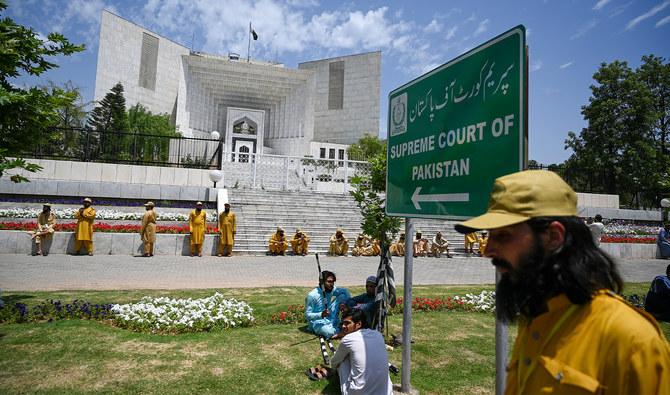
In this picture taken on May 15, 2023, supporters (sitting in foreground) of parties of Pakistan's ruling alliance gather outside the Supreme Court in Islamabad, Pakistan. (AFP/File)
Short Url
Updated 03 April 2024
Follow

Pakistan’s top court begins hearing on alleged judicial meddling by spy agencies

  • The Supreme Court took a suo motu notice after receiving a complaint from six judges of the Islamabad High Court
  • Just a day ahead of the hearing, the IHC judges received letters with white powder that claimed to be anthrax-tainted

ISLAMABAD: A seven-member Supreme Court bench began hearing a suo motu case on Wednesday, following a complaint by six Islamabad High Court (IHC) judges who alleged the country’s top intelligence agencies were interfering in judicial affairs, seeking to influence verdicts through intimidation and coercion.

The IHC judges raised the matter last month in a letter to the Supreme Judicial Council, demanding institutional consultation over the issue and pointing out that such meddling undermined the independence of the country’s judiciary.

Subsequently, Chief Justice of Pakistan Qazi Faez Isa held a meeting with Prime Minister Shehbaz Sharif in which it was decided to form an inquiry commission.

This was followed by the government’s decision to nominate a former Pakistan chief justice, Tassaduq Hussain Jillani, as head of the commission, though he recused himself and said the matter should be probed by the Supreme Judicial Council or the Supreme Court itself.

“There will be zero tolerance on the independence of the judiciary,” the chief justice said at the outset of the hearing.

The top court took the suo motu after members of the legal fraternity widely pointed out that the Supreme Judicial Council had got the powers to investigate the matter by summoning anyone involved.

Many lawyers also thought the incumbent government would not be able to investigate the matter impartially or completely.

“The Supreme Judicial Council should record statements of all those involved in this matter besides examining the available evidence to fix the responsibility,” a former judge, Justice Shaiq Usmani, told Arab News after the decision to form the inquiry committee was taken. “The whole process could be completed through an in-camera inquiry without sensationalizing the matter.”

Prior to that, the IHC judges had provided various examples of the alleged intelligence interference in their letter, including a case concerning Pakistan’s imprisoned former prime minister Imran Khan.

The letter also mentioned incidents where the judges said their relatives were abducted and tortured and their homes were secretly surveilled, aiming to coerce them into delivering favorable judgments in specific cases.

Just a day ahead of the Supreme Court hearing, all IHC judges received letters containing white powder that claimed to be laced with anthrax.

A case was also registered against the unknown sender of the letter and the matter is under police investigation.


Sindh assembly passes resolution rejecting move to separate Karachi

Updated 21 February 2026
Follow

Sindh assembly passes resolution rejecting move to separate Karachi

  • Chief Minister Shah cites constitutional safeguards against altering provincial boundaries
  • Calls to separate Karachi intensified amid governance concerns after a mall fire last month

ISLAMABAD: The provincial assembly of Pakistan’s southern Sindh province on Saturday passed a resolution rejecting any move to separate Karachi, declaring its territorial integrity “non-negotiable” amid political calls to carve the city out as a separate administrative unit.

The resolution comes after fresh demands by the Muttahida Qaumi Movement (MQM) and other voices to grant Karachi provincial or federal status following governance challenges highlighted by the deadly Gul Plaza fire earlier this year that killed 80 people.

Karachi, Pakistan’s largest and most densely populated city, is the country’s main commercial hub and contributes a significant share to the national economy.

Chief Minister Syed Murad Ali Shah tabled the resolution in the assembly, condemning what he described as “divisive statements” about breaking up Sindh or detaching Karachi.

“The province that played a foundational role in the creation of Pakistan cannot allow the fragmentation of its own historic homeland,” Shah told lawmakers, adding that any attempt to divide Sindh or separate Karachi was contrary to the constitution and democratic norms.

Citing Article 239 of Pakistan’s 1973 Constitution, which requires the consent of not less than two-thirds of a provincial assembly to alter provincial boundaries, Shah said any such move could not proceed without the assembly’s approval.

“If any such move is attempted, it is this Assembly — by a two-thirds majority — that will decide,” he said.

The resolution reaffirmed that Karachi would “forever remain” an integral part of Sindh and directed the provincial government to forward the motion to the president, prime minister and parliamentary leadership for record.

Shah said the resolution was not aimed at anyone but referred to the shifting stance of MQM in the debate while warning that opposing the resolution would amount to supporting the division of Sindh.

The party has been a major political force in Karachi with a significant vote bank in the city and has frequently criticized Shah’s provincial administration over its governance of Pakistan’s largest metropolis.

Taha Ahmed Khan, a senior MQM leader, acknowledged that his party had “presented its demand openly on television channels with clear and logical arguments” to separate Karachi from Sindh.

“It is a purely constitutional debate,” he told Arab News by phone. “We are aware that the Pakistan Peoples Party, which rules the province, holds a two-thirds majority and that a new province cannot be created at this stage. But that does not mean new provinces can never be formed.”

Calls to alter Karachi’s status have periodically surfaced amid longstanding complaints over governance, infrastructure and administrative control in the megacity, though no formal proposal to redraw provincial boundaries has been introduced at the federal level.