

Pakistan’s ruling coalition wins Senate polls — unofficial results

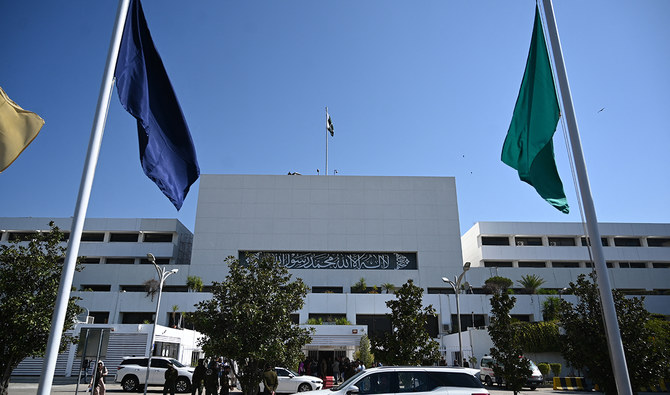
A general view of the Pakistan's Parliament House in Islamabad on March 9, 2024. (AFP/File)
Short Url
Updated 02 April 2024
Follow

Pakistan’s ruling coalition wins Senate polls — unofficial results

  • The vote in Khyber Pakhtunkhwa assembly was postponed due to delay in reserved seats for women, minorities being appointed
  • The PPP party, the second-largest coalition partner, is expected to appoint the leader of the Senate, after securing the most seats

ISLAMABAD: Pakistan’s ruling coalition seized a majority in Senate polls on Tuesday, unofficial results showed, after the election commission delayed the vote in a province controlled by loyalists of jailed ex-premier Imran Khan.

Polls for half the Senate’s 96 seats are held every three years, elected by lawmakers from Pakistan’s four provincial assemblies and the lower house of parliament.

Early results returned by provincial election commissions showed the ruling coalition had taken most of the seats that were up for grabs.

Eighteen senators from Punjab and Balochistan stood unopposed.

The results will be confirmed by the central election commission in the coming days.

The Pakistan Peoples Party (PPP), the second-largest coalition partner, are expected to appoint the leader of the Senate, after securing the most seats.

So far they have not played a major role in the government, led by Prime Minister Shehbaz Sharif and his Pakistan Muslim League-Nawaz party, taking only the presidential role for party patriarch Asif Ali Zardari, the widower of assassinated premier Benazir Bhutto.

The vote in Khyber Pakhtunkhwa Provincial Assembly was postponed due to a delay in reserved seats for women and religious minorities being appointed, the election commission said.

“The Constitution has been violated multiple times in this country,” chief minister of the province Ali Amin Gandapur told media.

“I want to make it clear that in this province we will fight, like our leader.”

Khan has been jailed since August in a series of cases he claims were designed to stop him from contesting February’s national elections, which were marred by vote-rigging allegations.

Candidates from Khan’s Pakistan Tehreek-e-Insaf (PTI) party were forced to run as independents, blocked from campaigning and subject to online and media censorship.

Despite the crackdown, they won the most seats but were kept from power by a coalition of rival parties that had the backing of the military.

They had also been expected to retain the most seats in the Senate, until the vote was delayed in Khyber Pakhtunkhwa province.

Khan and his wife Bushra Bibi on Monday had 14-year prison terms for graft suspended by Islamabad High Court, with an appeal against the conviction still pending.

Khan, 71, remains jailed on two other cases including for treason and illegal marriage to Bibi, with sentences stretching up to a decade.

Bibi, also jailed over the marriage which the courts said broke Islamic law for happening to quickly after a divorce, is being detained at home.

On Tuesday, a court official who asked not to be named, said they were called to Islamabad High Court to investigate “threatening letters” delivered to all eight judges.

The high court judges last week accused the nation’s intelligence agency of intimidating and coercing them over “politically consequential” cases in a letter sent to the Supreme Judicial Council watchdog.


Pakistan sets expectations for Trump-backed Gaza Board of Peace at UN

Updated 4 sec ago
Follow

Pakistan sets expectations for Trump-backed Gaza Board of Peace at UN

  • The country calls for ceasefire enforcement and reconstruction of the war-ravaged territory
  • Pakistani diplomat warns Gaza recovery must proceed without annexation or forced displacement

ISLAMABAD: Pakistan on Wednesday highlighted its expectations of US President Donald Trump’s Board of Peace (BoP) in Gaza, saying it joined the United Nations-backed body alongside other Muslim nations since it expected concrete steps toward a permanent ceasefire, reconstruction of Gaza and a lasting and just peace grounded in the Palestinian right to statehood.

Prime Minister Shehbaz Sharif signed the Gaza Board of Peace charter earlier this week along with other world leaders on the sidelines of the 56th Annual Meeting of the World Economic Forum in Davos.

Pakistan’s Permanent Representative to the UN, Ambassador Asim Iftikhar Ahmad, told an open Security Council debate on the Middle East that the decision was driven by the need to address the “unresolved Palestinian question,” which he described as “the core of the instability” in the region.

“We hope that the BoP under the framework of resolution 2803 will lead to concrete steps toward the implementation of a permanent ceasefire, further scaling up of humanitarian aid, reconstruction of Gaza, and realization of the right to self-determination of the people of

Palestine through a credible, time-bound political process, consistent with international legitimacy and relevant UN resolutions resulting in an independent, sovereign and contiguous state of Palestine based on pre-1967 borders with Al-Quds Al-Sharif as its capital,” Ahmad said while addressing the council.

“That is the ultimate goal supported by the international community,” he added. “Palestinian-led governance and institutional strengthening, with a central role of the Palestinian Authority, are indispensable in this regard.”

Ahmad maintained Pakistan was deeply concerned about the fragile situation in Gaza, pointing to Israel’s continued ceasefire violations that he said were putting civilian lives at risk. He stressed that the ceasefire must be fully respected with a view to a permanent cessation of hostilities.

The Pakistani diplomat said recovery and reconstruction should begin without delay and must proceed without annexation, forced displacement or any alteration of the territorial unity of the Occupied Palestinian Territory.

“The contiguity of Gaza and the West Bank is indispensable for the viability of the Palestinian state,” he said.

Ahmad also called for a credible, irreversible and time-bound political process culminating in the realization of Palestinian statehood in accordance with international legitimacy.

“The international community, particularly this council, bears the responsibility to translate renewed engagement into measurable change on the ground for the betterment of the Palestinian people,” he said, adding that Pakistan was ready to work with “members of the council, regional and international partners, and the United States to advance a just and lasting solution to the Palestinian question, and comprehensive peace in the Middle East.”