

Pakistan records 42.5 percent surge in TB cases in last three years — official data

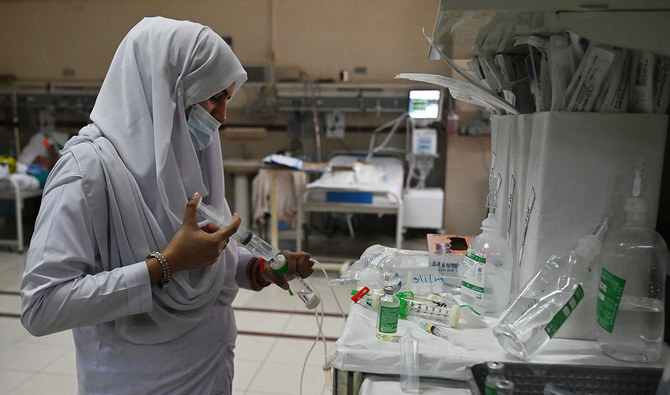
A nurse prepares a vaccine to treat a patient at a hospital in Lahore on January 31, 2024. (AFP/File)
Short Url
Updated 02 April 2024
Follow

Pakistan records 42.5 percent surge in TB cases in last three years — official data

  • The South Asian country of 241 million ranks fifth among high-burden TB countries worldwide, according to the WHO
  • The diseased killed 47,000 people last year, while 608,000 cases are currently registered with National TB Control Program

ISLAMABAD: Tuberculosis (TB) cases have risen in Pakistan by 42.5 percent in the last three years with 47,000 people dying of the illness in 2023, official data shows, as the government says it will stamp out the disease by 2035 despite inadequate resources for screening and treatment.

TB is an infectious disease that most often affects the lungs and is caused by a type of bacteria. It spreads through the air when infected people cough, sneeze or spit, though it is preventable and curable, according to the World Health Organization (WHO).

The disease is the second leading infectious killer after the coronavirus (above HIV and AIDS) and about a quarter of the global population is estimated to have been infected with TB bacteria. It remains one of the major public health problems in Pakistan as the South Asian nation of 241 million ranks fifth among high-burden TB countries worldwide.

In Pakistan, TB cases registered increase from 272,990 in 2020 to 474,981 in 2023, with a treatment success rate of more than 90 percent, according to official data. The disease killed 48,000 people in 2021, 46,000 in 2022, and 47,000 people in 2023. Currently, there are a total of 608,000 TB cases registered with the National TB Control Program.

“The number of TB cases have registered a significant increase in the last three years with a high mortality rate which is obviously concerning and a national action plan is devised to curb it,” Syed Azadar Abbas Gillani, an official of the National TB Control Program, told Arab News on Tuesday.

“Under a three-year strategic plan, we intend to bring down TB cases to zero by 2035.”

The increased number of TB incidences were also a proof for the improved screening and treatment of patients as over 1,900 TB diagnostic care facilities were operational across the country despite a lack of domestic funding, according to Gillani.

From 2024 till 2026, Pakistan requires $533 million funds to screen and treat TB patients, but there is a funding gap of around 57 percent.

“We get a meagre 8-10 percent of the required funds from the domestic resources, while majority of the funds come from international donors,” Gillani said, emphasizing early detection as a key to curb the disease.

Public health experts urge the government to concentrate on awareness, effective screening and provision of free medicines to TB patients to bring down the caseload.

“The government needs to digitalize the whole TB data for transparency, besides including its treatment in a universal health insurance program,” Dr. Nadeem Jan, former federal health minister, told Arab News.

He urged the government to follow up on a request for $1 billion funds from international donors for effective screening and treatment of TB patients. “We can control TB incidences in just three years if public and private health facilities join hands with an aim to curb the disease,” he added.

Dr. Munir Ahmed Bhatti, a TB specialist, acknowledged that TB screening and detection had improved in the past years, but urged authorities to ensure free TB tests at public health facilities that cost around Rs7,000 ($25.2) at private labs.

“It is a bacterial infectious disease that spreads from one person to another easily while coughing if not screened and treated in time,” Bhatti told Arab News. “TB is a fatal disease and can be controlled through massive rapid testing and free treatment across the country.”



Pakistan urges concessional finance for developing nations to boost clean energy security

Updated 11 January 2026
Follow

Pakistan urges concessional finance for developing nations to boost clean energy security

  • Pakistan has emerged as one of world’s fastest growing solar markets, with 12GWs of off-grid and 6GWs of net-metered capacity in 2025
  • PM’s aide says Islamabad remains committed to Paris Agreement, looks for continued support in building a resilient and low-carbon future

ISLAMABAD: Pakistan has urged international partners to scale up concessional financing for developing countries, the country’s Press Information Department (PID) said on Sunday, citing an aide to Prime Minister Shehbaz Sharif.

The call was made by Sharif’s coordinator on climate change, Romina Khurshid Alam, while delivering Pakistan’s national statement at the 16th International Renewable Energy Agency (IRENA) Assembly in Abu Dhabi.

Pakistan has emerged as one of the world’s fastest growing solar markets, with 12 gigawatts (GWs) of off-grid and over 6GWs of net-metered solar capacity by the end of 2025. Last fiscal year, renewables accounted for a historic 53 percent of total electricity generation, according to Alam.

The prime minister’s aide stressed that affordable funding for developing nations is critical to accelerating their transition to clean energy and strengthening energy security amid rising climate and economic challenges.

“Alam reaffirmed Pakistan’s target of achieving 60 percent renewables in the power mix by 2030,” the PID said in a statement.

“In her call to action, she urged IRENA and Member States to increase concessional finance for developing nations, treat technologies such as energy storage and green hydrogen as global public goods, and strengthen regional cooperation for shared energy security.”

IRENA is a global intergovernmental agency for energy transformation that serves as the principal platform for international cooperation, supports countries in their energy transition, and provides state of the art data and analyzes on technology, innovation, policy, finance and investment. Its membership comprises 170 countries and the European Union (EU).

The 16th session of the IRENA Assembly is taking place on Jan. 10-12 in Abu Dhabi and focuses on the theme of “Powering Humanity: Renewable Energy for Shared Prosperity.” The session has gathered global leaders and energy decision-makers to discuss strategies and underline necessary actions for the acceleration of renewable energy across countries, regions, and the world, driving economic inclusion, equity, and human well-being.

Alam shared that Pakistan is taking action against energy poverty through initiatives like the Punjab Solar Panel Scheme 2026, which provides free or subsidized systems to low-income households.

She highlighted how distributed solar kits have restored power and livelihoods in flood-affected communities and offer a replicable model for climate-resilient recovery.

“Pakistan remains fully committed to the Paris Agreement and looks to IRENA for continued technical and financial support in building a resilient, inclusive, and low-carbon future,” Alam said.

Adopted in 2015 to combat climate change, the Paris Agreement binds nations to hold “the increase in the global average temperature to well below 2°C above pre-industrial levels” and pursue efforts “to limit the temperature increase to 1.5°C above pre-industrial levels.”