Pakistan election regulator delays Senate polls in northwest province amid oath-taking controversy

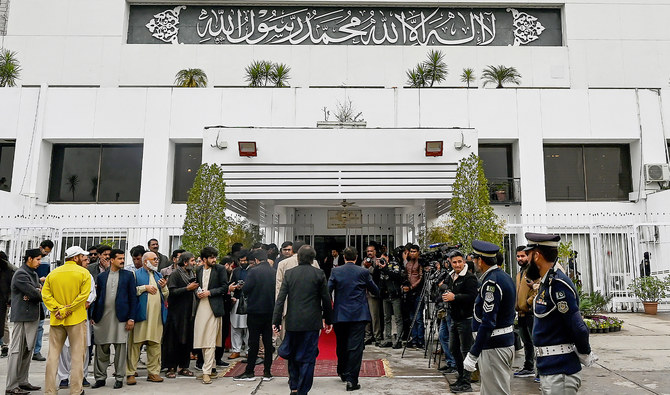
Lawmakers arrive at the Parliament House in Islamabad on March 3, 2024. (AFP/File)
Short Url
Updated 02 April 2024
Follow

Pakistan election regulator delays Senate polls in northwest province amid oath-taking controversy

  • The decision was taken after the KP speaker refused to administer oath to opposition members on reserved seats
  • With the postponement of polling process in KP, the electoral contest is now taking place on 19 Senate seats

ISLAMABAD: Pakistan’s election regulatory body on Tuesday postponed Senate elections in the northwestern Khyber Pakhtunkhwa (KP) province, responding to a plea by the opposition which called for a postponement because nearly two dozen provincial lawmakers on reserved seats had not been administered the oath despite a court order.

Polling to elect members on 30 vacant seats in the upper house of the country’s bicameral parliament was scheduled to be held today, with the Election Commission of Pakistan (ECP) staff ready to hold the voting process in the KP assembly.

However, the Pakistan Peoples Party’s Ahmad Karim Kundi objected to it, saying in the plea to the ECP that 25 lawmakers belonging to his party on the reserved seats had not been sworn in by the assembly speaker despite a Peshawar High Court ruling last month. The opposition members in KP previously protested the speaker’s decision to ignore the court ruling, saying it was to prevent the lawmakers on the reserved seats from participating in the Senate elections.

After evaluating the opposition’s plea, the ECP decided to postpone the polling process.

“The Commission in exercise of powers under Article 218(3) of the Constitution read with Section 4(1), Section 8(c) and Section 128 of the Election Act, 2017 and all other enabling provisions of the Constitution and law in this behalf, postpones the poll to the Senate Election to the extent of Khyber Pakhtunkhwa till the administration of oath to the elected members against the reserved seats,” it said in its order.

The ECP had already notified unopposed candidates as winners on 18 seats, including seven each from Punjab and Balochistan on general seats, two on women seats, and two on seats reserved for scholars or technocrats.

With the postponement of election on 11 Senate seats from KP due to the incomplete electoral college, the polling process is now only taking place on 19 seats.

Pakistani senators are elected for a term of six years. They are responsible to discuss laws, provide their technical input and vote on legislations like other public representatives. Half of these senators retire every three years and new ones are elected to replace them.

The Senate consists of 100 members, of which 52 recently retired, necessitating polls on 48 vacant seats as four seats from the erstwhile Federally Administered Tribal Areas (FATA) have already been abolished due to their merger with the Khyber Pakhtunkhwa province.

The ECP printed ballot papers in four different colors for polling today, including white papers for general seats, green for technocrat seats, pink for women and yellow for minority seats.

A total of 59 candidates were prepared to contest the polls on 30 vacant seats before the postponement of voting in KP.

Senator elections in Pakistan usually take place days before the senators’ terms end, but they were delayed this time due to the ECP’s failure to hold timely general election.

General elections scheduled for November last year were held on Feb. 8 this year.

The chief minister of KP, Ali Amin Gandapur, said his party would protest the postponement of the Senate polling process in response to the latest political development.

Gandapur belongs to former prime minister Imran Khan’s Pakistan Tehreek-e-Insaf that swept the last general elections in KP and formed the provincial administration.


Pakistani, Bangladeshi officials discuss trade, investment and aviation as ties thaw

Updated 28 December 2025
Follow

Pakistani, Bangladeshi officials discuss trade, investment and aviation as ties thaw

  • Pakistan and Bangladesh were once one nation, but they split in 1971 as a result of a bloody civil war
  • Ties between Pakistan, Bangladesh have warmed up since last year and both nations have resumed sea trade

ISLAMABAD: Pakistan's High Commissioner to Bangladesh Imran Haider on Sunday met Chief Adviser Muhammad Yunus in Dhaka, the latter's office said on, with the two figures discussing trade, investment and aviation.

Pakistan and Bangladesh were once one nation, but they split in 1971 as a result of a bloody civil war, which saw the part previously referred to as East Pakistan seceding to form the independent nation of Bangladesh.

Ties between Pakistan and Bangladesh have warmed up since former prime minister Sheikh Hasina’s ouster as a result of a student-led uprising in August 2024. Relations remain frosty between Dhaka and New Delhi over India’s decision to grant asylum to Hasina.

Pakistan has attempted to forge closer ties with Bangladesh in recent months and both South Asian nations last year began sea trade, followed by efforts to expand government-to-government commerce.

"During the meeting, both sides discussed ways to expand cooperation in trade, investment, and aviation as well as scaling up cultural, educational and medical exchanges to further strengthen bilateral relations between the two South Asian nations," Yunus's office said in a statement on X.

In 2023-24 Pakistan exported goods worth $661 million to Bangladesh, while its imports were only $57 million, according to the Trade Development Authority of Pakistan. In Aug. this year, the Pakistani and Bangladeshi commerce ministries signed a memorandum of understanding to establish a Joint Working Group on Trade, aiming to raise their bilateral trade volume to $1 billion in the financial year that began in July.

The Pakistani high commissioner noted that bilateral trade has recorded a 20 percent growth compared to last year, with business communities from both countries actively exploring new investment opportunities, according to the statement.

He highlighted a significant increase in cultural exchanges, adding that Bangladeshi students have shown strong interest in higher education opportunities in Pakistan, particularly in medical sciences, nanotechnology, and artificial intelligence. Haider also said that Dhaka-Karachi direct flights are expected to start in January.

"Chief Adviser Professor Muhammad Yunus welcomed the growing interactions between the two countries and emphasized the importance of increased visits as well as cultural, educational and people-to-people exchanges among SAARC (South Asian Association for Regional Cooperation) member states," the statement read.

"Professor Yunus also underscored the need to further boost Bangladesh–Pakistan trade and expressed hope that during Mr. Haider’s tenure, both countries would explore new avenues for investment and joint venture businesses."