

Donald Trump has posted a $175 million bond to avert asset seizure as he appeals NY fraud penalty

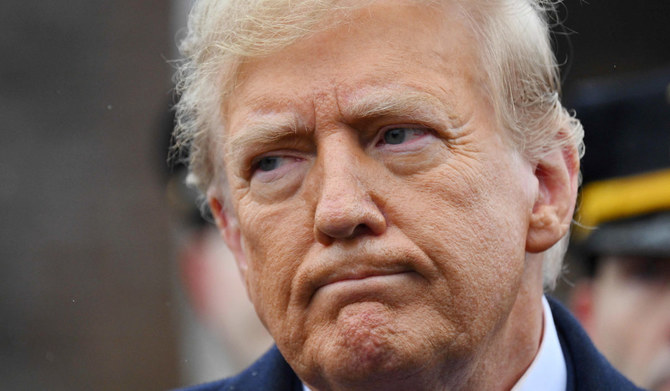
Former US President Donald Trump speaks to the press after attending the wake for New York Police Department (NYPD) Officer Jonathan Diller in Massapequa, Long Island, New York, on March 28, 2024. (AFP)
Short Url
Updated 02 April 2024
Follow

Donald Trump has posted a $175 million bond to avert asset seizure as he appeals NY fraud penalty

  • The court ruled after Trump’s lawyers complained it was “a practical impossibility” to get an underwriter to sign off on a bond for the $454 million, plus interest, that he owes

NEW YORK: Donald Trump posted a $175 million bond on Monday in his New York civil fraud case, halting collection of the more than $454 million he owes and preventing the state from seizing his assets to satisfy the debt while he appeals, according to a court filing.
A New York appellate court had given the former president 10 days to put up the money after a panel of judges agreed last month to slash the amount needed to stop the clock on enforcement.
The bond Trump is posting with the court now is essentially a placeholder, meant to guarantee payment if the judgment is upheld. If that happens, the presumptive Republican presidential nominee will have to pay the state the whole sum, which grows with daily interest.
If Trump wins, he won’t have to pay the state anything and will get back the money he has put up now.
Until the appeals court intervened to lower the required bond, New York Attorney General Letitia James had been poised to initiate efforts to collect the judgment, possibly by seizing some of Trump’s marquee properties. James, a Democrat, brought the lawsuit on the state’s behalf. Her office declined to comment Monday.
The court ruled after Trump’s lawyers complained it was “a practical impossibility” to get an underwriter to sign off on a bond for the $454 million, plus interest, that he owes.
The company that underwrote the bond is Knight Specialty Insurance, which is part of the Knight Insurance Group. The chairman of that company, billionaire Don Hankey, told The Associated Press that both cash and bond were used as collateral for Trump’s appellate bond.
Trump is fighting to overturn a judge’s Feb. 16 finding that he lied about his wealth as he fostered the real estate empire that launched him to stardom and the presidency. The trial focused on how Trump’s assets were valued on financial statements that went to bankers and insurers to get loans and deals.
Trump denies any wrongdoing, saying the statements actually lowballed his fortune, came with disclaimers and weren’t taken at face value by the institutions that lent to or insured him.
The state courts’ Appellate Division has said it would hear arguments in September. A specific date has not been set. If the schedule holds, it will fall in the final weeks of the presidential race.
Under New York law, filing an appeal generally doesn’t hold off enforcement of a judgment. But there’s an automatic pause — in legalese, a stay — if the person or entity obtains a bond guaranteeing payment of what’s owed.
Courts sometimes grant exceptions and lower the amount required for a stay, as in Trump’s case.
Trump’s lawyers had told the appeals court more than 30 bonding companies were unwilling to take a mix of cash and real estate as collateral for a $454 million-plus bond. Underwriters insisted on only cash, stocks or other liquid assets, the attorneys said.
They said most bonding companies require collateral covering 120 percent of the amount owed.
Trump recently claimed to have almost a half-billion dollars in cash — along with billions of dollars worth of real estate and other assets — but said he wanted to have some cash available for his presidential run.
Recent legal debts have taken a sizable chunk out of Trump’s cash reserves.
In addition to the $175 million he had to put up in the New York case, Trump has posted a bond and cash worth more than $97 million to cover money he owes to writer E. Jean Carroll while he appeals verdicts in a pair of federal civil trials. Juries found that he sexually assaulted her in the 1990s and defamed her when she went public with the allegation in 2019. He denies all the allegations.
In February, Trump paid the $392,638 in legal fees a judge ordered him to cover for The New York Times and three reporters after he unsuccessfully sued them over a Pulitzer Prize-winning 2018 story about his family’s wealth and tax practices.
In March, a British court ordered Trump to pay to pay legal fees of 300,000 pounds ($382,000) to a company he unsuccessfully sued over the so-called Steele dossier that contained salacious allegations about him. Trump said those claims were false.
Trump could eventually generate cash by selling some of the nearly 60 percent of stock he owns in his newly public social media company, Trump Media & Technology Group — but that would be a longer-term play. Trump’s stake could be worth billions of dollars, but a “lock-up” provision prevents insiders like him from selling their shares for six months.


US to cut roughly 200 NATO positions, sources say

Updated 21 January 2026
Follow

US to cut roughly 200 NATO positions, sources say

  • Trump famously threatened to withdraw from NATO during ⁠his first presidential term and said on the campaign trail that he would encourage Russia to attack NATO members that did not pay their fair share on defense

WASHINGTON: The United States plans to reduce the number of personnel it has stationed within several key NATO command centers, a move that could intensify concerns ​in Europe about Washington’s commitment to the alliance, three sources familiar with the matter said this week.
As part of the move, which the Trump administration has communicated to some European capitals, the US will eliminate roughly 200 positions from the NATO entities that oversee and plan the alliance’s military and intelligence operations, said the sources, who requested anonymity to discuss private diplomatic conversations.
Among the bodies that will be affected, said the sources, are the UK-based NATO Intelligence Fusion Center and the Allied Special Operations Forces Command in Brussels. Portugal-based STRIKFORNATO, which oversees some maritime operations, will also be cut, as will several other similar NATO entities, the sources said.
The sources did not specify why the US had decided to cut the number of staff dedicated to the NATO roles, but the moves broadly align with the ‌Trump administration’s stated intention to ‌shift more resources toward the Western Hemisphere.
The Washington Post first reported the decision.

TRUMP ‌RE-POSTS ⁠MESSAGE ​IDENTIFYING NATO ‌AS THREAT
The changes are small relative to the size of the US military force stationed in Europe and do not necessarily signal a broader US shift away from the continent. Around 80,000 military personnel are stationed in Europe, almost half of them in Germany. But the moves are nonetheless likely to stoke European anxiety about the future of the alliance, which is already running high given US President Donald Trump’s stepped-up campaign to wrest Greenland away from Denmark, raising the unprecedented prospect of territorial aggression within NATO.
On Tuesday morning, the US president, who is scheduled to fly to the World Economic Forum in Switzerland in the evening, shared another user’s post on social media that identified NATO as a threat to the ⁠United States. The post described China and Russia as merely “boogeymen.”
Asked for comment, a NATO official said changes to US staffing are not unusual and that the US presence in ‌Europe is larger than it has been in years.
“NATO and US authorities are in ‍close contact about our overall posture – to ensure NATO retains our ‍robust capacity to deter and defend,” the NATO official said.
The White House and the Pentagon did not respond to requests for ‍comment.

MILITARY IMPACT UNCLEAR, SYMBOLIC IMPACT OBVIOUS
Reuters could not obtain a full list of NATO entities that will be affected by the new policy. About 400 US personnel are stationed within the entities that will see cuts, one of the sources said, meaning the total number of Americans at the affected NATO bodies will be reduced by roughly half.
Rather than recalling servicemembers from their current posts, the US will for the most part decline to ​backfill them as they move on from their positions, the sources said.
The drawdown comes as the alliance traverses one of the most diplomatically fraught moments in its 77-year history. Trump famously threatened to withdraw from NATO during ⁠his first presidential term and said on the campaign trail that he would encourage Russian President Vladimir Putin to attack NATO members that did not pay their fair share on defense. But he appeared to warm to NATO over the first half of 2025, effusively praising NATO Secretary-General Mark Rutte and other European leaders after they agreed to boost defense spending at a June summit.
In recent weeks, however, his administration has again provoked alarm across Europe. In early December, Pentagon officials told diplomats that the US wants Europe to take over the majority of NATO’s conventional defense capabilities, from intelligence to missiles, by 2027, a deadline that struck European officials as unrealistic. A key US national security document released shortly after called for the US to dedicate more of its military resources to the Western Hemisphere, calling into question whether Europe will continue to be a priority theater for the US
In the first weeks of 2026, Trump has revived his longstanding campaign to acquire Greenland, an overseas territory of Denmark, enraging officials in Copenhagen and throughout Europe, many of whom believe any territorial aggression within the alliance would mark the end of NATO. Over the weekend, ‌Trump said he would slap several NATO countries with tariffs starting February 1 due to their support for Denmark’s sovereignty over the island. That has caused European Union officials to mull retaliatory tariffs of their own.