

Pakistani police arrest 12 people over suicide bombing that killed 5 Chinese workers

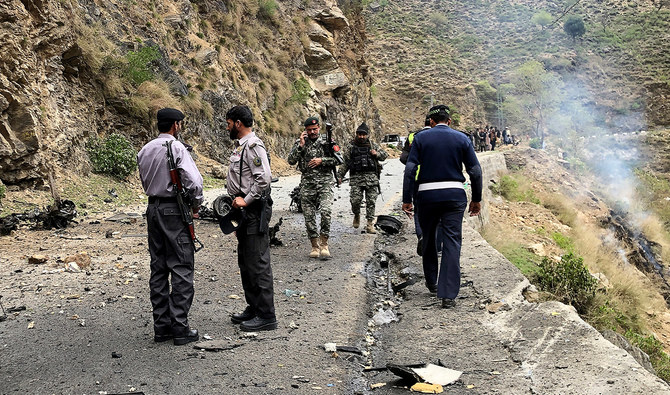
Security personnel inspect the site of a suicide attack near Besham city in the Shangla district of Khyber Pakhtunkhwa province on March 26, 2024. (AFP/File)
Short Url
Updated 01 April 2024
Follow

Pakistani police arrest 12 people over suicide bombing that killed 5 Chinese workers

  • Last week’s suicide bombing in northwestern Pakistan killed five Chinese nationals
  • Some of the detainees had links with Pakistani militants, police and officials say

ISLAMABAD: Pakistani counterterrorism police in multiple raids arrested at least 12 suspects in connection with last week’s suicide bombing that killed five Chinese workers and their Pakistani driver in the volatile northwest, officials said Monday.

The detainees were not directly involved in the attack but they helped those who orchestrated Tuesday’s bombing targeting the Chinese, three police and security officials said. They said some of the detainees had links with Pakistani militants, adding that the suspects were still being questioned and other raids were ongoing.

The officials spoke on condition of anonymity because they were not authorized to speak to media on the record. The officials said some of the detained suspects transported an explosive-laden car to Shangla, a district in Khyber Pakhtunkhwa province, where a suicide bomber rammed it into another vehicle, killing the Chinese workers.

The latest development came hours after the bodies of the five Chinese nationals were flown overnight from a military air base in the garrison city of Rawalpindi to Beijing, Pakistani officials and state media said.

The Chinese ambassador, Jiang Zaidong, was present at the Noor Khan air base when the bodies were brought there Sunday night. Zaidong in remarks conveyed his deep condolences to the families of the victims of the attack.

A Pakistani Cabinet minister, Salik Hussain, accompanied the bodies to China.

The slain Chinese were traveling to Pakistan’s biggest hydropower project, Dasu Dam, where they worked, when their vehicle came under attack.

On Monday, Prime Minister Shehbaz Sharif was also visiting Dasu Dam to meet with Chinese engineers and workers. Pakistani officials will also brief Sharif on the project’s progress.

Chinese and Pakistani investigators are conducting separate probes into the attack, which drew nationwide condemnation. China has also asked Pakistan to ensure the protection of its nationals working in various parts of Pakistan on projects in the China-Pakistan Economic Corridor.

Authorities say the Chinese bombing victims were heading to the project site amid tight security.

Other Chinese working on CPEC-related projects have faced similar attacks in recent years.

In July 2021, at least 13 people, including nine Chinese nationals, were killed when a suicide bomber detonated explosives in his vehicle near a bus carrying Chinese and Pakistani engineers and laborers, prompting Chinese companies to temporarily suspend work.


Sindh assembly passes resolution rejecting move to separate Karachi

Updated 21 February 2026
Follow

Sindh assembly passes resolution rejecting move to separate Karachi

  • Chief Minister Shah cites constitutional safeguards against altering provincial boundaries
  • Calls to separate Karachi intensified amid governance concerns after a mall fire last month

ISLAMABAD: The provincial assembly of Pakistan’s southern Sindh province on Saturday passed a resolution rejecting any move to separate Karachi, declaring its territorial integrity “non-negotiable” amid political calls to carve the city out as a separate administrative unit.

The resolution comes after fresh demands by the Muttahida Qaumi Movement (MQM) and other voices to grant Karachi provincial or federal status following governance challenges highlighted by the deadly Gul Plaza fire earlier this year that killed 80 people.

Karachi, Pakistan’s largest and most densely populated city, is the country’s main commercial hub and contributes a significant share to the national economy.

Chief Minister Syed Murad Ali Shah tabled the resolution in the assembly, condemning what he described as “divisive statements” about breaking up Sindh or detaching Karachi.

“The province that played a foundational role in the creation of Pakistan cannot allow the fragmentation of its own historic homeland,” Shah told lawmakers, adding that any attempt to divide Sindh or separate Karachi was contrary to the constitution and democratic norms.

Citing Article 239 of Pakistan’s 1973 Constitution, which requires the consent of not less than two-thirds of a provincial assembly to alter provincial boundaries, Shah said any such move could not proceed without the assembly’s approval.

“If any such move is attempted, it is this Assembly — by a two-thirds majority — that will decide,” he said.

The resolution reaffirmed that Karachi would “forever remain” an integral part of Sindh and directed the provincial government to forward the motion to the president, prime minister and parliamentary leadership for record.

Shah said the resolution was not aimed at anyone but referred to the shifting stance of MQM in the debate while warning that opposing the resolution would amount to supporting the division of Sindh.

The party has been a major political force in Karachi with a significant vote bank in the city and has frequently criticized Shah’s provincial administration over its governance of Pakistan’s largest metropolis.

Taha Ahmed Khan, a senior MQM leader, acknowledged that his party had “presented its demand openly on television channels with clear and logical arguments” to separate Karachi from Sindh.

“It is a purely constitutional debate,” he told Arab News by phone. “We are aware that the Pakistan Peoples Party, which rules the province, holds a two-thirds majority and that a new province cannot be created at this stage. But that does not mean new provinces can never be formed.”

Calls to alter Karachi’s status have periodically surfaced amid longstanding complaints over governance, infrastructure and administrative control in the megacity, though no formal proposal to redraw provincial boundaries has been introduced at the federal level.