

Turkish opposition ahead in battle with Erdogan for key cities

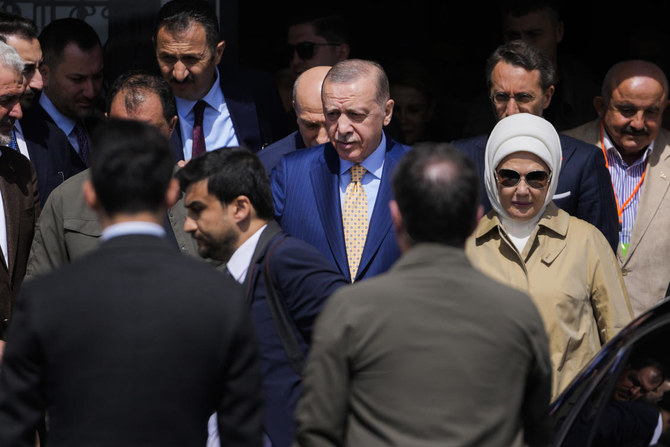
Turkish President Recep Tayyip Erdogan leaves after voting at a polling station in Istanbul, Turkey, Sunday, March 31, 2024. Turkey is holding local elections on Sunday that will decide who gets to control Istanbul and other key cities. (AP)
Short Url
Updated 31 March 2024
Follow

Turkish opposition ahead in battle with Erdogan for key cities

ISTANBUL: Turkiye’s opposition took an early lead in the battle with President Recep Tayyip Erdogan to control Istanbul and Ankara, according to partial results after elections Sunday.
Erdogan had launched an all-out personal campaign to win back Istanbul, the economic powerhouse where he was once mayor, for his ruling Justice and Development Party (AKP).
With rampant inflation and economic crisis hitting households, city mayor Ekrem Imamoglu expressed confidence of a new victory and a partial result put the CHP ahead in Istanbul and the capital Ankara.
With 49 percent of ballot boxes opened, Imamoglu led with 50.05 percent of the vote against 41.2 percent for the AKP candidate Murat Kuram. In Ankara, with 29.2 percent of ballot boxes opened, the CHP mayor Mansur Yavas led with 58.2 percent against 34.1 percent for the Erdogan-backed candidate.
The CHP was also ahead in Izmir, Turkiye’s third city, and a party stronghold.
“Based on the data we have obtained, I can say that our citizens’ faith in us has been rewarded,” Imamoglu told reporters at the CHP’s Istanbul headquarters.
“The picture we have seen now pleases us greatly, but no election is finalized before it is over,” he added.

“I would like to thank all of us, our citizens, from the bottom of my heart for fulfilling this sacred duty.”
After casting his vote with his family, Imamoglu emerged to applause and chants of “Everything will be fine,” his 2019 election slogan.
Although Erdogan dominated the campaign the veteran president’s personal role did not help overcome the widespread concerns over the country’s economy.
“Everyone is worried about the day to day,” said 43-year-old Istanbul inhabitant Guler Kaya as she voted.
“The crisis is swallowing up the middle class, we have had to change all our habits,” she said. “If Erdogan wins, it will get even worse.”
Vote change happens “when we cannot afford a living, when we cannot eat,” Ali Faik Demir, a political scientist at Galatasaray University, told AFP.
An Imamoglu victory Sunday would make him the likely main opponent to Erdogan’s ruling AKP in the next presidential election in 2028.
Erdogan has been president since 2014 and won a new term in May last year. He had called Istanbul the national “treasure” when launching his campaign to retake the city.
If Erdogan won back Istanbul and Ankara, he would have an incentive to “amend” the constitution to stand for re-election for a fourth term, warned Bayram Balci, political scientist at Sciences Po university in France.

“This election will mark the beginning of a new era for our country,” Erdogan said after casting his vote in Istanbul at midday on Sunday.
“Whoever wins Istanbul, wins Turkiye,” Erman Bakirci, a pollster from Konda Research and Consultancy, recalled Erdogan once saying.
The election was held with the country reeling from an inflation rate of 67 percent and having seen the lira currency slide from 19 to a dollar to 32 to a dollar in one year.
Armed clashes were reported in Turkiye’s Kurdish-majority southeast, leaving one dead and 12 wounded, a local official told AFP.
The pro-Kurdish DEM party said it had identified irregularities “in almost all the Kurdish provinces,” in particular through suspicious cases of proxy voting.
Observers from France were refused access to a polling station in the region, according to the lawyers’ association MLSA.
Some 61 million people were eligible to vote for mayors across Turkiye’s 81 provinces, as well as provincial council members and other local officials.
The opposition has been fractured ahead of the polls, in contrast with the local elections five years ago.
This time the CHP, has failed to rally support behind a single candidate.


US senators visit key Ukrainian port city as they push for fresh sanctions on Russia

Updated 5 sec ago
Follow

US senators visit key Ukrainian port city as they push for fresh sanctions on Russia

  • The visit and the push for Congress to take up sanctions on Russia come at a crucial moment in the conflict

WASHINGTON: A delegation of US senators was returning Wednesday from a trip to Ukraine, hoping to spur action in Congress for a series of sanctions meant to economically cripple Moscow and pressure President Vladimir Putin to make key concessions in peace talks.
It was the first time US senators have visited Odesa, Ukraine’s third-most populous city and an economically crucial Black Sea port that has been particularly targeted by Russia, since the war began nearly four years ago. Democratic Sens. Jeanne Shaheen, Chris Coons, Richard Blumenthal and Sheldon Whitehouse made the trip. Republican Sen. Thom Tillis had planned to join but was unable to for personal reasons.
“One of the things we heard wherever we stopped today was that the people of Ukraine want a peace deal, but they want a peace deal that preserves their sovereignty, that recognizes the importance of the integrity of Ukraine,” Shaheen said on a phone call with reporters.
The visit and the push for Congress to take up sanctions on Russia come at a crucial moment in the conflict. Delegations for the two sides were also meeting in Switzerland for two days of US-brokered talks, but neither side appeared ready to budge on key issues like territory and future security guarantees. The sanctions, senators hoped, could prod Putin toward settling for peace, as the US has set a June deadline for settlement.
“Literally nobody believes that Russia is acting in good faith in the negotiations with our government and with the Ukrainians,” Whitehouse said. “And so pressure becomes the key.”
Still, legislation to impose tough sanctions on Russia has been on hold in Congress for months.
Senators have put forward a range of sanction measures, including one sweeping bill that would allows the Trump administration to impose tariffs and secondary sanctions on countries that purchase Russia’s oil, gas, uranium and other exports, which are crucial to financing Russia’s military. The Senate Foreign Relations Committee has also advanced a series of more-targeted bills that would sanction China’s efforts to support Russia’s military, commandeer frozen Russian assets and go after what’s known as Moscow’s “shadow fleet” of oil tankers being used to circumvent sanctions already in place.
Republican Sen. Lindsey Graham, who has co-sponsored the Senate’s sweeping sanctions and tariff legislation, also released a statement during the Munich Security Conference this weekend saying that Senate Majority Leader John Thune had committed to bringing up the sanctions bill once it clearly has the 60 votes needed to move through the Senate.
“This legislation will be a game changer,” Graham said. “President Trump has embraced it. It is time to vote.”
Blumenthal, who co-sponsored that bill alongside Graham, also said there is bipartisan support for the legislation, which he called a “very tough sledgehammer of sanctions and tariffs,” but he also noted that “we need to work out some of the remaining details.” Democrats, and a handful of Republicans, have been opposed to President Donald Trump’s campaign to impose tariffs around the world in an effort to strike trade deals and spur more manufacturing in the US
In the House, Democrats are opposed to the tariff provisions of that bill. Instead, a bipartisan group of lawmakers, led by Republican Rep. Brian Fitzpatrick, has proposed separate legislation that makes it more difficult for Trump to waive sanctions, but does away with the tariff provisions.
A separate bill, led by the top Democrat on the House Foreign Affairs Committee, Rep. Gregory Meeks, would bolster US military support for Ukraine by $8 billion. Democrats currently need one more Republican to support an effort to force a vote on that bill.
Once they return to the US, the senators said they would detail how US businesses based in Ukraine have been attacked by Russia. The Democrats are also hoping to build pressure on Trump to send more US weapons to Ukraine. “Putin understands weapons, not words,” Blumenthal said.
Still, the lawmakers will soon return to a Washington where the Trump administration is ambivalent about its long-term commitments to securing peace in Ukraine, as well as Europe. For now, at least, they were buoyed by the conversations from their European counterparts and Republican colleagues.
“We and the Republican senators who were with us in Munich spoke with one voice about our determination to continue to support Ukraine,” Coons said.