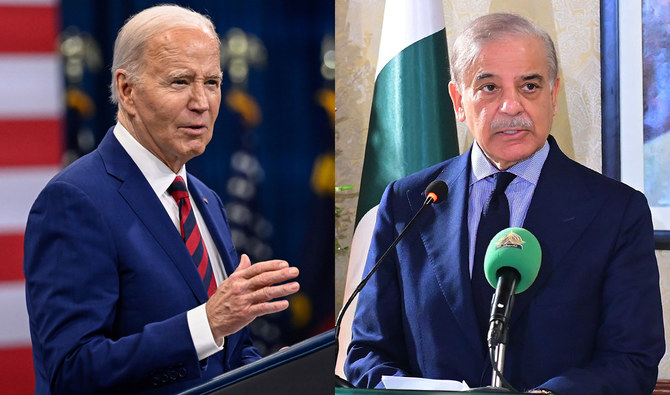
ISLAMABAD: Prime Minister Shehbaz Sharif on Sunday responded to a letter written by President Joe Biden and expressed Islamabad’s desire to worked with the United States (US) for global peace and security, Sharif’s office said.
In the top-level contact between the US and Pakistan this week, Biden assured Sharif of his administration’s full support in addressing the critical challenges facing the region, signifying a thaw in frosty US-Pakistan relations following the withdrawal of international forces from Afghanistan and the subsequent allegations by Pakistan’s former premier Imran Khan of a US conspiracy against his administration.
The US president’s outreach marked a notable shift from the previously perceived indifference, evident in the absence of direct communication with Khan’s government. The correspondence underscores a potential recalibration of bilateral relations, with the US president describing the partnership between the two countries’ people as “crucial for global and local security.”
In response to Biden’s letter, Sharif said that Islamabad attached “key importance” to its relations with the United States, noting that both countries were working together on important initiatives in the fields of energy, climate change, agriculture, health and education.
“Pakistan wants to work with the United States to achieve the shared objectives of global peace and security, and regional prosperity and development,” Sharif said in his letter, welcoming cooperation between the two countries in the energy sector and the Green Alliance initiative.
The Green Alliance framework seeks to promote renewable energy, sustainable agriculture and green transportation, and aims to create opportunities for economic growth and development in Pakistan by investing in sustainable infrastructure, innovation, and research and development.
In his letter, the US president had specifically mentioned of the Green Alliance initiative, saying his administration would continue to work with Pakistan for environmental improvement. Biden also spoke of sustainable agricultural development, water management and recovery from the devastating effects of the 2022 floods in Pakistan.
“The US will stand with Pakistan in facing the most critical challenges of the time and region,” Biden was quoted as saying in an official statement released by the Pakistani authorities on Friday. “Public health protection, economic growth and education for all are shared visions that will continue to be promoted together.”
He also expressed dedication to protecting human rights and promoting development together with Pakistan amid previous US concerns over freedom of speech and expression in the wake of social media disruptions in the South Asian country.
“The strong partnership established between the two nations will be strengthened,” Biden was quoted as saying.


Sharif tells Biden Pakistan wishes to work with US for global peace, security
https://arab.news/nukp8
Sharif tells Biden Pakistan wishes to work with US for global peace, security

- Sharif comments came in response to President Biden’s letter in which he vowed to ‘stand with Pakistan’
- The exchange is first top-level contact between the two countries in a while, signifies a thaw in frosty ties

Pakistan kills 11 militants in separate operations in western provinces
- Military says five Baloch separatist fighters were killed in an intelligence-based operation in Kohlu district
- Police say six Pakistani Taliban died in Lakki Marwat during a joint operation after drone attacks on homes
ISLAMABAD/PESHAWAR: Pakistani security forces and police killed at least 11 militants in separate counterterrorism operations in the country’s western provinces of Balochistan and Khyber Pakhtunkhwa, authorities said on Friday, highlighting the distinct insurgencies confronting the country along its border with Afghanistan.
In southwestern Balochistan, the military said it killed separatist militants in an intelligence-based operation in Kohlu District on Dec. 25, while police in the northwestern district of Lakki Marwat fought and killed the Pakistani Taliban.
Pakistan’s military said the Balochistan operation targeted fighters it identified as part of “Fitna al Hindustan,” a term authorities use for Baloch separatist outfits, including the Balochistan Liberation Army (BLA), which have waged a decades-long insurgency in the resource-rich province.
“During the conduct of operation, own forces effectively engaged the terrorists’ location, and after an intense fire exchange, five Indian sponsored terrorists were sent to hell,” the military’s media wing, Inter-Services Public Relations (ISPR), said in a statement, adding that weapons and explosives were recovered and follow-up clearance operations were underway.
In Lakki Marwat, police said counterterrorism units and local peace committees launched a coordinated operation against militants they described as “khwarij,” a term the Pakistani state uses for factions aligned with the Tehreek-e-Taliban Pakistan (TTP), an umbrella group of militants that primarily operates in Khyber Pakhtunkhwa.
According to police, six militants were killed and several others wounded during the operation, after authorities said militants had used drone-mounted devices to target residential homes, injuring civilians.
“Protection of life and property of the public is the police’s top priority, and strict, indiscriminate action against khwarij and other anti-peace elements will continue,” Bannu Region Deputy Inspector General Sajjad Khan said in a statement released by the regional police office.
The two operations highlight Pakistan’s parallel security challenges in its western regions.
In Balochistan, separatist groups accuse the federal government and military of marginalizing ethnic Baloch communities and denying them a fair share of the province’s mineral wealth, allegations Islamabad denies.
In Khyber Pakhtunkhwa, the TTP has intensified attacks on security forces and civilians since the Afghan Taliban’s return to power in Kabul in 2021.
Pakistan has repeatedly said these militant groups operating in both provinces receive backing from India and find shelter in Afghanistan, claims denied by New Delhi and Kabul.
Pakistani authorities said counterterrorism operations will continue nationwide under a campaign approved by the federal government to curb militancy and restore security.


