

Pakistan’s finance minister eyes fresh IMF loan deal by fiscal year-end

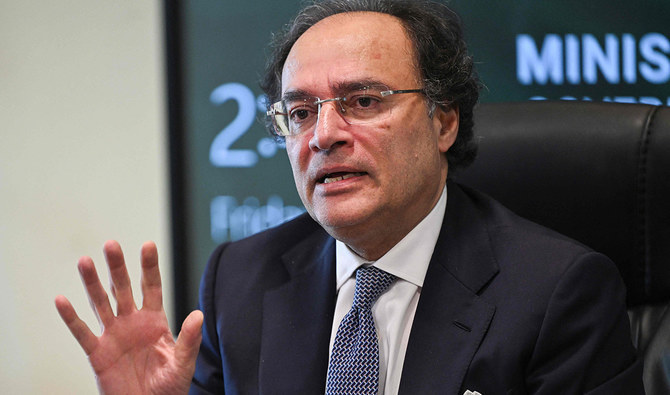
Pakistan Finance Minister Muhammad Aurangzeb gestures while speaking with media representatives at the finance ministry in Islamabad on March 22, 2024. (AFP/File)
Short Url
Updated 30 March 2024
Follow

Pakistan’s finance minister eyes fresh IMF loan deal by fiscal year-end

  • Muhammad Aurangzeb plans to discuss the contours of the new loan program during his meetings in Washington
  • Pakistan has successfully completed the second and final review under a short-term IMF agreement for $1.1 billion

ISLAMABAD: Pakistan plans to reach a staff-level agreement with the International Monetary Fund (IMF) for a new loan program by the end of the current fiscal year, said finance minister Muhammad Aurangzeb on Friday, adding the issue would come up for discussion in his upcoming meetings in Washington.

Pakistan successfully completed the second and final review under a short-term IMF stand-by arrangement amounting to $3 billion earlier this month, clearing the way for the disbursement of the final tranche of nearly $1.1 billion.

However, the country’s fragile $350-billion economy continues to be in desperate need for external financing to shore up its foreign exchange reserves and escape yet another macroeconomic crisis. This was also indicated by Prime Minister Shehbaz Sharif who pointed out it was “inevitable” for his government to seek further IMF assistance after taking over the top political office of his country.

The Pakistani finance minister said he was going to attend the spring meetings in Washington where he would meet the IMF and World Bank officials and discuss the contours of a fresh Extended Fund Facility (EFF).

“Those discussions will go into end April, into May,” he informed. “We can expect, because no final discussion or agreement [with IMF] has taken place yet, but it is our desire that by the time we wrap up this fiscal year, so end June, early July, we at least reach the staff-level agreement [for the EFF].”

Committing to a new IMF program will require Pakistan to implement steps needed to stay on a narrow path to recovery. The country has already tried to implement stringent economic reforms like raising fuel and power rates that have led to spiraling inflation in the country.

Getting into another IMF program would further limit the government’s policy options to provide relief to a deeply frustrated population and cater to industries that are looking for government support to spur growth.


US sees 18 percent rise in Pakistani students despite UGRAD pause, opens new USEFP headquarters

Updated 9 sec ago
Follow

US sees 18 percent rise in Pakistani students despite UGRAD pause, opens new USEFP headquarters

  • USEFP inaugurates purpose-built campus in Islamabad as Fulbright program marks 75 years in Pakistan
  • Undergraduate UGRAD program remains suspended but graduate scholarships and visas continue, US officials say

ISLAMABAD: The United States inaugurated a new purpose-built headquarters for the United States Educational Foundation in Pakistan (USEFP) this week, as American officials reported an 18 percent rise in Pakistani students studying in the US, despite the suspension of a major undergraduate exchange scheme earlier this year.

The launch comes as the Fulbright program completes 75 years in Pakistan, the world’s largest US-funded scholarship portfolio for master’s and PhD study. Officials said growing student mobility and stable visa issuance reflect continued academic engagement between the two countries, even after the UGRAD exchange program was paused in April.

USEFP Executive Director Peter Moran told Arab News that Pakistani students are still securing visas without unusual difficulty and enrollment levels remain strong.

“We are not finding that Pakistani students are facing undue difficulties getting their visas when they want to go and study on their own. The number of Pakistani students who are studying in the United States, actually based on data from the year before last, because you know there’s always a lag, it’s up 18 percent,” Moran said, citing 2023 figures.

He said nearly 10,000 Pakistanis are currently enrolled in US institutions, including self-funded students. While UGRAD, which previously sent 100–130 undergraduates per year, remains paused under US budget adjustments, Moran said there is hope it will return.

“So, the UGRAD program for now is on pause ... the UGRAD program sent undergraduate, actually high school students. That program ended in April. We don’t know when that will come back, but we sure hope that it will.”

USEFP clarified that no reductions have been applied to graduate programs.

“There is no cut on Fulbright… and we don’t anticipate there being any,” Moran added.

Around 65 Pakistani scholars left for the US through Fulbright this year, another 10–12 departed under the Humphrey Fellowship, and USEFP expects next year’s Fulbright cohort to rise to 75–80.

The inauguration of the new headquarters brought together US officials, scholarship alumni and education leaders.

US Embassy Minister Counselor for Public Diplomacy Andy Halus said the new facility reflects the depth of the bilateral academic partnership.

“We have over 9,000 students in Pakistan that have had experience in the United States on the Fulbright programs that started 70 years ago. Our commitment to sending more and more students to the United States on the Fulbright program is strong and it’s going to continue.”

Among attendees was Fulbright alumnus Aftab Haider, the CEO of Pakistan Single Window, the government-backed digital trade clearance platform. He credited the scholarship with shaping his career:

“I am a very proud Fulbrighter from 2008. I think it is one of the most transformational programs that can be offered to young Pakistanis to have the opportunity to be educated abroad, come back to Pakistan and contribute in public service delivery as well as in enhancement of the private sector.”