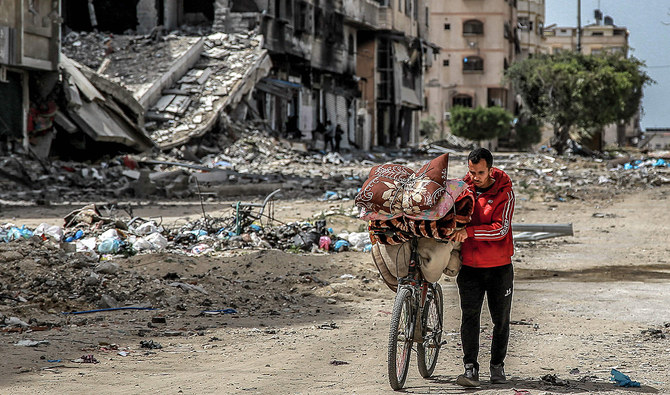
ISLAMABAD: Pakistan’s foreign office on Thursday called for the swift implementation of the United Nations Security Council’s ceasefire resolution in the Gaza Strip to end Israel’s relentless military campaign against the people of Palestine which has lasted for over five months.
Israel launched its campaign after a surprise attack was initiated by Hamas on Oct. 7 in response to the deteriorating condition of Palestinian people living under Israeli occupation. Since then, Israel has killed over 32,000 Gaza residents, most of them women and children, by targeting hospitals and residential neighborhoods.
The Security Council demanded an immediate ceasefire between Israel and Hamas earlier this week in what was viewed as a massive legal blow to Prime Minister Benjamin Netanyahu’s administration that has been widely accused of running a genocidal campaign against Palestinians.
However, Israel has continued to carry out its operations in the area.
“It has been three days since the adoption of the UN Security Council resolution calling for an immediate ceasefire in Palestine,” the foreign office spokesperson, Mumtaz Zahra Baloch, said during her weekly media briefing. “However, the Israeli war on the people of Gaza continues unabated and the Palestinian people continue to face starvation and genocide.”
“We call on the backers of Israel to urge Israel to bring an end to the massacre of the Palestinian people, lift the inhumane siege and allow humanitarian assistance in all parts of Gaza,” she continued. “The international community must redouble its efforts for a just and durable solution to the Palestine question and for the creation of a of an independent viable sovereign and contiguous Palestinian state along pre-1967 borders with Al-Quds Al-Sharif as its capital.”
A day earlier, Prime Minister Shehbaz Sharif also mentioned the UN resolution at an iftar-dinner hosted by the foreign ministry to honor the members of the diplomatic community in the country, calling for an immediate ceasefire.
“I would like to reiterate Pakistan’s firm support for the people of Palestine in their just struggle for their inseparable right to self-determination and we all hope and to make our sincere efforts that this UN Security Council’s resolution is implemented in latent spirit immediately and brutality against the Palestinians must end henceforth,” he said.

Pakistan seeks swift implementation of Security Council’s ceasefire resolution in Gaza
https://arab.news/bk7ux
Pakistan seeks swift implementation of Security Council’s ceasefire resolution in Gaza
- The foreign office asks Israel’s ‘backers’ to force the Netanyahu administration to end the Palestinian ‘massacre’
- It also seeks lifting of the ‘inhumane siege’ of Gaza to ensure smooth flow of humanitarian assistance to people
Economists flag high production costs, low exports as key risks for Pakistan in 2026
- Financial experts urge government to address high interest and taxation rates to attract more foreign direct investment this year
- Economists note strong performance by Pakistan’s stock market, reduced inflation as key macroeconomic gains in the last year
KARACHI: Pakistani economists and business leaders urged the government on Wednesday to cut high production costs, arrest inflation and increase exports to capitalize on macroeconomic gains in 2025 as the country prepared to ring in the new year.
Prime Minister Shehbaz Sharif this week highlighted his government’s economic achievements over the past two years, saying that inflation had fallen from 29.2 percent to 4.5 percent, while foreign exchange reserves had more than doubled from $9.2 billion to $21.2 billion.
While Pakistan reported some economic gains during the year, such as comparatively low inflation, a $100 million current account surplus in November and a strong performance by the stock market, economist Sana Tawfik said deeper reforms were still needed to address pressing economic issues.
“When we talk about stability and growth, we cannot deny that there are challenges in the economy,” Tawfik, head of research at Arif Habib Limited, told Arab News. “High energy tariffs, interest rates and the broader cost of doing business need to be addressed if Pakistan wants to sustain growth, boost exports and attract foreign investment.”
Pakistan reported consumer inflation at 6.1 percent in November, saying it was projected to remain within the moderate 5.5-6.5 percent range in December.
Muhammad Rehan Hanif, president of the Karachi Chamber of Commerce and Industry (KCCI), agreed that high power tariffs were eroding the effectiveness of Pakistan’s exports.
“Our interest rate is still 10.5 percent, while the region is at six or seven percent,” Hanif lamented. “[While] electricity costs around 12 cents per unit here, compared to about nine cents in Bangladesh.”
The KCCI president also pointed to the country’s poor infrastructure, particularly that of its commercial capital Karachi, as a major challenge for the year ahead.
He said dilapidated roads, poor drainage and poor industrial conditions were damaging Pakistan’s image for visiting buyers and diplomats, discouraging investment.
“Infrastructure is the biggest challenge the industrialists in Karachi are facing,” he explained.
‘EXPORTS ARE OUR LIFELINE’
More troubling for Pakistan is the fact that foreign direct investment (FDI) inflows fell by more than 25 percent to $927 million during the July-November period, as per data from the central bank. Pakistan’s FDI inflows have never surged beyond $3 billion in nearly 20 years.
Economists say high energy costs along with interest and taxation rates are responsible for low FDI in the country.
Hanif stressed the importance of increasing Pakistan’s exports to ensure macroeconomic gains in 2026.
“Exports are our lifeline,” he said. “When 7 to 8 million Pakistanis abroad can generate $37 billion [in remittances], why are 250 million people here exporting only $32 billion?“
Tawfik agreed, saying that shifting to an export-driven economic model was essential for long-term sustainability.
“It is about time that we move from an import-driven economy to an export-driven one,” she said, adding that macroeconomic stability was a prerequisite for restoring investor confidence and attracting FDI.
Meeting the International Monetary Fund’s benchmarks, ensuring timely inflows from creditors and continuing reforms such as privatization of state-owned enterprises (SOEs) will also be critical in 2026, she added.
‘YEAR OF MACROECONOMIC STABILITY’
Despite these challenges, financial experts recognized that 2025 marked a clear improvement for Pakistan compared to the previous two years.
“The year 2025 can be described as a year of macroeconomic stability and overall, we saw some improvement in different macroeconomic indicators,” Tawfik said.
She noted that inflation, which had surged to a record 38 percent in May 2023, had been reduced to single-digit figures in 2025.
Pakistan’s Finance Adviser Khurram Schehzad said this week the Pakistan Stock Exchange has delivered 50 percent-plus returns in US dollar terms since January 2025, making it one of the “best markets in Asia.”
Tawfik said 2026 could see “positive” developments if the government maintains macroeconomic stability.
The economist said she expected growth at around 3.7 percent, inflation to remain within the central bank’s five to seven percent target range and a relatively stable exchange rate with modest depreciation.
However, she cautioned that without addressing high energy costs, easing business conditions and boosting exports, the government could risk squandering its hard-won macroeconomic gains.
“It is important to take all stakeholders on the same page and work in the same direction for overall economic betterment.”