

Pakistani diplomat hails trade talks with Kabul as ‘successful’ amid ongoing security concerns

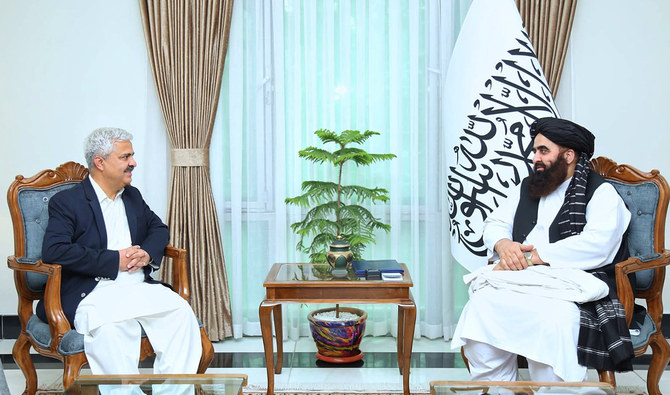
Commerce Secretary Khurram Agha (left) meets Afghan Foreign Minister Maulvi Amir Khan Muttaqi (right) in Kabul on March 26, 2024, amid ongoing trade talks between the two countries. (Photo courtesy: Afghan Embassy Islamabad)
Short Url
Updated 28 March 2024
Follow

Pakistani diplomat hails trade talks with Kabul as ‘successful’ amid ongoing security concerns

  • The understanding between the two countries can allow Pakistani trade trucks to travel all the way to Central Asia
  • Pakistan and Afghanistan have also agreed to take steps to increase the quantum of trade in the coming months

PESHAWAR: Pakistan’s top diplomat in Kabul hailed the recent talks between the country’s commerce delegation and Afghan officials as “successful” on Wednesday, expressing hope it would give fresh impetus to bilateral trade between the two estranged neighbors.
Led by Commerce Ministry Secretary Khurram Agha, the Pakistani delegation arrived in Afghanistan’s capital on Monday to discuss trade-related issues. The visit occurred amid deteriorating bilateral relations following deadly several suicide attacks in Pakistan in the last couple of months that Islamabad attributes to the banned militant network, Tehreek-e-Taliban Pakistan (TTP), believed to be based in Afghanistan.
Faced with teething security challenges, Pakistan started expelling undocumented foreigners, predominantly Afghans, last November, as its officials accused Kabul of sheltering militants who target Pakistani civilians and security forces.
Discussing the recently concluded negotiations between the two countries, Pakistan’s Charge d’Affaires Ubaid-ur-Rehman Nizamani said the delegation’s visit aimed to strengthen trade ties with Afghanistan.
“I’m happy to report that this was a successful visit and both sides have agreed to work together for mutual benefit on a number of areas, he said in a video message.

“They will facilitate transit, they will facilitate bilateral trade and they will take all possible measures that create an environment for continuous and productive trade and economic relations between the two countries,” he continued.
The diplomatic tensions between the two countries over the last few months have led to economic losses, as key border crossing for trade and travel have remained intermittently closed, hitting trade-dependent business and industrial communities.
Flanked by Pakistan’s commerce secretary and the head of its mission in Kabul following the trade talks, Afghanistan’s Interim Minister for Industry and Commerce Nurudin Azizi said his side had held fruitful negotiations in a cordial environment with the visiting delegation.
“We discussed in detail with the Pakistani side specific issues related to heavy transport vehicles that will be resolved,” he informed. “We will achieve positive results as our discussions remained productive.”
Azizi hoped that issues related to trade, transportation and transit would get gradually resolved by the coming year, adding it would benefit both neighboring countries.
He said that Afghanistan expected to sign a formal agreement with Pakistan within six months, allowing Pakistani trucks to enter Afghanistan and travel to the Central Asian states and Afghan trucks to go all the way to the Pakistani port cities of Karachi and Gwadar.
Apart from discussing trade-related issues, the two sides also focused on movement of passengers, patients and businesspeople across their common border during these negotiations.
Azizi noted uninterrupted trade and business between Kabul and Islamabad would play a significant role creating a peaceful environment between the two countries and facilitate their economic development.
He said the two sides also pledged to enhance their existing trade volume, adding that both countries could become ideal markets for each other if they did not allow business to be affected by any geopolitical tensions.
The Afghan official said his country could export agricultural products to China and other countries via Pakistan ports and cities.


Pakistani, Bangladeshi officials discuss trade, investment and aviation as ties thaw

Updated 28 December 2025
Follow

Pakistani, Bangladeshi officials discuss trade, investment and aviation as ties thaw

  • Pakistan and Bangladesh were once one nation, but they split in 1971 as a result of a bloody civil war
  • Ties between Pakistan, Bangladesh have warmed up since last year and both nations have resumed sea trade

ISLAMABAD: Pakistan's High Commissioner to Bangladesh Imran Haider on Sunday met Chief Adviser Muhammad Yunus in Dhaka, the latter's office said on, with the two figures discussing trade, investment and aviation.

Pakistan and Bangladesh were once one nation, but they split in 1971 as a result of a bloody civil war, which saw the part previously referred to as East Pakistan seceding to form the independent nation of Bangladesh.

Ties between Pakistan and Bangladesh have warmed up since former prime minister Sheikh Hasina’s ouster as a result of a student-led uprising in August 2024. Relations remain frosty between Dhaka and New Delhi over India’s decision to grant asylum to Hasina.

Pakistan has attempted to forge closer ties with Bangladesh in recent months and both South Asian nations last year began sea trade, followed by efforts to expand government-to-government commerce.

"During the meeting, both sides discussed ways to expand cooperation in trade, investment, and aviation as well as scaling up cultural, educational and medical exchanges to further strengthen bilateral relations between the two South Asian nations," Yunus's office said in a statement on X.

In 2023-24 Pakistan exported goods worth $661 million to Bangladesh, while its imports were only $57 million, according to the Trade Development Authority of Pakistan. In Aug. this year, the Pakistani and Bangladeshi commerce ministries signed a memorandum of understanding to establish a Joint Working Group on Trade, aiming to raise their bilateral trade volume to $1 billion in the financial year that began in July.

The Pakistani high commissioner noted that bilateral trade has recorded a 20 percent growth compared to last year, with business communities from both countries actively exploring new investment opportunities, according to the statement.

He highlighted a significant increase in cultural exchanges, adding that Bangladeshi students have shown strong interest in higher education opportunities in Pakistan, particularly in medical sciences, nanotechnology, and artificial intelligence. Haider also said that Dhaka-Karachi direct flights are expected to start in January.

"Chief Adviser Professor Muhammad Yunus welcomed the growing interactions between the two countries and emphasized the importance of increased visits as well as cultural, educational and people-to-people exchanges among SAARC (South Asian Association for Regional Cooperation) member states," the statement read.

"Professor Yunus also underscored the need to further boost Bangladesh–Pakistan trade and expressed hope that during Mr. Haider’s tenure, both countries would explore new avenues for investment and joint venture businesses."