Egypt urges US to resume aid to UN agency for Palestinians

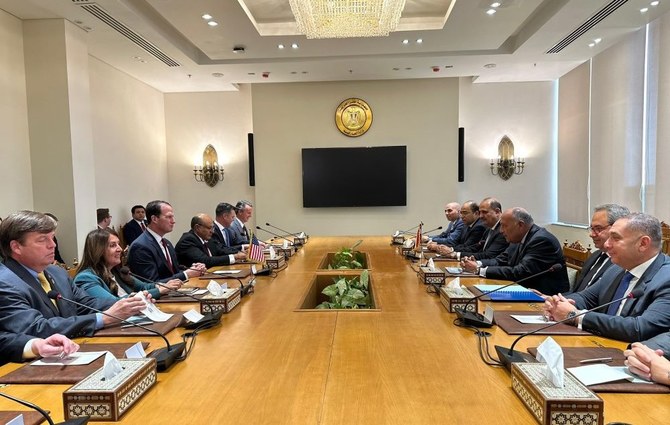
Sameh Shoukry meets with members of the US House Committee on Homeland Security. (X/@MfaEgypt)
Short Url
Updated 27 March 2024
Follow

Egypt urges US to resume aid to UN agency for Palestinians

  • Foreign Minister Sameh Shoukry meets visiting delegates
  • UNWRA vital to supporting refugees in Gaza, West Bank, Jordan, Syria, Lebanon, he says

CAIRO: Egypt’s foreign minister on Wednesday urged a visiting US delegation to resume its financial support for UNRWA, the UN aid agency for Palestinians.

Sameh Shoukry told the group of members of the US House Committee on Homeland Security, led by August Pfluger, that the decision to halt funding would have an impact on Palestinian refugees in Gaza, the West Bank, Jordan, Syria and Lebanon.

A total of 16 countries suspended their financial support for UNRWA after Israel accused 12 of the agency’s 13,000 employees in the Gaza Strip of taking part in the Hamas-led assault on Israel on Oct. 7.

Shoukry also stressed the importance of an immediate and comprehensive ceasefire to allow humanitarian aid to enter Gaza in a sustainable manner and in sufficient quantities to meet the growing need. He also called for the implementation of Security Council Resolution 2720, which gives the UN a mandate to facilitate the entry of aid into Gaza.

The minister reiterated Egypt’s rejection of any Israeli military operation against the Palestinian city of Rafah, which he said would represent a humanitarian catastrophe for more than 1.4 million displaced people.

He also highlighted his country’s efforts to bring security and stability to the region amid the ongoing threat of armed conflicts, terrorism and various economic and development challenges.

Egypt’s vision and strategy for fighting terrorism took into account economic, social, cultural, educational and development issues and sought to eradicate the problem at its roots, he said.

The visiting delegation stressed the importance of good Egypt-US relations and expressed their appreciation for the role played by Cairo in supporting regional peace, security and stability.

They also offered their full support for Egypt’s efforts aimed at reaching a permanent ceasefire agreement in Gaza.


Israel says it launched pre-emptive attacks against Iran

Updated 5 min 49 sec ago
Follow

Israel says it launched pre-emptive attacks against Iran

  • An Israeli defense official said the operation had been planned for months in coordination with Washington

Israel said it launched a pre-emptive attack against Iran on Saturday, pushing the Middle East into a renewed military confrontation and further ​dimming hopes for a diplomatic solution to Tehran’s long-running nuclear dispute with the West.

The New York Times, citing a US official, reported that US strikes on Iran were underway. A source said that Iran’s supreme leader, Ayatollah Ali Khamenei, was not in Tehran and had been transferred to a secure location.

An apparent strike in Iran’s capital Saturday happened near the offices of Khamenei. State television acknowledged an explosion in the area of the offices.

Israeli media reported attempts to assassinate Iranian President Masoud Pezeshkian during the attacks, and have not ruled out Khamenei being targeted.

People watch as smoke rises on the skyline after an explosion in Tehran on Feb. 28, 2026. (AP)

Several missiles have struck University Street and the Jomhouri area in Tehran, while explosion likely occurred in the northern Seyyed Khandan area of Tehran, state media reported. Thick smoke was also rising from the vicinity of Pasteur Street in downtown Tehran, ISNA said.

The attack, coming after Israel and Iran engaged in a 12-day air war in June, follows repeated US-Israeli warnings that they would strike again if ‌Iran pressed ‌ahead with its nuclear and ballistic missile programs.

“The State ​of ‌Israel ⁠launched ​a pre-emptive ⁠attack against Iran to remove threats to the State of Israel,” Defense Minister Israel Katz said.

An Israeli defense official said the operation had been planned for months in coordination with Washington, and that the launch date was decided weeks ago.

The US military declined to immediately comment on the attack.

Explosions were heard in Tehran on Saturday, Iranian media reported, and sirens sounded across Israel around 08:15 local time in what the military said was a proactive ⁠alert to prepare the public for the possibility of an ‌incoming missile strike.

People run for cover following an explosion in Tehran on Feb. 28, 2026. (WANA via Reuters)

The Israeli military announced ‌the closure of schools and workplaces, with exceptions for ​essential sectors, and a ban on public ‌airspace. Israel closed its airspace to civilian flights, and the airports authority ‌asked the public not to go to any of the country’s airports.

The country’s airspace will reopen and flights to and from Israel to resume ‘as soon as the security situation allows,’ the airport authority said.

Iran’s airspace has been closed, Tasnim news agency reported.

The US and Iran renewed negotiations in February in a bid to resolve the decades-long dispute through diplomacy and avert the threat of a military confrontation that could destabilize the region.

Israel, however, ‌insisted that any US deal with Iran must include the dismantling of Tehran’s nuclear infrastructure, not just stopping the ⁠enrichment process, and ⁠lobbied Washington to include restrictions on Iran’s missile program in the talks.

Iran said it was prepared to discuss curbs on its nuclear program in exchange for lifting sanctions but ruled out linking the issue to missiles.

Tehran also said it would defend itself against any attack.

It warned neighboring countries hosting US troops that it would retaliate against American bases if Washington struck Iran.

In June, the US joined an Israeli military campaign against Iranian nuclear installations, in the most direct American military action ever against the Islamic Republic.

Tehran retaliated then by launching missiles toward the US Al Udeid air base in Qatar, ​the largest in the Middle ​East.

Western powers have warned that Iran’s ballistic missile project threatens regional stability and could deliver nuclear weapons if developed. Tehran denies seeking atomic bombs.