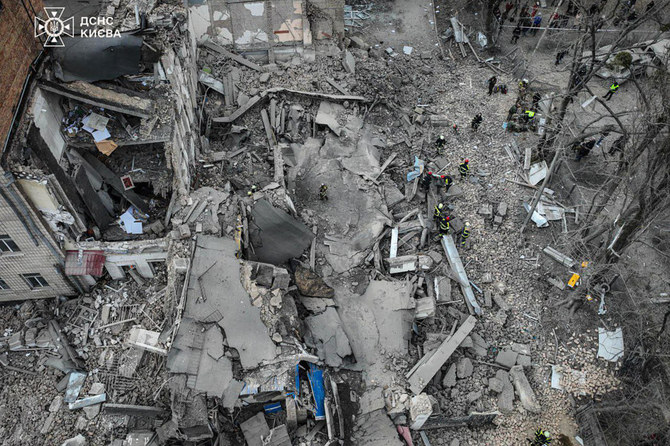
KYIV: Russian attacks on eastern and southern Ukraine killed two people and wounded 10 others, officials said Wednesday, as Kyiv called for Patriot air defense systems to battle a surge in missile strikes.
Moscow has escalated its aerial attacks on Ukraine in the past few weeks, targeting key infrastructure including power stations in retaliation for fatal bombardment of Russia’s border regions.
A 55-year-old man was killed by artillery fire in Ukraine’s southeastern city of Nikopol, Dnipropetrovsk region head Sergiy Lysak said.
The governor of Ukraine’s southern Kherson region, which is partially occupied by Russia, said one woman had been killed in a drone attack on the village of Mykhailivka.
Ukrainian forces retook swathes of the Black Sea territory in late 2022 but Russia has been shelling recaptured towns and villages since.
“A 61-year-old local resident was fatally wounded in her own home,” the official, Oleksandr Prokudin, wrote on social media.
The governor of the neighboring Mykolaiv region said later that a Russian ballistic missile had struck the coastal territory, leaving six wounded, with one in a critical condition.
Separately, the governor of the eastern Kharkiv region, Oleg Sinegubov, said three men and one woman all over the age of 50 were injured in separate strikes on towns and villages in the region.
The mayor of the region’s capital, also called Kharkiv, said that a strike on a residential neighborhood had left “dead and wounded,” but did not give details about casualties.
The Ukrainian air force said Russia had launched 13 Iranian-designed attack drones at Ukraine overnight and that 10 were downed over the Kharkiv region, the neighboring Sumy region and near the capital Kyiv.
During an online briefing Wednesday, Ukraine’s Foreign Minister Dmytro Kuleba called for urgent deliveries of air defense systems to ward off an increase in ballistic missile strikes.
“The peculiarity of the current Russian attacks is the intensive use of ballistic missiles that can reach targets at extremely high speeds, leaving little time for people to take cover and causing significant destruction,” Kuleba said.
“Patriot and other similar systems are defensive by definition. They are designed to protect lives, not take them,” he said.
Ukraine has been forced onto the defensive in the past few months as it struggles with ammunition shortages and a hold up to a $60 billion aid package from Washington.
It has also been forced to concede ground to Russia on the eastern front in recent months, warning earlier this week of “difficult” battles around the eastern city of Chasiv Yar.
Russia meanwhile announced that its air defense systems had shot down 18 rockets near the border city of Belgorod, which has recently seen an uptick in fatal Ukrainian attacks.
The governor of Russia’s Belgorod region, Vyacheslav Gladkov, said one person was wounded during the barrage.


![]()

Two dead, 10 wounded in Russian attacks on Ukraine
Short Url
https://arab.news/49etb
Two dead, 10 wounded in Russian attacks on Ukraine
- Moscow has escalated its aerial attacks on Ukraine in the past few weeks, targeting key infrastructure including power stations
- A 55-year-old man was killed by artillery fire in Ukraine’s southeastern city of Nikopol


Latest updates


Recommended


© 2026 SAUDI RESEARCH & PUBLISHING COMPANY, All Rights Reserved And subject to Terms of Use Agreement.