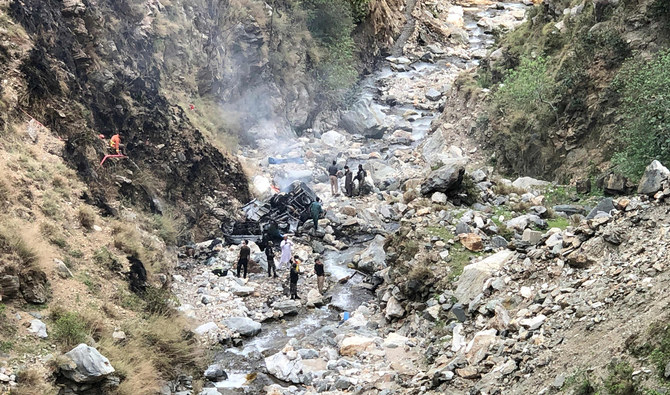
PESHAWAR: Pakistani authorities will perform DNA testing on the remains of the suicide bomber who rammed his explosive-laden car into a vehicle in the country’s northwest, killing five Chinese nationals and their local driver, officials said Wednesday.
The attack occurred in Shangla, a district in the Khyber Pakhtunkhwa province where thousands of Chinese nationals work on the China-Pakistan Economic Corridor which includes a multitude of megaprojects such as road construction, power plants and agriculture. The CPEC is a lifeline for Pakistan’s cash-strapped government, currently facing one of its worst economic crises.
The five were engineers and laborers heading Tuesday to the Dasu Dam, the biggest hydropower project in Pakistan, where they worked. Their remains were transported to the capital, Islamabad, local police official Altaf Khan said, adding that the deceased had a police escort when the attack happened.
Pakistani officials said they shared the latest investigation developments with their Chinese counterparts. China is expected to send its own experts Wednesday to the attack site to conduct an independent investigation while collaborating with Pakistani authorities.
Khan said they have further expanded a search that started a day earlier, looking for the attacker’s possible accomplices.
No group has so far claimed responsibility for the attack, but suspicion is likely to fall on separatists as well as a breakaway Gul Bahadur faction of Pakistani Taliban, known as Tehreek-e-Taliban Pakistan or TTP, and is a separate group, but a close ally of the Afghan Taliban.
The TTP denied being behind the attack in a statement Wednesday, saying: “We are in no way related to the attack on the Chinese engineers.”
Tuesday’s attack came less than a week after Pakistani security forces killed eight Balochistan Liberation Army militants who opened fire on a convoy carrying Chinese citizens outside the Chinese-funded Gwadar port in the volatile southwestern Baluchistan province.
The Chinese foreign ministry condemned the attack and offered “deep condolences to the deceased” in a statement Wednesday.
The ministry said China has asked “Pakistan to thoroughly investigate the incident as soon as possible, hunt down the perpetrators, and bring them to justice” and added that “any attempt to undermine China-Pakistan cooperation will never succeed”.
Pakistan’s Prime Minister Shehbaz Sharif promised a swift conclusion to the investigation during a visit with the Chinese ambassador, Jiang Zaidong, on Tuesday.
Chinese laborers working on CPEC-related projects in Pakistan have come under attack in recent years.
In July 2021, at least 13 people, including nine Chinese nationals, were killed when a suicide bomber detonated his vehicle near a bus carrying several Chinese and Pakistani engineers and laborers, prompting the Chinese companies to suspend work at the time. Pakistani authorities at the time initially insisted it was a road accident, but China disputed the claim, saying victims were the target of a suicide attack.


Pakistan to perform DNA testing on remains of suicide bomber who killed 5 Chinese nationals
https://arab.news/4app5
Pakistan to perform DNA testing on remains of suicide bomber who killed 5 Chinese nationals

- Attack occurred in Khyber Pakhtunkhwa where thousands of Chinese nationals work on China-Pakistan Economic Corridor
- The five Chinese were engineers and laborers heading Tuesday to Dasu Dam, the biggest hydropower project in Pakistan

IAEA approves safeguards for Pakistan’s Chashma nuclear power plant unit — FO
- Move reflects world’s confidence in Pakistan’s commitment to peaceful use of nuclear energy, non-proliferation, says FO
- Says after completion, power plant’s unit will provide substantial source of low-carbon electricity to the national grid
ISLAMABAD: Pakistan’s foreign office said on Wednesday that the International Atomic Energy Agency’s (IAEA) board of governors has approved a safeguards agreement with Islamabad for a unit of its Chashma nuclear power plant, reflecting the world’s growing confidence in the South Asian country’s commitment to peaceful use of nuclear energy.
Under a safeguards agreement, the IAEA has the right and obligation to ensure that safeguards are applied on all nuclear material in the territory, jurisdiction or control of a state to verify that such material is not diverted to nuclear weapons or other nuclear explosive devices.
The agreement pertains to Unit 5 of the Chashma nuclear power plant located in Pakistan’s eastern Punjab province. The plant will have a gross capacity to generate 1,200 megawatts, with its pressurized water reactor expected to become operational by 2030, the foreign office said.
“This important development reflects the international community’s continued confidence in Pakistan’s commitment to the peaceful use of nuclear energy and its adherence to global non-proliferation and safeguards obligations,” the statement said.
It said after completion, the plant’s Unit 5 will provide a substantial source of low-carbon electricity to Pakistan’s national grid, contributing to energy security, climate goals and sustainable economic growth.
Over the past year, nuclear power accounted for 18.3 percent of Pakistan’s national electricity mix and 34 percent of the country’s total low-carbon electricity generation.
Pakistan currently operates six nuclear power plants with a combined installed capacity of 3,530 megawatts, the foreign office said.
“With more than 100 reactor-years of operational experience, Pakistan maintains a strong record of safe, secure and fully safeguarded nuclear power operations in line with international standards,” the statement included.
Despite contributing less than one percent to greenhouse gas emissions worldwide, Pakistan is ranked among the world’s most vulnerable nations to climate change effects.
Torrential rains and floods in 2022 and 2025 wreaked havoc across the country, killing thousands and inflicting damages of billions of dollars on the country.


