As Ramadan favor, Karachi traffic police say no speeding tickets near iftar time

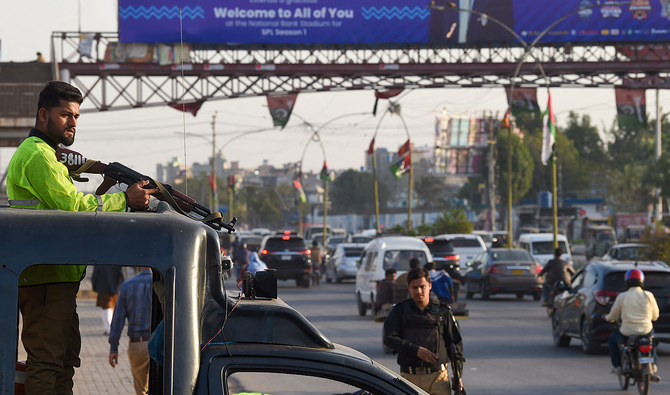
Policemen stand guard along a street in Karachi on February 1, 2024. (AFP/File)
Short Url
Updated 27 March 2024
Follow

As Ramadan favor, Karachi traffic police say no speeding tickets near iftar time

  • Traffic jams are frequent during evening rush hours in Karachi, a city with population of over 20 million
  • Police chief says challans consume time of commuters and tie up police officers who need to manage traffic flow

KARACHI: Traffic police in Pakistan’s bustling port city of Karachi have been instructed not to issue speeding tickets to commuters during the evening rush hours ahead of the fast-breaking iftar meal, the city’s traffic police chief said on Wednesday.
Traffic volume on the main thoroughfares of Karachi, a city of over 20 million people, usually surges around 6pm in the evening until 9pm as people return to their houses from work. During Ramadan, traffic peaks between 5 p.m. and iftar time a little after 6pm as people rush home to eat after a long day of fasting. 
“Traffic police have been instructed to refrain from issuing any challans [tickets] from 5pm until iftar, focusing instead on facilitating smoother traffic flow to enable timely arrivals of people for iftar,” Traffic Police Deputy Inspector General (DIG) Ahmed Nawaz told Arab News. 
“We face resource constraints, and engaging traffic police in challan activity would disrupt traffic flow, especially during Ramadan’s peak hours when there is severe traffic on roads and everyone is in a hurry to reach home.”
He said issuing tickets not only consumed the time of the traffic cops but also delayed commuters, adding that policemen had been instructed instead to ensure a smoother flow of traffic.


Pakistan business body writes to PM seeking ‘clear roadmap’ to spur investment

Updated 5 sec ago
Follow

Pakistan business body writes to PM seeking ‘clear roadmap’ to spur investment

  • Business confidence in Pakistan has fallen sharply amid rising inflation, high energy costs and unpredictable tax environment
  • In a letter written to PM Shehbaz Sharif, the Pakistan Business Forum president highlights challenges facing the business community

KARACHI: The Pakistan Business Forum (PBF), a representative body of traders and businesspersons in the country, on Monday urged Prime Minister Shehbaz Sharif’s intervention in outlining a “clear economic roadmap” to promote long-term investment in Pakistan.

Business confidence in Pakistan has fallen sharply amid rising inflation, high energy costs and an unpredictable tax environment. Currency volatility and slowing demand have prompted many firms to delay investments and scale back expansion plans.

In a letter to PM Sharif, PBF President Khawaja Mehboob-ur-Rehman highlighted the challenges facing the business community, including high input costs, soaring energy tariffs and an increasingly “uncompetitive” tax regime that weakens exports.

“Looking ahead to 2026, the Pakistan Business Forum urged the prime minister to provide the business community with a clear, credible, and forward-looking economic roadmap,” read a PBF statement.

“Such clarity... is essential to restore confidence, encourage investment, and enable long-term planning by businesses.”

The South Asian country of more than 241 million people is currently navigating a tricky path to economic recovery under a $7 billion International Monetary Fund (IMF) program since averting a default in 2023.

Besides introducing structural reforms relating to expansion of the country’s tax base and privatization of loss-making entities, the government of PM Sharif says it is taking various measures to boost foreign investment and trade.

The PBF highlighted the business community is ready to play its role in competing with regional markets, if provided with the “necessary competitive tools.” It outlined critical reforms relating to regionally competitive electricity tariffs and corporate tax rates.

An increase in electricity tariffs would put further strain on industries and could lead to widespread downsizing and the closure of industrial units, according to the PBF.

It urged the government to include business representatives in the policymaking process to ensure it understands “on-ground realities.”