Egypt starts repaying up to $1.5bn in oil company arrears, sources say 

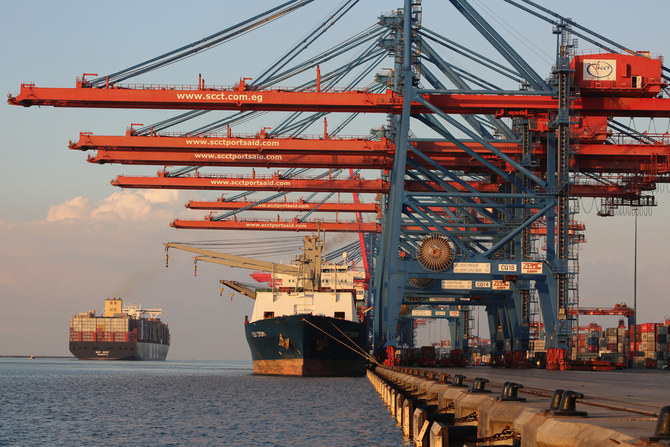
A cabinet statement said the payment process that had already begun accounted for about 20 percent of arrears owed to the companies, adding that the remainder would be paid off through a scheduled plan. Shutterstock
Short Url
Updated 27 March 2024
Follow

Egypt starts repaying up to $1.5bn in oil company arrears, sources say 

CAIRO: Egypt has started paying off dues owed to foreign oil and gas companies operating in the country, the government said on Tuesday, with sources saying that up to $1.5 billion had been set aside for the payments. 

A cabinet statement said the payment process that had already begun accounted for about 20 percent of arrears owed to the companies, adding that the remainder would be paid off through a scheduled plan. 

Egypt began accumulating arrears to companies and contractors during a long-running foreign currency shortage. The shortage has eased over the past month after the announcement of a record investment deal, a devaluation and an expansion of Egypt’s current International Monetary Fund programme. 

A source close to oil companies said Egypt had informed at least one of the companies that it would start paying back up to $1.5 billion of the overall arrears as soon as Tuesday. 

A separate industry source said there was information that $1.5 billion had been set aside for oil co-receivable payments and that the idea was to pay each 20 percent of their overdue receivables. 

“Some companies are apparently going to receive this money today,” the industry source added. 

Egypt’s finance and petroleum ministries did not respond immediately to requests for comment. 

Egypt’s chronic foreign currency shortage worsened in early 2022, triggering some restrictions on imports and government payments. 

After a deal announced late last month with UAE sovereign fund ADQ, Egypt says it has received $10 billion out of $24 billion of new funds for the rights to develop prime land at Ras El Hekma on the Mediterranean coast. 

The government also agreed on an expanded $8 billion financial support package with the IMF on March 6 and pledges of additional financing from the World Bank and the EU. 

The government has not said how much money it owes companies. Egypt had accumulated billions of arrears to foreign oil companies a decade ago, which it began to pay off after another devaluation and IMF deal in 2016. 


Closing Bell: Saudi main index extends gains as market opens wider to foreign investment

Updated 02 February 2026
Follow

Closing Bell: Saudi main index extends gains as market opens wider to foreign investment

RIYADH: Saudi Arabia’s Tadawul All Share Index rose on Monday, gaining 153.61 points, or 1.38 percent, to close at 11,321.09.

The total trading turnover of the benchmark index was SR5.85 billion ($1.56 billion), as 207 of the listed stocks advanced, while 55 retreated.

The MSCI Tadawul Index increased, up 21.20 points or 1.41 percent, to close at 1,524.18.

The Kingdom’s parallel market Nomu gained 278.13 points, or 1.17 percent, to close at 24,013.03. This comes as 43 of the listed stocks advanced, while 29 retreated.

The best-performing stock was Saudi Pharmaceutical Industries and Medical Appliances Corp., with its share price surging by 7.26 percent to SR28.94.

Other top performers included Rasan Information Technology Co., which saw its share price rise by 6.51 percent to SR144, and Knowledge Economic City, which saw a 6.25 percent increase to SR13.09.

On the downside, the worst performer of the day was Najran Cement Co., whose share price fell by 2.11 percent to SR6.49.

Almasane Alkobra Mining Co. and Saudi Cable Co. also saw declines, with their shares dropping by 2 percent and 1.88 percent to SR103.10 and SR166.80, respectively.

On the announcement front, Riyad Bank has announced its annual financial results for 2025, with the total income from special commission of financing reaching SR24.1 billion, while net income from special commission of financing amounted to SR12 billion.

In a statement on Tadawul, the bank said: “Net income increased by 11.7 percent mainly due to an increase in total operating income and a decrease in total operating expenses.”

The bank further noted that the rise in total operating income was primarily driven by increased revenue from fees and commissions, trading activities, special commissions, gains on non-trading investments, and other operating sources. This growth was partially tempered by declines in exchange and dividend income.

“Net provision of expected credit losses and other losses decreased by 15.8 percent due to a decrease in impairment charge of credit losses and impairment charge for other financial assets, partially offset by an increase in impairment charge for investments,” it added.

RIBL’s share price closed at SR18.18 on the main market, marking a 1.43 percent increase.