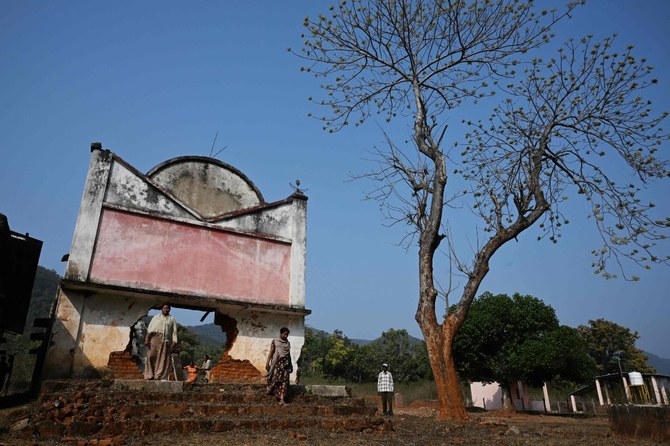
Irpiguda, India: Church walls crumble in India’s Kandhamal district, where brutal attacks on Christians 16 years ago means many survivors still worry about their minority’s place in a Hindu-majority nation.
With India’s election on the horizon and Hindu nationalist Prime Minister Narendra Modi widely expected to win, many Christians fear they may once again become targets.
Deepti was among those attacked in 2008 when mobs rampaged through parts of India’s eastern state of Odisha after the murder of a Hindu priest and his four followers.
The murder was widely blamed on Christians, and the ensuing revenge rampage left at least 101 people dead.
Aged 19 at the time, she was gang raped by a mob enraged that her uncle had refused to recant his Catholicism.
“I remember it every minute,” the 35-year-old domestic worker said in tears, using a pseudonym because she feared being identified.
“I had been living there since childhood, I recognized them from their voice,” said Deepti, who moved to the state capital Bhubaneswar after the attack.
“I can still remember each one of them.”
She was one of scores of women who, according to community leaders, were sexually assaulted across the district.
Mobs targeted dozens of churches, prayer halls and Christian homes, forcing tens of thousands to flee.
Last year, the Vatican greenlighted the start of the beatification process toward potential sainthood for 35 of those killed in the violence, a group the church calls the “Kandhamal martyrs.”
Local Odisha Archbishop John Barwa calls the move a “source of renewed faith and hope.”
A simple memorial for those who were killed has been erected in the village of Tiangia.
“Where there is hatred, let me sow love,” the memorial reads, quoting Saint Francis of Assisi.
Prasanna Bishnoi, head of Kandhamal’s survivors’ association, said church recognition that people had “died because of their faith” was welcomed — but that honoring the dead did nothing to address the worries of the living.
“Otherwise, I don’t think it is going to benefit our people,” Bishnoi said.
Six weeks of voting in marathon general elections begin on April 19, but few doubt the June 4 result — with the ruling Hindu-nationalist Bharatiya Janata Party (BJP), in power for a decade, widely tipped to win again.
Critics accuse Modi’s BJP of wanting to turn officially secular India into a Hindu nation, something he denies.
But many Christians worry.
Right-wing Hindu groups have long accused Christians of forcibly converting Hindus and these allegations, which the community has vehemently denied, have resulted in attacks.
India has 1.4 billion people and according to the last census, more than two percent are Christians.
Believers say the religion has been present in the country for nearly two millennia, since the apostle Thomas arrived in the year AD 52.
The New Delhi-based United Christian Forum (UCF) rights watchdog recorded 731 attacks against Christians in India last year, warning of “vigilante mobs comprising religious extremists.”
In Kandhamal, the trauma of the 2008 attack haunts survivors, fearful they could be targeted again.
“Even now the danger persists,” said Raheli Digal, 40, showing AFP the charred walls of what was once her house in Irpiguda village, where the church also lies in ruins.
“When we remember those old scenes, and watch the news (about ongoing incidents of violence against Christians), we feel scared,” she added.
“They have been saying for a long time that they won’t let Christians live here.”
The housewife said she has lived since the 2008 violence in a resettlement camp nearby, and rarely returns to her village.
“We do not come here... we are still scared to talk to them (Hindus),” she said.
She sobbed as she described how she hid in the surrounding forested hills, watching as a mob chanting anti-Christian slogans came with blazing torches.
“They destroyed our home, set it on fire,” she said.
“We had nothing, not even a piece of cloth, not even water or food,” she added. “We had small children with us — we grabbed them, and ran into the forest.”
When Modi in January inaugurated a grand temple to the deity Ram in the northern city of Ayodhya, sparking Hindu celebrations nationwide, Digal and her neighbors stayed home.
The temple was built on the site of a centuries-old mosque whose destruction by Hindu zealots in 1992 sparked sectarian riots that killed 2,000 people nationwide, most of them Muslims.
The BJP admits there is a “level of threat perception,” but says it is trying to change that.
“It is important that we dispel that,” said BJP national spokesman Mmhonlumo Kikon.
Modi has been “engaging with the Christian community and the leaders to reassure them this country is for everyone — it is not just for the majority community,” Kikon said.
Bishnoi, from the survivors’ association, said seeing Modi meeting Christians helped him feel “safe.”
But he also said that reports of violence worried him and cast doubt in his mind.
“If this government comes to power, then I think minorities will be under pressure,” he said.


![]()

Christians in India fearful as election looms
Short Url
https://arab.news/45n87
Christians in India fearful as election looms
- Six weeks of voting in marathon general elections begin on April 19, but few doubt the June 4 result
- India has 1.4 billion people and according to the last census, more than 2% are Christians


Latest updates


© 2026 SAUDI RESEARCH & PUBLISHING COMPANY, All Rights Reserved And subject to Terms of Use Agreement.