

Pakistan, Saudi Fund for Development in talks on energy, health, education, infrastructure projects — official 

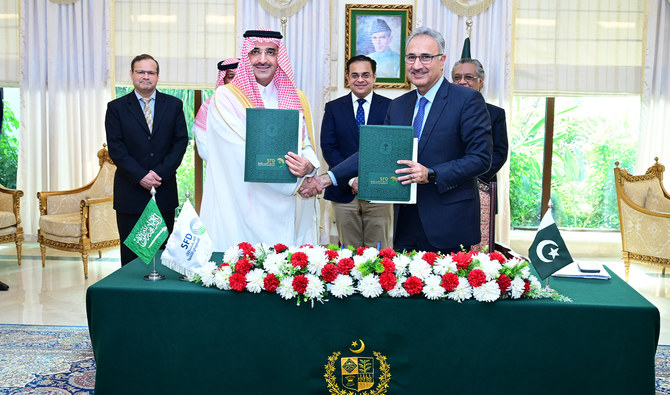
Pakistan’s Economic Affairs Division Secretary, Dr. Kazim Niaz (right), shakes hands with the CEO of Saudi Fund for Development, Sultan Bin Abdul Rehman Al-Marshad, after signing a loan agreement in Islamabad, Pakistan on March 22, 2024. (Government of Pakistan)
Short Url
Updated 25 March 2024
Follow

Pakistan, Saudi Fund for Development in talks on energy, health, education, infrastructure projects — official 

  • Pakistan and SFD last week signed loan agreements worth $107 million to finance two hydropower projects
  • Pakistan team to meet SFD officials in Riyadh on sidelines of Islamic Development Bank annual meetings in April 

ISLAMABAD: Pakistan and the Saudi Fund for Development (SFD) are in discussions to collaborate on a number of projects, including in the fields of energy, health, education and infrastructure, a top Pakistan official said on Sunday.

Pakistan’s Economic Affairs Division (EAD) Secretary Dr. Kazim Niaz and SFD Chief Executive Officer (CEO) Sultan Bin Abdul Rehman Al-Marshad signed two loan agreements worth $107 million last week to finance hydropower projects in Azad Kashmir, supporting Pakistan’s efforts toward energy sustainability and economic growth.

The SFD, a Saudi government agency, provides development assistance and financial aid to developing countries through loans and grants. In the past, the Fund has deposited money in Pakistan’s central bank to bolster foreign exchange reserves and funded various development projects in infrastructure, education, and health care.

“We already had a framework agreement with SFD. As the Saudi delegation concluded its visit [on Sunday], we have discussed a pipeline of numerous projects for future cooperation, in which they have shown keen interest,” Dr. Kazim Niaz, Pakistan’s Economic Affairs Division Secretary, told Arab News.

“These projects are in the energy, health, education and infrastructure sectors.”

Niaz did not provide more details on the projects, which he said would be shared after Saudi feedback on a list of initiatives shared by Islamabad for investment and cooperation. 

“They [Saudis] have taken these projects with them for examination and analysis,” the bureaucrat added. “Once their analysis is complete, both sides will proceed with signing.”

A Pakistani delegation will next be meeting SFD officials in Riyadh on the sidelines of the annual meetings of the Islamic Development Bank from April 27-30. 

On the loan agreements signed with SFD during its Mar. 22-24 visit to Pakistan, Niaz said they would be used to fund two hydropower projects in Azad Jammu and Kashmir (AJK).

“SFD will finance $66 million for 48MW Shounter Hydropower Project and $41 million for 22MW Jagran-IV Hydropower Project in Neelam Valley District,” he said, adding that the projects would generate 70 MW of electricity, which would be transmitted to the national grid.

SFD has been one of Pakistan’s leading development partners since its establishment in 1974. 

“They are providing assistance in energy, health, education, and infrastructure projects and have really played a significant part with their support for the floods in 2022,” Niaz said. 

“From our engagements and discussions,” the top official said, “I can say that the future of this cooperation and collaboration is very bright and encouraging.”


Pakistan says defense pact with Saudi Arabia elevated brotherly ties to ‘new heights’

Updated 25 February 2026
Follow

Pakistan says defense pact with Saudi Arabia elevated brotherly ties to ‘new heights’

  • Pakistan, Saudi Arabia signed strategic defense pact last year pledging aggression against one will be treated as attack on both
  • Deputy PM Ishaq Dar says enduring bonds with Islamic and Arab nations form vital pillar of Pakistan’s foreign policy 

ISLAMABAD: Deputy Prime Minister Ishaq Dar said on Wednesday that Pakistan’s defense pact with Saudi Arabia elevated its brotherly ties with the Kingdom to “new heights,” stressing that close ties with Arab and Islamic nations form a key pillar of Islamabad’s foreign policy. 

Pakistan and Saudi Arabia signed a Strategic Mutual Defense Agreement on Sept. 17 last year, pledging that aggression against one country would be treated as an attack on both, enhancing joint deterrence and formalizing decades of military and security cooperation.

Both nations agreed in October 2025 to launch an economic cooperation framework to strengthen trade and investment ties. 

“In the Middle East, our landmark Strategic Mutual Defense Agreement with Saudi Arabia has elevated our brotherly ties to new heights,” Dar said while speaking at the Pakistan Governance Forum 2026 event in Islamabad. 

The Pakistani deputy prime minister was speaking on the topic “Navigating International Relations Amidst Changing Geo-Politics.”

Dar noted that Pakistan has reinforced partnerships with other Middle Eastern nations such as the UAE, Qatar, Jordan, Oman, Egypt and Bahrain. He said these partnerships have yielded “concrete agreements” in investment, agriculture, infrastructure, and energy sectors. 

“Our enduring bonds with Islamic and Arab nations form a vital pillar of our foreign policy, and we will continue to expand our partnerships across Asia, Latin America, and Africa,” he said. 

Dar pointed out that the presidents of Kazakhstan, Uzbekistan and Kyrgyzstan have undertaken visits to Pakistan in recent months, reflecting Central Asian nations’ desire to boost cooperation with Islamabad.

On South Asia, the Pakistani deputy PM said Pakistan has successfully transformed its fraternal ties with Bangladesh into “a substantive partnership.”

“Similarly, the trilateral mechanism involving China, Pakistan, and Bangladesh has been launched with a view to expanding and deepening regional cooperation and synergy,” the Pakistani minister said. 

He said Islamabad has strengthened its “all-weather” partnership with China via the second phase of the multi-billion-dollar China-Pakistan Economic Corridor agreement and “unwavering support” from both sides for each other’s core interests. 

Dar said Pakistan had also reinvigorated its partnership with the US, advancing cooperation in trade, technology, investment, and regional stability. 

“This calibrated approach has enhanced our ability to navigate complexity with skill and confidence, ensuring that our national interests are served without compromising our core foreign policy principles,” he said.