

Protesters in disputed Ladakh demand protection of fragile ecology, land autonomy

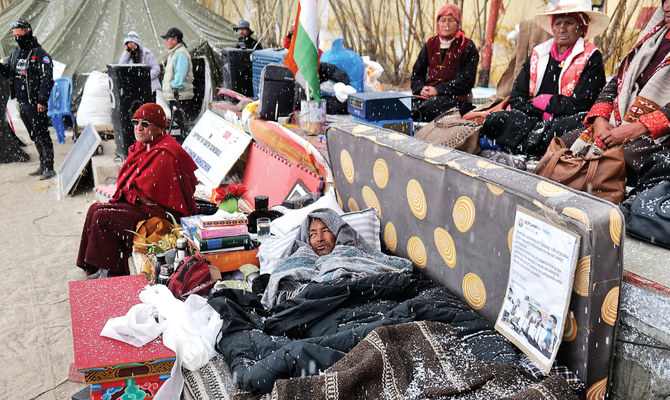
Sonam Wangchuk, an Indian education reformer in Ladakh, is surrounded by supporters on the 17th day of his hunger strike seeking protected status for the region’s people. (AP)
Short Url
Updated 25 March 2024
Follow

Protesters in disputed Ladakh demand protection of fragile ecology, land autonomy

  • Ladakh’s thousands of glaciers, which helped dub the rugged region one of the “water towers of the world,” are receding at an alarming rate, threatening the water supply of millions of people
  • Ladakh nomads were also losing prime pastureland to huge Indian industrial plans and Chinese encroachment

SRINAGAR: Thousands of people in the remote region of Ladakh have been protesting for over two weeks in freezing temperatures, demanding constitutional provisions from the Indian government to protect their territory’s fragile ecology and to have autonomy over land and agriculture decisions.

Nestled between India, Pakistan and China, Ladakh has faced territorial disputes and suffered the effects of climate change. Shifting weather patterns in the sparsely populated villages altered people’s lives through floods, landslides and droughts.

Top climate activist Sonam Wangchuk is taking part in the demonstrations in the town of Leh. He has been on a fast, since the protests started on March 6, in the open in sub-zero temperatures and surviving only on salt and water.

Wangchuk, also an engineer working on solutions for sustainability at his Himalayan Institute of Alternative Ladakh, has called his protest a“climate fast.”

“We’re already facing climate disaster and these glaciers and mountains will be destroyed if there is not a check on unbridled industrial development and military maneuvers” in the region, Wangchuk told The Associated Press Sunday.
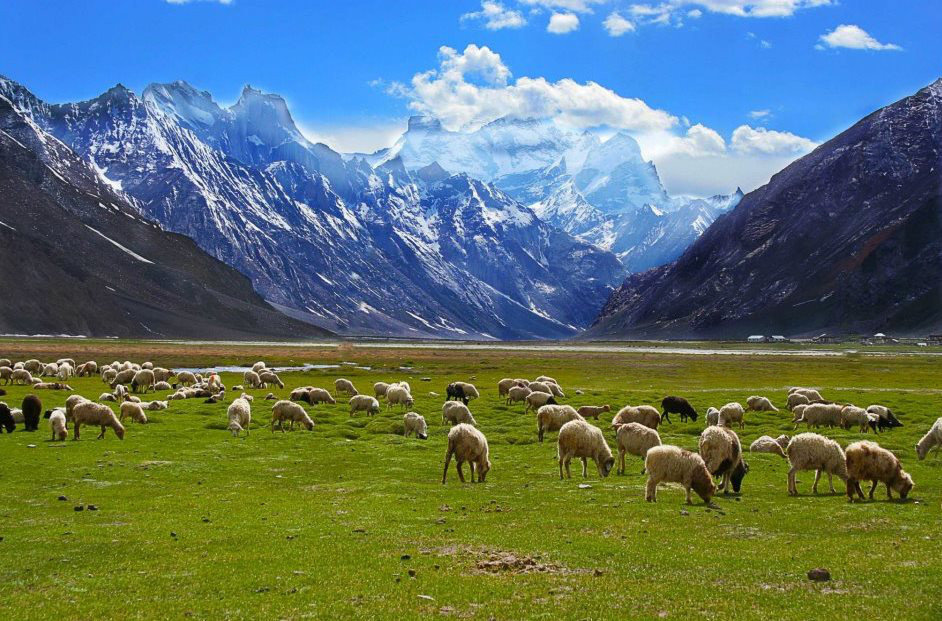


A photo of Rangdum village in Suru Valley. Ladakh nomads complain of losing prime pastureland to huge Indian industrial plans and Chinese encroachment. (Wikimedia Commons: Narender9)

Ladakh’s thousands of glaciers, which helped dub the rugged region one of the “water towers of the world,” are receding at an alarming rate, threatening the water supply of millions of people. The melting has been exacerbated by an increase in local pollution that has worsened due to the region’s militarization, further intensified by the deadly military standoff between India and China since 2020.

He also said Ladakh critically needs ecological protection because “it’s not just a local disaster in (the) making but an international one as these mountains are part of Greater Himalayas intricately linked to over 2 billion people and multiple countries.”

Wangchuk said the Ladakh nomads were also losing prime pastureland to huge Indian industrial plans and Chinese encroachment. The region’s shepherds complain that Chinese soldiers have captured multiple pasturelands and restricted them from grazing their herds.

The shepherds and Wangchuk are planning to march to the Chinese border later this month to underscore what they say is Beijing’s land grab attempts in Ladakh to gain territory.

In August 2019, Ladakh was split from Indian-controlled Kashmir after New Delhi stripped the disputed region of its statehood and semi-autonomy.


Las Vegas police investigate terrorism event after vehicle rammed into power substation

Updated 7 sec ago
Follow

Las Vegas police investigate terrorism event after vehicle rammed into power substation

LAS VEGAS: Las Vegas police say they’re investigating a car that rammed into a power substation as a ” terrorism-related event.”
There’s no ongoing threat to the public, Las Vegas Metropolitan Police Department Sheriff Kevin McMahill said during a news conference Friday.
The driver of the vehicle was 23-year-old Dawson Maloney from Albany, New York, who was reported missing and died from a self-inflicted gunshot wound, McMahill said.
The man had communicated with family before the crash, referencing self-harm, and said he was going to commit an act that would place him on the news. He referred to himself as a terrorist in a message sent to his mother, according to police.
Authorities found explosive materials and multiple books “related to extremist ideologies” in Maloney’s hotel room, McMahill said. The books included ones about right- and left-wing extremism, environmental extremism, white supremacism and anti-government ideology, he said.
“These findings significantly elevate the seriousness of this incident,” McMahill said.
Maloney is listed as a student at Albany Law School in the class of 2027. He was also an honors student for multiple semesters at Siena University, located in New York.
Two shotguns, an assault rifle-style pistol, and flame throwers were found in his rental car, McMahill said. Maloney was wearing what police described as “soft-body armor.”
Authorities recovered a 3D printer and several gun components needed to assemble a firearm from an Albany residence.
Boulder City is a historic town located approximately 25 miles  southeast of Las Vegas and home to the Hoover Dam, which is considered one of the country’s modern civil engineering wonders. The dam provides water to millions of people and generates an average of 4 billion kilowatt-hours of hydroelectric power each year for Nevada, Arizona and California.
The power substation that was rammed is owned by the Los Angeles Department of Water and Power. The facility works closely with Hoover Dam and transfers power to the Los Angeles basin, McMahill said. The Los Angeles Department of Water and Power said in a statement to The Associated Press that it is aware of the incident, and there were no impacts or disruptions to its operations.
Boulder City Police Chief Timothy Shea said there is no evidence of major damage to critical infrastructure and no service disruptions.
A similar incident occurred in 2023 when a man rammed a car through a fence at a solar power facility in the desert northeast of Las Vegas, setting the car on fire. The solar power facility served Las Vegas Strip casinos. He was declared unfit for trial. That attack followed several incidents and arrests involving electrical substations in states including Washington, Oregon and North Carolina and concerns expressed by federal officials about the security of the nation’s electricity transmission network.
“We are heartbroken to hear of the tragic passing of one of our law students, Dawson Maloney, in an off-campus incident,” said Tom Torello, director of communications and marketing at Albany Law School, in a statement.
