

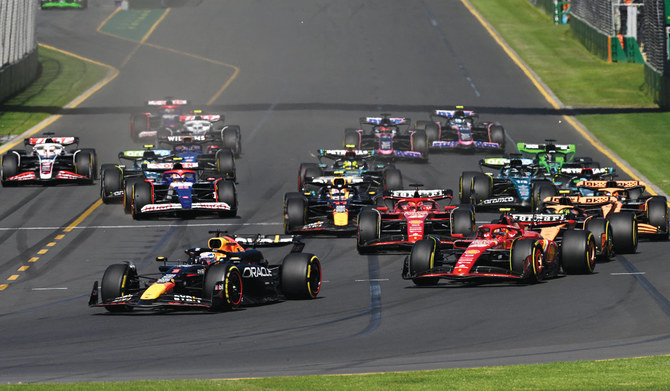
Carlos Sainz Jr. wins Australian GP in Ferrari 1-2 as Verstappen fails to finish

Despite not being fully fit, Spaniard Carlos Sainz Jr., whose seat at Ferrari is to be taken by Britain’s Lewis Hamilton next year, topped Q1 and Q2 to fire a warning shot. (Reuters)
Short Url
Updated 24 March 2024
Follow

Carlos Sainz Jr. wins Australian GP in Ferrari 1-2 as Verstappen fails to finish

  • Spaniard missed the last race in Saudi Arabia and went through surgery two weeks ago

MELBOURNE: Ferrari’s Carlos Sainz Jr. surged to victory at the Australian Grand Prix Sunday to snap Red Bull’s winning start to the season after three-time world champion Max Verstappen sensationally failed to finish.

The Spaniard, who had appendicitis surgery two weeks ago, took the chequered flag 2.3 seconds ahead of teammate Charles Leclerc, with McLaren’s Lando Norris a bold third.

It was his third grand prix win and first since Singapore last year.

“I’m happy to be in a one-two with Charles here. It shows that hard work pays off,” said Sainz, who missed the last race in Saudi Arabia and was bed-ridden for a week afterwards.

“Life sometimes is crazy ... the podium in Bahrain, then the appendix, the comeback, the win. It’s a rollercoaster but I loved it and I’m extremely happy.”

While he celebrated, it was a disastrous day for pole-sitter Verstappen, who limped out with smoke billowing from his car after being passed by front-row partner Sainz on lap two.

The Dutchman blamed a brake issue for his first retirement in two years.

“What we can see so far from the data is that as soon as the lights went off the right-rear brake just stuck on,” he said.

“It just caused the damage and it kept on increasing so it was also basically driving with the handbrake on.” 
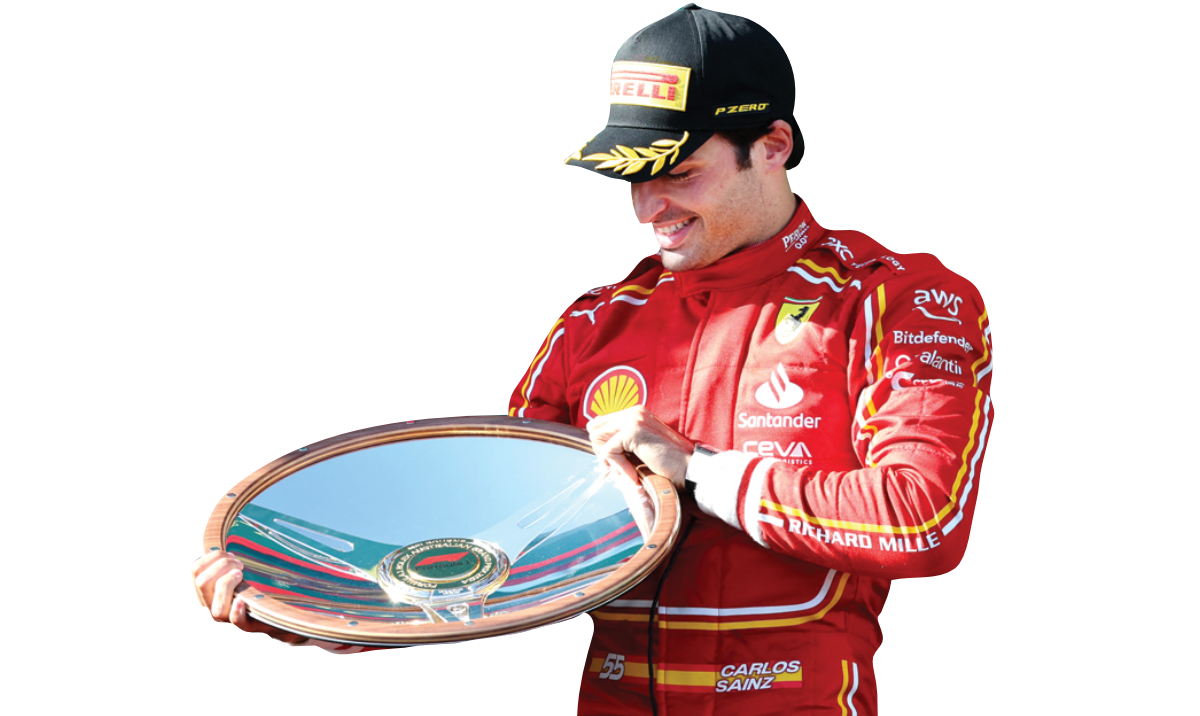


Carlos Sainz Jr.

It was also a horror race for Lewis Hamilton in his inconsistent Mercedes, with the British seven-time world champion suffering engine failure on lap 17.

To add to Mercedes’ woes, teammate George Russell crashed heavily on the last lap with the car ending on its side.

Russell climbed out unscathed, with Aston Martin’s Fernando Alonso faulted for “potentially dangerous” driving over the incident and slapped with a 20-second penalty.

Verstappen emphatically won the opening two grands prix of the season in Bahrain and Saudi Arabia, with both a Red Bull 1-2, and was hot favorite to make it three from three.

He had been aiming to match his own record set last year of 10 consecutive wins — one more than Sebastian Vettel in 2013 — and was unbeaten in his last 18 starts from pole position.

But while Verstappen was favored to win, the Ferraris had proved highly competitive in practice and qualifying on the fast and flowing Albert Park track.

Despite not being fully fit, Sainz, whose seat at Ferrari is to be taken by Hamilton next year, topped Q1 and Q2 to fire a warning shot.

Oscar Piastri in the other McLaren was fourth ahead of Red Bull’s Sergio Perez. Alonso dropped to eighth after his penalty with teammate Lance Stroll elevated to sixth and RB’s Yuki Tsunoda to seventh.

Haas pair Nico Hulkenberg and Kevin Magnussen rounded out the top 10.

“It feels good mostly for the team of course, first and second didn’t happen since Bahrain 2022,” said Leclerc. “Carlos has had an incredible weekend to come back from his surgery, he’s done an amazing race.”

Verstappen made a clean start and pulled clear of Sainz when the lights went out, with Norris holding onto third as they jostled for position.

But his lead didn’t last with Sainz opening his DRS on lap two to slice past before smoke started pouring out of the Red Bull and the Dutchman retired.

Sainz led from Norris and Leclerc before the first pit stops.

Sainz put on fresh rubber on lap 17 and had a 2.6sec lead from Leclerc at the halfway mark, closely followed by Piastri and Norris.

With no Verstappen to contend with, the Spaniard gradually built the gap as Norris passed Piastri to move into third.

Leclerc pitted again and he came back out in fifth on hards, but quickly surged back to second.

Sainz also pitted for a second time and retained his narrow lead to cruise home in front of 130,000 fans.


Teams on edge as F1 reset faces litmus test in Australia

Updated 05 March 2026
Follow

Teams on edge as F1 reset faces litmus test in Australia

  • Formula One’s new era faces first test in Melbourne

MELBOURNE: Formula One’s new era starts at this weekend’s season-opening Australian Grand Prix, where teams will leap into the unknown and grapple with sweeping technical changes under race conditions for the first time.

F1 has simultaneously overhauled chassis and power unit regulations for the first time in decades, posing a challenge for drivers and engineers alike while raising concerns about the quality of racing.

With near-parity between electrical and combustion engines and cars running on 100 percent advanced sustainable fuel, drivers gained some insight into the changes during winter testing. But all are in the dark about how the reset will play out when going wheel-to-wheel on race-day.

“I’m certainly more comfortable now than I was a couple of months ago, with how ‌to drive these ‌cars and how to try and get the most out of ‌them,” McLaren’s Oscar Piastri told reporters on Wednesday.

“But I think there’s still the saying of, ‘You don’t know what you don’t know.’”

Australian Piastri said McLaren thought they had the cars worked out two months ago, only to find they had “a whole bunch of stuff” they did not understand during winter testing.

With more power generated by electricity than last year’s engines, there is more emphasis on drivers needing to be tactical with energy deployment and regeneration.

The old drag reduction system has been replaced by a new overtake mode giving extra power for overtaking.

Four-time world champion Max Verstappen described the changes ‌as “like Formula E on steroids” and “anti-racing.”

Formula One chief executive Stefano ‌Domenicali defended them and assured fans there will still be plenty of thrills.

‘Unnatural’ driving

The changes may have ‌different effects at different circuits, leaving all teams to learn on the fly, week by ‌week.

Piastri said Sunday’s race at Albert Park would probably showcase the more “unnatural” parts of driving.

“You know, a lot more lift and coast, a lot more kind of just driving to maximize the power unit,” he said.

“You’ve got power units that are reducing in power down the straights at different points. And there’s a ‌lot of unknowns, a lot of challenges in there.”

The new regulations raised hopes of a more open championship and the prospect of a disruptor team emerging to force change at the top.

But pre-season testing in Bahrain hinted at a familiar top four, with Ferrari, Mercedes, Red Bull and McLaren all performing.

Audi team principal Jonathan Wheatley said the gap between the “best and the rest” might only widen.

“I think it’s going to be a very different year in terms of the competitiveness in the sport,” he told Reuters. “We’re already seeing the gap between the fastest teams and the slowest teams, but larger than it’s been in the last few years.”

Whatever the pecking order, F1 race tracks will be more crowded with the addition of the new Cadillac team although there may be more breathing room at Albert Park given Aston Martin’s pre-season troubles.

Despite the technical guidance of Adrian Newey, who joined from Red Bull, the Honda-powered team completed few laps during winter testing and have reliability problems.

The AMR26 cars will be in Australia — something of a relief for F1 management — but may only race for a few laps before retiring.