

UN chief praises Egypt’s efforts to provide aid to Gaza Strip

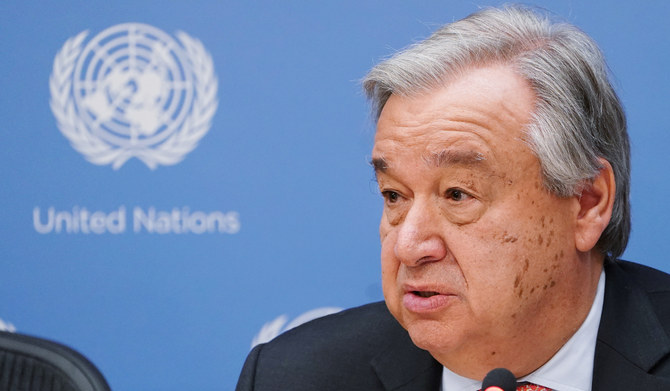
The Secretary General of the United Nations Antonio Guterres attends a press conference in New York, New York, US. (REUTERS file photo)
Short Url
Updated 24 March 2024
Follow

UN chief praises Egypt’s efforts to provide aid to Gaza Strip

  • Antonio Guterres meets President El-Sisi in Cairo to discuss crisis facing Palestinians
  • ‘Horror & starvation stalk the people of Gaza,’ he says on X

CAIRO: The head of the United Nations has praised Egypt for its efforts to achieve a ceasefire in the Gaza Strip and its commitment to keeping the Rafah border crossing open since the start of the conflict.

UN Secretary-General Antonio Guterres was received by Egyptian President Abdel Fattah El-Sisi in Cairo on Sunday.

The pair discussed a range of international and regional issues, with an emphasis on developments in the Gaza Strip. They agreed that a two-state solution was the only path to achieving justice, security and stability and highlighted the need to create conditions conducive to its implementation, a presidential spokesperson said.

El-Sisi highlighted the danger linked to some countries’ decision to suspend funding for UNRWA, the UN agency that supports Palestine refugees, which has been seen as a form of collective punishment.

The meeting also discussed efforts to reach an immediate ceasefire, free hostages and implement humanitarian aid, whether by land, in coordination with the relevant UN agencies, or through air drops, particularly over northern areas of the Gaza Strip.

El-Sisi said he appreciated Guterres’ keenness to adhere to the principles of international law and international humanitarian law and continued efforts to urge the international community to act to help end the hostilities and protect civilians.

It was important for the UN Security Council to assume its responsibilities in these matters, he said.

Guterres, who visited the Rafah crossing on Saturday, praised Egypt for its efforts in leading the process of delivering aid to the people of Gaza in the face of severe obstacles and difficulties.

He reiterated the importance of a ceasefire for humanitarian purposes to enable the delivery and distribution of aid.

The meeting, which was also attended by Egypt’s Foreign Minister Sameh Shoukry, General Intelligence Service Director Maj. Gen. Abbas Kamel, UNRWA Commissioner General Philippe Lazzarini and UN Resident Coordinator in Egypt Elena Panova, rejected any displacement of Palestinians from their lands.

It also warned against any military operation in Rafah, which would have “catastrophic consequences.”

Guterres and Shoukry held extended talks after which they took part in a joint press conference.

The discussions dealt with a range of issues, most notably the need to end the war in Gaza and ensure the flow of humanitarian aid.

Guterres said that the manner in which Israel had carried out its military operations in the Gaza Strip violated international law and that it must remove obstacles to the relief effort.

He added that the UN was working to ensure sufficient funding for UNRWA to enable it to fulfill its obligations to the Palestinian people and said the only effective way to transfer aid to Gaza was via land crossings.

The international community was facing a credibility crisis as the attacks continued, Guterres said.

“Horror & starvation stalk the people of Gaza,” he wrote on X.

“Any further onslaught will make everything worse. Worse for Palestinian civilians, for the hostages, for all people of the region. It’s more than time for an immediate humanitarian ceasefire & the immediate release of all hostages.”


UN chief visits Iraq to mark end of assistance mission set up after 2003 invasion

Updated 5 sec ago
Follow

UN chief visits Iraq to mark end of assistance mission set up after 2003 invasion

  • Sudani said his country “highly values” the mission’s work in a region “that has suffered for decades from dictatorship, wars, and terrorism”
  • Guterres praised “the courage, fortitude and determination of the Iraqi people”

BAGHDAD: United National Secretary-General Antonio Guterres was in Baghdad on Saturday to mark the end of the political mission set up in 2003 following the US-led invasion of Iraq that toppled Saddam Hussein.
The UN Security Council, at Iraq’s request, voted last year to wind down the mandate of the United Nations Assistance Mission in Iraq (UNAMI), by the end of 2025. The mission was set up to coordinate post-conflict humanitarian and reconstruction efforts and help restore a representative government in the country.
Iraqi caretaker Prime Minister Mohammed Shia Al-Sudani said his country “highly values” the mission’s work in a region “that has suffered for decades from dictatorship, wars, and terrorism.” He said its conclusion showed Iraq had reached a stage of “full self-reliance.”
“Iraq emerged victorious thanks to the sacrifices and courage of its people,” he said in a joint statement with Guterres.
The ending of UNAMI’s mandate “does not signify the end of the partnership between Iraq and the UN,” Sudani said, adding that it represents the beginning of a new chapter of cooperation focused on development and inclusive economic growth.
The prime minister said a street in Baghdad would be named “United Nations Street” in honor of the UN’s work and in recognition of 22 UN staff who were killed in an Aug. 19, 2003, truck bomb attack on the Canal Hotel in Baghdad, which housed the UN headquarters.
Guterres praised “the courage, fortitude and determination of the Iraqi people” and the country’s efforts to restore security and order after years of sectarian violence and the rise of extremist groups, including the Daesh group, in the years after the 2003 invasion.
“Iraqis have worked to overcome decades of violence, oppression, war, terrorism, sectarianism and foreign interference,” the secretary-general said. “And today’s Iraq is unrecognizable from those times.”
Iraq “is now a normal country, and relations between the UN and Iraq will become normal relations with the end of UNAMI,” Guterres added. He also expressed appreciation for Iraq’s commitment to returning its citizens from the Al-Hol camp, a sprawling tent camp in northeastern Syria housing thousands of people — mostly women and children — with alleged ties to the IS.
Guterres recently recommended former Iraqi President Barham Salih to become the next head of the UN refugee agency, the first nomination from the Middle East in half a century.
Salih’s presidential term, from 2018 to 2022, came in the immediate aftermath of the Daesh group’s rampage across Iraq and the battle to take back the territory seized by the extremist group, including the key northern city of Mosul.
At least 2.2 million Iraqis were displaced as they fled the IS offensive. Many, particularly members of the Yazidi minority from the northern Sinjar district, remain in displacement camps today.