

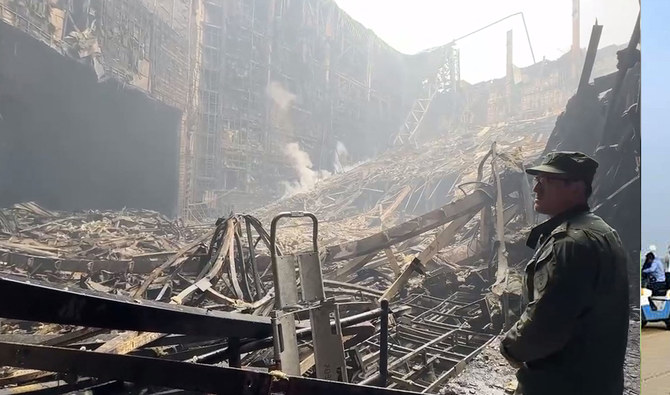

PARIS: World leaders denounced a deadly attack by gunmen on a Moscow concert hall that killed more than 130 people and wounded dozens more.
Four gunmen stormed the Crocus City venue before the start of a rock concert on Friday, opened fire on the audience and set fire to the building, in an assault claimed by Daesh.
Here are the reactions from governments and leaders around the world.
President Vladimir Putin vowed retribution for the attack on Saturday, saying the “barbaric, terrorist act” was an “atrocity, a strike against Russia and our people.”
In a televised address, he said all four perpetrators had been “found and detained” after “traveling toward Ukraine.”
Kyiv, facing a Russian military offensive for the past two years, had “nothing to do” with the attack, presidential aide Mykhailo Podolyak said on Telegram.
Ukrainian President Volodymyr Zelensky said Saturday that Putin was “just trying to blame it on someone else,” in response to claims the attackers were heading toward Ukraine.
The main intelligence directorate of the Ukrainian defense ministry said the attack was a “deliberate provocation by the Russian special services” to “escalate” the war with Ukraine.
UN Secretary-General Antonio Guterres on Friday condemned the attack “in the strongest possible terms,” spokesman Farhan Haq said.
Guterres “conveys his deep condolences to the bereaved families,” he added.
The UN Security Council also offered condolences and urged all states “to cooperate actively” to hold perpetrators and backers of “these reprehensible acts of terrorism accountable.”
US Secretary of State Antony Blinken called the attack a “heinous crime” saying Washington condemns “terrorism in all its forms.”
The United States stands “in solidarity with the people of Russia in grieving the loss of life from this horrific event,” Blinken said in a statement.
The White House called Daesh “a common terrorist enemy that must be defeated everywhere.”
Washington warned Moscow this month about a “planned terrorist attack” possibly targeting “large gatherings” in the capital, the White House said.
President Xi Jinping “strongly condemned” the attack and sent condolences to Putin, state media reported.
Xi “stressed that China opposes all form of terrorism, strongly condemns the terrorist attack and firmly supports the Russian government’s efforts to safeguard its national security and stability,” Xinhua news agency said.
The EU said it was “shocked and appalled” by the attack.
“The EU condemns any attacks against civilians. Our thoughts are with all those Russian citizens affected,” said a spokesman.
Britain’s foreign minister David Cameron said the UK condemned “in the strongest terms the deadly terrorist attack.”
“We offer our heartfelt condolences and express our deepest sympathy to the families of the many victims,” he added.
French President Emmanuel Macron said he “strongly condemns the terrorist attack” claimed by Daesh, according to the Elysee Palace.
“France expresses its solidarity with the victims, their loved ones and all the Russian people,” the palace said.
German Chancellor Olaf Scholz condemned “the terrible terrorist attack against innocent spectators” in a post on X, adding “our thoughts are with the victims’ families and all those wounded.”
Italian Prime Minister Giorgia Meloni called the attack an “odious act of terrorism.”
“The horror of the massacre of innocent civilians in Moscow is unacceptable,” Meloni said, expressing her “full solidarity with the affected people and the victims’ families.”
Spain said it was “shocked” by the attack, saying it “condemns any form of violence.”
“Our solidarity with the victims, their families and the Russian people,” the Spanish foreign ministry wrote on X.
The Swedish foreign affairs ministry said on X that it was “appalled by the attack” and condemned “any attacks against civilians.”
“Saddened by tonight’s tragic events in Moscow. Our hearts go out to the families of the victims and to all those affected,” Israeli Foreign Minister Israel Katz posted on X.
The presidency of the Palestinian Authority condemned the attack and “affirmed its solidarity and support for the Russian leadership,” the official Wafa news agency said.
In a letter to Putin, Syrian President Bashar Assad said the attack was linked to the “painful defeats of neo-Nazism” in Moscow’s “special military operation” in Ukraine.
“We condemn this brutal act and all the bloodshed committed by terrorists around the world.”
Iranian President Ebrahim Raisi, in a message to Putin, expressed his condolences, according to the presidency website.
Raisi also called for action by the international community to punish the plotters and perpetrators.
Turkiye’s foreign ministry condemned “this heinous terrorist attack on innocent civilians” and sent condolences to the Russian people and government.
Moussa Faki Mahamat, chairman of the African Union Commission, said on X that he was “shocked to learn of the horrific terror attack in Moscow.”
He expressed solidarity with the Russian people and government “following this heinous attack.”
“We express our support for President Vladimir Putin and raise our voice to categorically reject any act of violence,” said Venezuelan President Nicolas Maduro on X.
“India stands in solidarity with the government and the people of the Russian Federation in this hour of grief,” Prime Minister Narendra Modi said on X.
Lebanon’s Iran-backed Hezbollah movement said it “strongly condemns the bloody terrorist attack,” offering “deepest condolences to the Russian leadership” and people.


