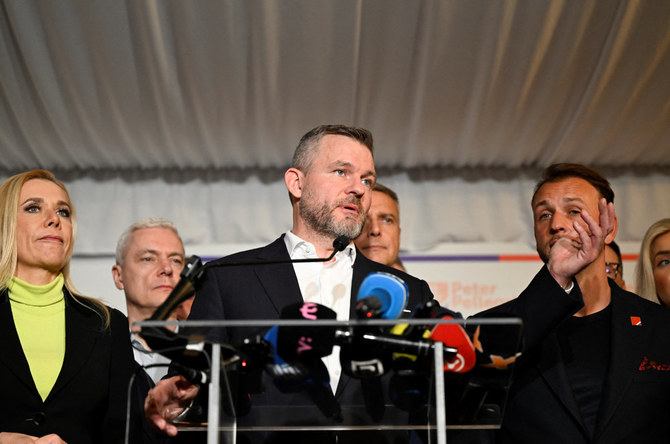

BRATISLAVA: A pro-EU former Slovak foreign minister scored a surprise victory in the first round of a presidential election on Saturday, setting up a run-off vote with a key ally of populist Prime Minister Robert Fico.
Slovakia’s presidential election is a chance for Fico, whose views on Ukraine have angered critics for veering too close to Russia, to strengthen his grip on power. Opposition forces want a counterbalance to his rule.
The government’s foreign policy shift, attempts to revamp the country’s criminal laws and clashes with media outlets have led to a series of protests and criticism from President Zuzana Caputova, 50, who has been a fierce opponent of Fico but did not seek a new term.
Ivan Korcok, 59, a career diplomat who was minister in a past government, is seeking to follow her and won the most votes among nine candidates in the first round.
His 42.5 percent share of the vote, with 99.9 percent of districts counted, was above 37.1 percent for Peter Pellegrini, 48, the parliament speaker who heads junior government party Hlas (Voice).
The two will advance to a run-off on April 6 in which Korcok said he needed to reach voters across the political spectrum.
“I certainly have to speak to the tens of thousands of voters of the ruling coalition who disagree with where the government is pulling Slovakia,” Korcok told his supporters.
A Russian-leaning former Supreme Court chief, Stefan Harabin, gained the third most votes at just 11.75 percent, after getting support from a nationalist party that is also in the government coalition. His voters could help Pellegrini.
Fico and his ruling leftist Smer party won a parliamentary election last September with pledges to halt military aid to Ukraine and maintain support for people hit by price surges.
Pellegrini, a former prime minister and ex-member of Smer, was key in forming a coalition and said the first-round results on Saturday showed a majority did not want a “liberal-right-progressive” president who would only be in conflict with the government.
“The majority in Slovakia expressed an interest in having a president who will defend the national state interests,” he said.
Presidents do not wield many executive powers but have a role in government and judicial appointments, can veto laws and shape public debate as the liberal Caputova often did.
Voters in the past have rejected giving ruling parties both the government and presidential offices, including Caputova’s win in 2019 when anti-corruption sentiment hurt Fico’s party, which was in government then.
“This election will show whether mass protests that have taken place in Bratislava and other major cities in recent weeks are also supported by people who usually express their disapproval at the polling stations,” said Radoslav Stefancik, a political analyst at the University of Economics in Bratislava, the capital.
Split views on Ukraine
The war in Ukraine, high inflation and chaotic governance under an opposition-led coalition from 2020-2023 have polarized voters. Opinion polls before Saturday showed Pellegrini leading and being the likely winner in a run-off with Korcok.
Fico has abruptly shifted parts of Slovakia’s foreign policy, ending state military supplies to Ukraine — while still allowing commercial supply deals — and opening dialogue with Moscow even as the European Union isolates the Russian regime.
Pellegrini has said Slovakia will remain anchored in the EU and NATO but, like Fico, says the conflict in Ukraine does not have a military solution and supports peace talks between Kyiv and Moscow — a stance Korcok and other critics say is capitulation when parts of Ukraine are occupied.
Fico’s coalition government has pushed criminal law changes that critics say weaken the fight against corruption. Caputova, as president, has challenged the changes at the Constitutional Court.
The government’s decision to shut a dedicated state graft prosecution unit was heavily criticized by the European Commission this week.
Fico’s administration is planning changes that will give it more control over public broadcaster RTVS, raising concern among advocates for press freedom. Korcok has criticized the government’s push for more power.