

Pakistan condemns deadly suicide bombing in Afghanistan, calls militant violence ‘shared concern’

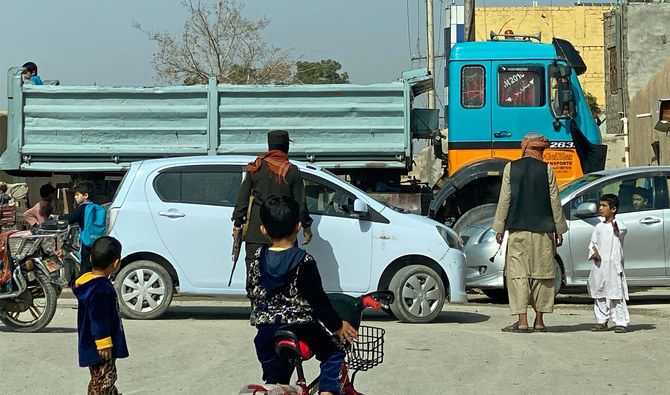
An Afghan security personnel checks a vehicle near the site of a suicide bomb attack in Kandahar on March 21, 2024. (AFP)
Short Url
Updated 22 March 2024
Follow

Pakistan condemns deadly suicide bombing in Afghanistan, calls militant violence ‘shared concern’

  • The attack in the Taliban heartland of Kandahar killed about 20 people after a suicide bomber targeted a bank
  • The attack was claimed by Daesh that has posed significant security challenges to Taliban government in Kabul

ISLAMABAD: Pakistan on Friday condemned a suicide bombing that killed at least 20 people in the Taliban heartland of Kandahar in neighboring Afghanistan a day earlier, calling such violent incidents a “shared concern” for both countries.

The suicide attack targeted people going to a bank in the southern Afghan city, many of them government employees, to collect their salaries.

The death toll was shared by hospital authorities with the media, though it was denied by Taliban officials who said only three people had died while dozens of others had suffered injuries.

The attack was later claimed by Daesh which has posed a significant security challenge to the Taliban administration in Kabul.

“Pakistan strongly condemns the terrorist attack that took place in Kandahar on 21 March 2024 and resulted in the loss of valuable lives and injuries to many others,” the foreign office said in a statement.

“Terrorism is a shared concern that both countries need to address through collective efforts,” it added.

Relations between the Pakistani and Afghan administrations have hit a low following deadly suicide attacks in Pakistan which have been claimed by a banned militant network, Tehreek-e-Taliban Pakistan (TTP), whose leaders are believed to have found a sanctuary in Afghanistan.

Pakistan recently launched airstrikes against TTP hideouts along its border with Afghanistan after an attack in its northwestern region killed seven soldiers, including two army officers.

Pakistan’s defense minister Khawaja Muhammad Asif said earlier this week his country did not seek armed conflict with Afghanistan, though he noted that cross-border militancy had reached an unacceptably high level.


Pakistan, China to sign multiple MoUs at major agriculture investment conference today

Updated 18 January 2026
Follow

Pakistan, China to sign multiple MoUs at major agriculture investment conference today

  • Hundreds of Chinese and Pakistani firms to attend Islamabad event
  • Conference seen as part of expanding CPEC ties into agriculture, trade

KARACHI: Islamabad and Beijing are set to sign multiple memorandums of understanding (MoUs) to boost agricultural investment and cooperation at a major conference taking place in the capital today, Monday, with hundreds of Chinese and Pakistani companies expected to participate.

The conference is being billed by Pakistan’s Ministry of National Food Security and Research as a platform for deepening bilateral agricultural ties and supporting broader economic engagement between the two countries.

“Multiple memorandums of understanding will be signed at the Pakistan–China Agricultural Conference,” the Ministry of National Food Security said in a statement. “115 Chinese and 165 Pakistani companies will participate.”

The conference reflects a growing emphasis on expanding Pakistan-China economic cooperation beyond the transport and energy foundations of the flagship China-Pakistan Economic Corridor (CPEC) into agriculture, industry and technology.

Under its first phase launched in 2015, CPEC, a core component of China’s Belt and Road Initiative, focused primarily on transportation infrastructure, energy generation and connectivity projects linking western China to the Arabian Sea via Pakistan. That phase included motorways, power plants and the development of the Gwadar Port in the country's southwest, aimed at helping Pakistan address chronic power shortages and enhance transport connectivity.

In recent years, both governments have formally moved toward a “CPEC 2.0” phase aimed at diversifying the corridor’s impact into areas such as special economic zones, innovation, digital cooperation and agriculture. Second-phase discussions have highlighted Pakistan’s goal of modernizing its agricultural sector, attracting Chinese technology and investment, and boosting export potential, with high-level talks taking place between planning officials and investors in Beijing.

Agri-sector cooperation has also seen practical collaboration, with joint initiatives examining technology transfer, export protocols and value-chain development, including partnerships in livestock, mechanization and horticulture.

Organizers say the Islamabad conference will bring together government policymakers, private sector investors, industry associations and multinational agribusiness firms from both nations. Discussions will center on investment opportunities, technology adoption, export expansion and building linkages with global buyers within the framework of Pakistan-China economic cooperation.