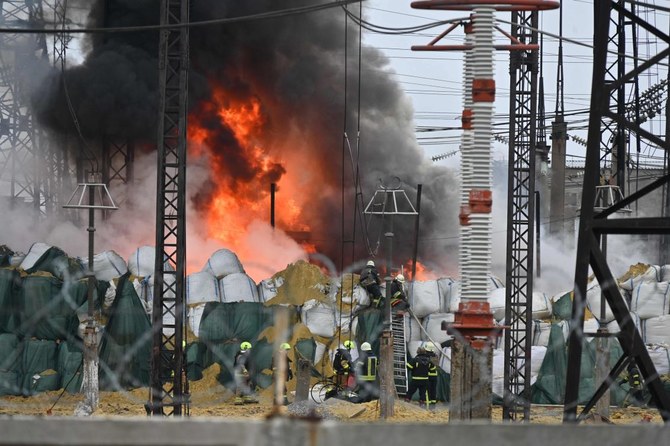
KYIV: Russia attacked electrical power facilities in much of Ukraine, including the country’s largest hydroelectric plant, causing widespread outages and killing at least five people, officials said Friday.
President Volodymyr Zelensky said more than 60 drones and about 90 rockets were used in the attack.
The attack came a day after Russia launched 31 missiles in a single attack on the capital. It was the largest assault on Ukraine’s energy infrastructure during the more than two-year-long war, said Volodymyr Kudrytsky, head of the national utility Ukrenergo.
“This attack was especially dangerous because the adversary combined different means of attack, kamikaze drones, ballistic and cruise missiles,” he told The Associated Press. He said the city of Kharkiv, Ukraine’s second-largest, suffered the most damage.
Last winter, Russia targeted Ukraine’s energy infrastructure, resulting in frequent blackouts across the country. Many had warned that Russia might repeat this strategy this winter. But instead, Russia has launched massive missile and drone attacks primarily directed at Ukraine’s defense industry.
Every large-scale air attack depletes Ukraine’s capabilities to repel Russian missiles. Zelensky has been urging Ukraine’s Western allies for weeks to provide additional air defense systems and ammunition amid delays in aid from the US
“With Russian missiles, there are no delays, like with aid packages to our state. Shaheds don’t have indecisiveness, as do some politicians. It is important to understand the cost of delays and postponed decisions,” Zelensky said, referring to Iranian-made Shahed drones, which are widely used by Russia in the war.
The attacks caused a fire at the Dnipro Hydroelectric Station, which supplies electricity to the Zaporizhzhia Nuclear Power Plant, Europe’s largest nuclear power installation.
The main external power line to the plant was cut off, International Atomic Energy Agency head Rafael Grossi said early Friday, but Ukraine’s nuclear energy operator said it was restored several hours later.
The plant is occupied by Russian troops, and fighting around the plant has been a constant concern because of the potential for a nuclear accident.
The dam at the hydroelectric station was not in danger of breaching, the country’s hydroelectric authority said. A dam breach could not only disrupt supplies to the nuclear plant but could potentially cause severe flooding similar to what occurred last year when a major dam at Kakhovka further down the Dnieper collapsed.
Three people were killed and at least eight injured in the Russian attack, said Zaporizhzhia regional Gov. Ivan Fedorov.
Attacks on energy facilities in the Kharkiv region caused blackouts in the country’s second-largest city and disrupted critical air-raid siren systems. Regional Gov. Oleh Syniehubov said police would inform residents of possible air raids through loudspeakers and walkie-talkies and that alerts would be sent to cellular phones.
Other attacks were reported in areas of western Ukraine far from the front lines. Two people died in the Khmelnytskyi region, according to the Internal Affairs Ministry.
The power outages left 1,060 miners trapped in the Dnipropetrovsk region and an evacuation was underway, according to private energy company DTEK.
“The world sees the targets of Russian terrorists as clearly as possible: power plants and energy supply lines, a hydroelectric dam, ordinary residential buildings, even a trolleybus. Russia is fighting against the ordinary life of people,” Zelensky said Friday on the Telegram messaging app.
Russian officials said Friday that one person died and at least three were injured in Ukrainian shelling of areas near the border.
The governor of the Belgorod region, Vyacheslav Gladkov, said a woman was killed when a shell hit nearby while she was walking her dogs and that two others were injured. The town of Tetkino in the Kursk region was shelled, injuring one person, said Gov. Roman Starovoit.
Both regions have been subject to shelling and drone attacks in recent weeks and officials have said that attempts by Ukrainian fighters to cross into Russian territory have been repelled.
Russian officials refer to the conflict as a “special military operation,” eschewing the word “war.” But Kremlin spokesman Dmitry Peskov attracted attention on Friday by telling a Russian newspaper that “when the collective West became a participant in this on the side of Ukraine, for us it already became a war.”
He later told reporters in a conference call that ″This is not connected with any kind of juridical change. It is de jure an SVO,” the Russian acronym for special military operation.
Both Peskov and President Vladimir Putin have occasionally used the word “war” about the fighting in Ukraine.


![]()
![]()

Russia attacks Ukrainian electrical power facilities, including major hydroelectric plant

Short Url
https://arab.news/mzy28
Russia attacks Ukrainian electrical power facilities, including major hydroelectric plant
- It was the largest assault on Ukraine’s energy infrastructure during the more than two-year-long war, said Volodymyr Kudrytsky, head of the national utility Ukrenergo
- Every large-scale air attack depletes Ukraine’s capabilities to repel Russian missiles


Latest updates


© 2026 SAUDI RESEARCH & PUBLISHING COMPANY, All Rights Reserved And subject to Terms of Use Agreement.