US official Donald Lu rejects ex-PM Khan’s foreign interference allegations as a ‘lie’

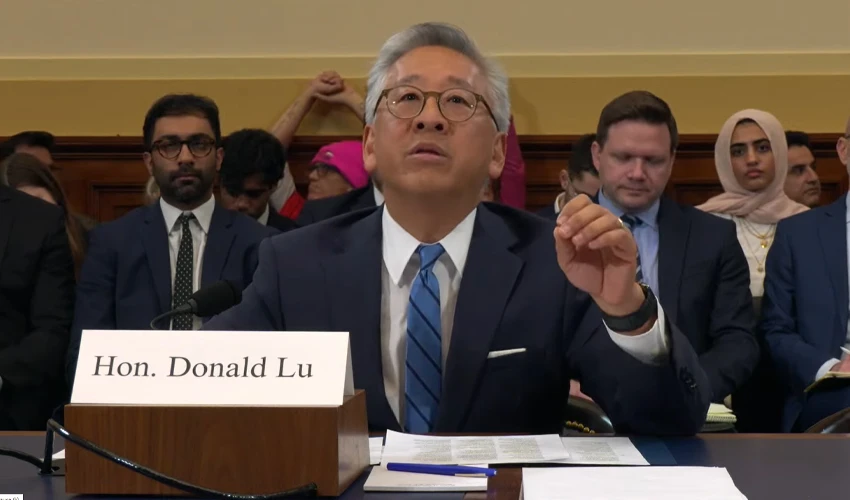
US Assistant Secretary of State Donald Lu is seen speaking during a hearing held by the Committee on Foreign Affairs in the US House of Representatives in US in March 20, 2024. (US Capitol)
Short Url
Updated 20 March 2024
Follow

US official Donald Lu rejects ex-PM Khan’s foreign interference allegations as a ‘lie’

  • Ex-PM Khan accused Washington of conspiring to remove him from office in April 2022
  • Donald Lu testifies in congressional hearing on relations between Pakistan and the US

ISLAMABAD: US Assistant Secretary of State Donald Lu on Wednesday rubbished former Pakistan prime minister Imran Khan’s allegations his government was ousted via a conspiracy orchestrated by Washington, describing it as a “conspiracy theory” and a “lie.”

Lu testified as a subcommittee of the Committee on Foreign Affairs in the US House of Representatives held a hearing on relations between the two countries. The hearing was titled: “Future of democracy in Pakistan and the US-Pakistan relationship.”

The American official is at the center of the “cipher” controversy as it is popularly known in Pakistan. It relates to an alleged diplomatic correspondence between Washington and Islamabad that Khan said was proof his ouster as PM was part of a US conspiracy to remove him. Washington has repeatedly denied Khan’s accusations.

In January, a Pakistani court handed Khan and his close aide Shah Mahmood Qureshi, who was the country’s foreign minister during Khan’s premiership, a 10-year jail term each on charges of leaking the diplomatic cable to unauthorized individuals for political gain.

“I want to be very clear on this point. These allegations — this conspiracy theory — is a lie,” Lu said during the hearing when asked whether the US had conspired to remove Khan from office. 

“It is a complete falsehood.”

Khan became Pakistan’s first prime minister to be ousted from office via a parliamentary vote in April 2022. The former prime minister remains incarcerated since August on a slew of charges he says are politically motivated, 

Lu pointed out that the then-Pakistan ambassador to the US even testified to his government that there was no conspiracy to remove Khan. 

His testimony was marred by chants of “liar” and Free Imran Khan” by a person attending the proceedings. 

“We respect the sovereignty of Pakistan, we respect the principle that Pakistanis should be the only ones choosing their leaders through a democratic process,” Lu said. 

The hearing was announced last week after over 30 members of the US Congress wrote to President Joe Biden and US Secretary of State Antony Blinken, asking them not to recognize Pakistan’s new government under Prime Minister Shehbaz Sharif. 

Sharif was elected prime minister of Pakistan this month after the contentious Feb. 8 election. Khan has accused Pakistan’s election regulator of manipulating votes in favor of his political opponents. His Pakistan Tehreek-e-Insaf (PTI) party claims it won a two-thirds majority in polls.

Pakistan’s national polls were marred by violence, the suspension of mobile networks on election day for security reasons, and unprecedented delays in announcing results. 

Despite countrywide protests by the PTI and other political parties against alleged rigging, Pakistan’s election regulator and its previous caretaker government have denied that polls were rigged. 

UN says 270,000 Afghans have returned from Iran, Pakistan this year

Updated 4 sec ago
Follow

UN says 270,000 Afghans have returned from Iran, Pakistan this year

  • UNHCR says 110,000 Afghans returned from Iran while 160,000 returned from Pakistan since start of 2026
  • Return numbers seem to have risen since Gulf war erupted on Feb. 28, says UNHCR official in Afghanistan

GENEVA: Some 270,000 Afghans have returned to their country from Pakistan and Iran so far this year, the UN said Tuesday, warning that the escalating Middle East war risked pushing the numbers higher.

UNHCR, the United Nations’ refugee agency, said that 110,000 Afghans had returned from Iran and another 160,000 had returned from Pakistan since the start of 2026.

And the numbers seem to have risen since the Middle East erupted on February 28, with the United States and Israel unleashing a barrage of strikes on Iran, and Tehran responding with drone and missile strikes on Israeli and US interests across the region.

Since then, there have been some 1,700 returns from Iran to Afghanistan each day, Arafat Jamal, UNHCR’s representative in Afghanistan, told reporters in Geneva.

Speaking from Islam Qala, on the Afghan-Iranian border, he said the situation there was “deceptively calm.”

“Returns are orderly but freighted with tension and apprehension,” he said, adding that with the hostilities elsewhere escalating, “I do fear there is more to come.”

“We are preparing for massive returns.”

He pointed out that Afghanistan was “facing the ramifications of what is happening with Iran,” while clashes have erupted along the Afghan border with Pakistan.

The new Middle East war, he warned, was “layering itself on top of an existing war on another frontier,” Jamal said.

UNHCR highlighted that the latest crises came after returns to Afghanistan had already been “exceptionally high” in recent years.

More than five million Afghans had returned from neighboring countries in the past two years, including 1.9 million returning from Iran last year alone.

Jamal warned that “many Afghan families are now facing cycles of displacement: first forced to flee Afghanistan, later displaced again inside Iran due to conflict, and now returning once more to Afghanistan.”

“And upon return in Afghanistan, the triply-displaced enter a spiral of precarity and uncertainty.”
Returns from Pakistan had meanwhile stabilized in recent weeks, as the main crossing point at Torkham remained closed due to the tensions there, Jamal said.

But he warned that “movements could increase sharply once the border reopens.”

UNHCR and the UN children’s agency UNICEF said Tuesday they were working to strengthen their capacity to operate at the borders and within Afghanistan.

But “given the scale of returns and the financial constraints facing humanitarian operations, additional support will be needed if arrivals increase,” UNHCR said, without specifying the amount needed.