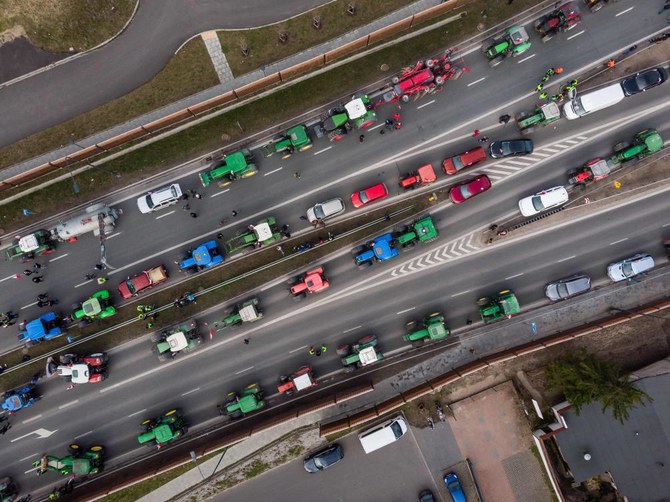
ZAKRET, Poland: Polish farmers on Wednesday blocked roads nationwide in a new protest against farm imports from outside the European Union, in particular Ukraine, and environmental regulations that they say increases costs.
The farmers have been blocking border crossings with Ukraine since last month to protest lower cost produce that has been allowed into the EU since Russia’s invasion of the neighboring country.
A demonstration in Warsaw this month by thousands of farmers degenerated into clashes with police.
Polish police said that more than 580 protests involving 70,000 people were planned Wednesday.
Farmers targeted roads into Warsaw and other big cities including Wroclaw, Poznan and Bydgoszcz.
Fifty-seven year old farmer Slawomir Miesak said protesters wanted the “the abolishment” of the European Union’s “Green Deal” policies aimed at helping the bloc meet its climate goals.
“That’s the priority. And we also want the closure of the border” with Ukraine, he told AFP in Zakret outside of Warsaw.
Fellow protester Przemyslaw Galazka, 33, said the agriculture industry needed more money.
“How long can we produce at a loss? The past two years have been difficult but the price of grain remained more or less stable, whereas now every farmer is asking himself whether it makes sense to go out in the fields and sow,” he told AFP.
Some protesters stalled traffic at the Ukraine frontier, briefly blocking buses waiting at the Medyka border crossing, which led to new frictions between the neighbors.
Ukraine’s infrastructure minister Oleksandr Kubrakov said the passengers had been “held hostage in the political confrontations.”
But Polish authorities said they had ensured the free flow of buses through the border.
Interior ministry spokeswoman Paulina Klimek told the PAP news agency that “police intervene to clear the crossing” whenever farmers attempt to block the frontier.
Ukraine’s agriculture sector has been crippled by Russia’s 2022 invasion, with many export routes through the Black Sea blocked and swaths of farmland rendered unusable by the conflict.
To help Kyiv, the European Union scrapped tariffs on Ukrainian goods transiting the 27-nation bloc by road.
But logistical problems mean large amounts of Ukrainian cereal exports destined for non-EU countries have accumulated in Poland, undercutting local producers.
On Wednesday, EU member states and lawmakers reached a deal to cap duty-free imports of some Ukrainian grains in response to the farmers’ complaints.
Poland’s Agriculture Minister Czeslaw Siekierski signed a preliminary agreement with farm groups on Tuesday on planned subsidies, regulating trade relations with Ukraine and other provisions.
But farmers still went ahead with the blockades.
“It’s a small glimmer of hope that something will finally happen,” said Roman Kondrow, one of the farming representatives who signed the document.
He told AFP that two key problems remain: wheat not suited for food production and should not be passing through the border, and up to five million tons of surplus grain that should be removed from Poland.
The border blockades and grain dispute have strained ties between Warsaw and Kyiv, even as Poland has shown its neighbor staunch support over Russia’s invasion.
Farmers in other European countries have also protested over the Ukraine grain and EU regulations.
On Wednesday, hundreds of tractor drivers carried out a slow-drive protest across the Czech Republic, and farmers blocked the Strazny border crossing with Germany for an hour.
The EU has proposed revamping subsidies in its Common Agricultural Policy (CAP), in a bid to ease the rural anger. The proposed changes are being negotiated between EU member states and the European Parliament.


![]()

Polish farmers block roads in new Ukraine imports protest
Short Url
https://arab.news/5s49g
Polish farmers block roads in new Ukraine imports protest
- The farmers have been blocking border crossings with Ukraine since last month to protest lower cost produce
- A demonstration in Warsaw this month by thousands of farmers degenerated into clashes with police


Latest updates


© 2026 SAUDI RESEARCH & PUBLISHING COMPANY, All Rights Reserved And subject to Terms of Use Agreement.