Israeli strikes target Hezbollah inside Syria

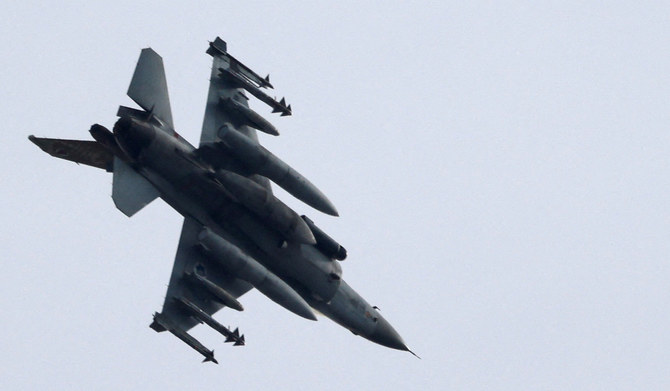
The strikes have increased since Israel's war with Palestinian militant group Hamas, a Hezbollah ally. (REUTERS)
Short Url
Updated 19 March 2024
Follow

Israeli strikes target Hezbollah inside Syria

  • Israel has launched hundreds of air strikes in Syria since civil war broke out in 2011, targeting Iran-backed forces including Hezbollah as well as Syrian army positions
  • Strikes have increased since Israel’s war with Hamas, a Hezbollah ally, began on October 7

BEIRUT: Israel launched missiles at several military targets outside the Syrian capital, Damascus, on Tuesday, Syria’s Defense Ministry said, in what regional intelligence and Syrian sources said were stepped-up strikes on fortifications of Lebanon’s Hezbollah.
Syrian air defenses intercepted Israeli “missiles and shot down some of them,” the ministry said in a statement, adding they caused only material damage.
Two Syrian military sources familiar with the strikes said Israel targeted a Hezbollah ammunition depot near the city of Yabroud in the Qalamoun Mountains, northeast of the Syrian capital.
It was the second strike within 48 hours on the same mountain range that spills over into Lebanon, where the heavily armed Hezbollah has several major supply routes into Syria.

BACKGROUND

Two Syrian military sources familiar with the strikes said Israel targeted a Hezbollah ammunition depot near the city of Yabroud in the Qalamoun Mountains, northeast of the Syrian capital.

Hezbollah and the Israeli military have been trading fire since Hamas stormed southern Israel from the Gaza Strip on Oct. 7, in a steadily intensifying conflict that has fueled concern of wider escalation.
Another strike hit a nearby location near Qutayfah, almost 40 km east of Damascus, within the same stretch of territory where Hezbollah forces are well entrenched, according to a Western intelligence source.
“These latest raids are targeting Hezbollah’s infrastructure in Syria, especially its elaborate fortifications along the Lebanese-Syrian border,” the source who requested anonymity told Reuters. He also referred to a recent strike on the city of Qusayr along the border where Hezbollah maintains security control with checkpoints. An Israeli military spokesperson was not immediately available for comment.
Iran has been a major backer of President Bashar Assad during Syria’s 13-year-old conflict.
Its support for Damascus and Hezbollah has drawn regular Israeli air strikes meant to curb Tehran’s extraterritorial military power.
The Israeli strikes in Syria have killed scores of Hezbollah and militia fighters drawn from a group of pro-Iranian proxy groups present in the eastern outskirts of Damascus and southern and southeastern Syria, Western and regional intelligence sources say.
They say since Oct.7 Israel has expanded both the nature of targets and territorial reach of its attacks to Syrian army encampments in Daraa province in the south, a source of sporadic mortars into Israel’s northern border.
The strikes have focused on the vicinity of the Al-Bukamal border crossing to the east in Deir Ezzor, a major supply route for Iraqi militias in and out of Syria.
Israel has also stepped its missile strikes into the heavily fortified Sayeda Zeinab neighborhood of the capital where a major shrine is located, and high-ranking militia leaders are known to have headquarters, both Syrian and Western intelligence sources say.
At least half a dozen Iranian Revolutionary Guards officers, mostly in the Sayeda Zainab area, along with several Hezbollah cadres were killed in the strikes.
Hezbollah says at least 20 of its fighters have been killed in Syria since Oct. 7.
The conflict marks the worst hostilities between Hezbollah and Israel since they fought a war in 2006, commonly known in Lebanon as “the July war.”


Hundreds flee to government-held areas in north Syria ahead of possible offensive

Updated 16 January 2026
Follow

Hundreds flee to government-held areas in north Syria ahead of possible offensive

  • Many of the civilians who fled used side roads to reach government-held areas
  • Men, women and children arrived in cars and pickup trucks that were packed with bags of clothes

DEIR HAFER, Syria: Scores of people carrying their belongings arrived in government-held areas in northern Syria on Friday ahead a possible attack by Syrian troops on territory held by Kurdish-led fighters east of the city of Aleppo.
Many of the civilians who fled used side roads to reach government-held areas because the main highway was blocked with barriers at a checkpoint that previously was controlled by the Kurdish-led and US-backed Syrian Democratic Forces, Associated Press journalists observed.
The Syrian army said late Wednesday that civilians would be able to evacuate through the “humanitarian corridor” from 9 a.m. to 5 p.m. Thursday. The announcement appeared to signal plans for an offensive against the SDF in the area east of Aleppo.
There were limited exchanges of fire between the two sides.
Men, women and children arrived in cars and pickup trucks that were packed with bags of clothes, mattresses and other belongings. They were met by local officials who directed them to shelters.
In other areas, people crossed canals on small boats and crossed a heavily damaged pedestrian bridge to reach the side held by government forces.
The SDF closed the main highway but about 4,000 people were still able to reach government-held areas on other roads, Syrian state TV reported.
A US military convoy arrived in Deir Hafer in the early afternoon but it was not immediately clear whether those personnel will remain. The US has good relations with both sides and has urged calm.
Inside Deir Hafer, many shops were closed and people stayed home.
“When I saw people leaving I came here,” said Umm Talal, who arrived in the government-held area with her husband and children. She added that the road appeared safe and her husband plans to return to their home.
Abu Mohammed said he came from the town of Maskana after hearing the government had opened a safe corridor, “only to be surprised when we arrived at Deir Hafer and found it closed.”
SDF fighters were preventing people from crossing through Syria’s main east-west highway and forcing them to take a side road, he said.
The tensions in the Deir Hafer area come after several days of intense clashes last week in Aleppo, previously Syria’s largest city and commercial center, that ended with the evacuation of Kurdish fighters from three neighborhoods north of the city that were then taken over by government forces.
The fighting broke out as negotiations stalled between Damascus and the SDF over an agreement reached in March to integrate their forces and for the central government to take control of institutions including border crossings and oil fields in the northeast.
The US special envoy to Syria, Tom Barrack, posted on X Friday that Washington remains in close contact with all parties in Syria, “working around the clock to lower the temperature, prevent escalation, and return to integration talks between the Syrian government and the SDF.”
The SDF for years has been the main US partner in Syria in fighting against the Daesh group, but Turkiye considers the SDF a terrorist organization because of its association with Kurdish separatist insurgents in Turkiye.