MAKKAH: They have reverberated through the Grand Mosque in Makkah for centuries — the soulful and soothing voices of muezzins calling the believers, and imams leading prayers five times a day.
Almukbariya in the Grand Mosque of Makkah is the place from which the muezzin, in his soulful voice, chants the adhan (the call to prayer). It is the place from which he repeats the Takbir al-Ihram (opening takbir), ruku (bowing), sujud (prostration) and the concluding prayers, in response to the imam’s prayers.
Almukbariya is distinguished by modern technologies, enabling the muezzin’s voice to be heard throughout the mosque and outside.

Pilgrims from around the world circumambulate the Holy Kaaba before sunset on the first day of fasting in Ramadan at the Grand Mosque in Makkah, last year. (Supplied)
The Presidency for the Affairs of the Two Holy Mosques told Arab News that Almukbariya’s importance lies in summoning hundreds of thousands of believers inside and around the Grand Mosque to prayer.
The muezzin arrives inside Almukbariya an hour before the call to prayer. For each prayer, there is a muezzin, a funeral prayer caller and a substitute muezzin.
HIGHLIGHTS
• The first call to prayer, at noon in the Grand Mosque, was delivered from the roof of the Kaaba by the Prophet Muhammad’s companion Bilal bin Rabah.
• Loudspeakers in the Grand Mosque were introduced for the first time in 1947 during the reign of King Abdulaziz.
The melodious and soulful sounds of the muezzins, young and experienced, reverberate through Almukbariya. The general presidency, represented by the Imams and Muezzins Affairs Agency, sets special schedules in which these muezzins alternate between the adhan and the iqamah.
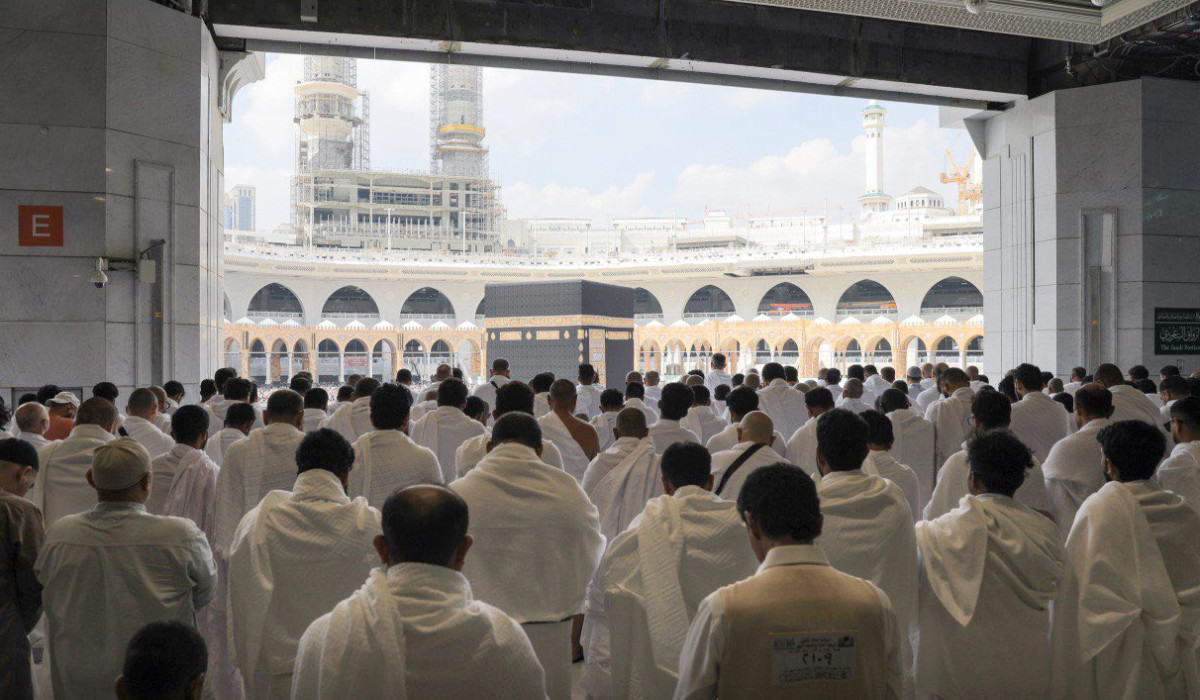
Pilgrims from around the world circumambulate the Holy Kaaba before sunset on the first day of fasting in Ramadan at the Grand Mosque in Makkah, last year. (Supplied)
Almukbariya cabin, which overlooks the mataf, has gone through several stages. It was demolished in 1337 AH (1958) due to the first Saudi expansion, moved to the “maqam Shafi’i” above the Zamzam Well until 1383 AH, and then to the southern mataf of the Kaaba until its construction was completed in 1397 AH.
Saad Al-Joudi, a researcher specializing in the history of Makkah, said that the first call to prayer, at noon in the Grand Mosque, was delivered from the roof of the Kaaba by the Prophet Muhammad’s companion Bilal bin Rabah. This was on the order of the prophet on the day of the conquest of Makkah in the year 630 (8 AH).
Al-Joudi added that Almukbariya is considered the “magnifying glass” of the Grand Mosque and that its many modern technologies allow the transmission of the muezzin’s voice across the mosque and beyond.

This picture taken on April 1, 2023 during the Muslim holy fasting month of Ramadan, from the Makkah Royal Clock Tower of the Abraj al-Bait skyscraper complex, shows an aerial view of Muslim worshippers around the Kaaba, the holiest shrine in the Grand Mosque complex in Saudi Arabia's holy city of Makkah. (AFP)
Loudspeakers in the Grand Mosque were introduced for the first time in 1947 during the reign of King Abdulaziz.
The late Makkan historian and writer Prof. Ahmed Ali Asad Allah Al-Kazemi said in his memoirs “The Daily Events in Makkah” that in 1947, Sheikh Abd Al-Zahir Abu Al-Samh, the imam and preacher of the Grand Mosque, asked Minister of Finance Abdullah bin Suleiman Al-Hamdan to provide loudspeakers and a microphone.
He wrote that in that year the speakers in the Grand Mosque were used for the Friday and Eid sermons, which fell on the same day. The sermon was usually delivered by Sheikh Abu Al-Samh’s son, Abdul Rahman, with only a few worshipers in the mosque able to hear. However, on Oct. 31, 1947, Sheikh Abu Al-Samh delivered the Friday sermon with a microphone heard by thousands of worshipers in the Grand Mosque.
In 1957, the speaker’s location was changed when the first expansion of the Mataf in the Grand Mosque took place. In 1963, the speakers were placed in a separate private building — the Almukbariya.
The building was designed for greater sound clarity to amplify the voices of the muezzins. There are also sound and television control rooms and studios, special waiting offices for muezzins and alternates, and rooms for public services. The Mataf and Kaaba can be seen from the southern part of the Almukbariya.