

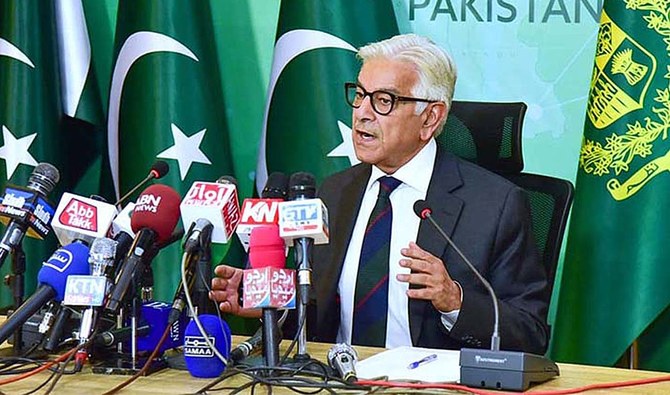

ISLAMABAD: Pakistan’s Defense Minister Khawaja Muhammad Asif said on Sunday that “terrorism” in the South Asian country was being conducted mostly from Afghanistan, a day after militants killed seven Pakistan Army soldiers in the country’s troubled northwestern province.
Pakistan has repeatedly blamed Afghan authorities for not cracking down against banned outfits that it alleges operate from Afghanistan and launch attacks against Pakistan’s security forces and civilians. Kabul denies the allegations and has repeatedly assured Islamabad it would not allow its soil to be used for attacks against any country.
Seven Pakistan Army soldiers, including two officers, were killed on Saturday when militants rammed an explosives-laden truck into a security forces’ checkpost in the restive northwestern tribal area of Mir Ali.
“Terrorism is being conducted mostly from Afghanistan against us,” Asif told reporters in Pakistan’s eastern city of Sialkot. “By people who are there but definitely they [terrorists] have sanctuaries here.”
Information Minister Ataullah Tarar accused former prime minister Imran Khan’s Pakistan Tehreek-e-Insaf (PTI) party of running a social media campaign against the army soldiers who were killed in Saturday’s attack. He alleged many social media accounts hurling insults at the slain soldiers were linked to the PTI and were being operated from outside Pakistan.
Khan’s PTI party condemned the attack in a statement on Sunday and prayed for the army soldiers killed in the attack. It demanded the government take stern action against the perpetrators of the attack.
Without naming the PTI, Asif said it was possible that those hurling insults at the deceased soldiers were the same ones providing militants sanctuaries in Pakistan.
“Several terrorists are coming through the border areas with Afghanistan in Khyber Pakhtunkhwa and Balochistan,” Asif said, adding that some of them are killed, others are caught but some manage to enter into Pakistani territory.
The minister said authorities in the past had traced militants’ sanctuaries in Pakistan and that Islamabad knew about their hideouts in Afghanistan as well.
“We have also raised this issue with Afghanistan,” he said.
The spike in militancy in Pakistan soured its relations with Afghanistan, leading Islamabad to initiate a deportation campaign against illegal immigrants, predominantly Afghans, in Nov. 2023. The move heightened tensions between the two countries further, as Afghanistan alleged Pakistani authorities mistreated Afghan citizens.
“The Afghan government does not want its citizens deported but Pakistan is a sovereign, independent country,” Asif said. “It can’t happen that 500,000-800,000 citizens of another country arrive here and start living here without documentation.”
He said Afghans who wanted to enter Pakistan could do so via valid travel documents such as passports and visas.
Asif’s allegations come a day after Pakistan’s newly appointed Foreign Minister Ishaq Dar expressed his preference to expand bilateral cooperation with neighboring Afghanistan in trade, counterterrorism and people-to-people contacts, in a telephonic conversation with his Afghan counterpart.


