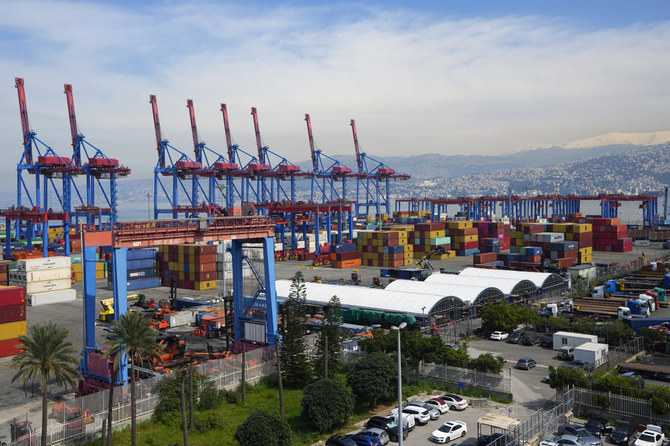
BEIRUT: Three and a half years after hundreds of tons of improperly stored ammonium nitrate ignited at the Beirut port, setting off one of the world’s biggest non-nuclear explosions, Lebanese and French officials put forward a plan for reconstruction and reorganization of the port Wednesday.
The Aug. 4, 2020, explosion at Beirut’s port killed more than 200 people, injured and displaced thousands and devastated entire neighborhoods of the city.
Since then, an investigation into the causes of the blast has ground to a halt, and reconstruction of the damaged areas has largely been carried out piecemeal with private funding as international funds promised for rebuilding were largely contingent on political reforms that never materialized.
A number of proposals that have been floated for reconstruction and redevelopment of the still-functioning port have floundered, including an ambitious plan suggested in 2021 by a group of German companies to redevelop the port alongside new commercial and residential developments.
In 2022, French shipping giant CMA CGM Group won a 10-year contract to run the container terminal at the port.
The French government funded the development of the plan presented Wednesday by two French engineering firms, Artelia and Egis. It will focus on rebuilding quays damaged in the explosion, reorganizing the port’s layout to streamline traffic, and shifting the facility to solar power. A French public agency, Expertise France, conducted an assessment with recommendations for improving security at the port.
Lebanon will need to come up with an estimated $60- $80 million to complete the reconstruction. It plans on using the port’s revenues which have been on the rise — after a slump amid the COVID-19 pandemic and Lebanon’s descent into an unprecedented economic crisis — reaching $150 million in 2023, the port’s Director General Omar Itani said at a press conference Wednesday.
The Lebanese Prime Minister Najib Mikati and French Ambassador to Lebanon also were also in attendance, along with representatives of the French companies.
Mikati told reporters that Lebanon and France have “strong historical relations that we are proud of,” referring to ties that go back to when the small Arab nation was a French protectorate after World War I until independence in 1943.
“We consider France’s support for Lebanon to be particularly important because it represents the heart of the international community,” he said.
Magro said rebuilding the Beirut port is one of France’s “priorities in our support for Lebanon.” He added: “The Lebanese economy indeed needs a reconstructed, modernized and secure port of Beirut.”
However, the plan presented Wednesday did not address the fate of the port’s massive grain silos, which had absorbed much of the shock of the explosion, effectively shielding the western part of Beirut from the blast.
The Lebanese government at one point planned to demolish the damaged silos but decided against it after families of the blast’s victims and survivors protested, demanding their preservation as a memorial and in case they might contain evidence useful for the judicial probe.
A large portion of the silos collapsed in 2022, while the remaining section has been left in place.


![]()

Lebanese, French officials float a plan to rebuild Beirut port nearly 4 years after huge explosion
Short Url
https://arab.news/gm6ev
Lebanese, French officials float a plan to rebuild Beirut port nearly 4 years after huge explosion
- The French government funded the development of the plan presented Wednesday by two French engineering firms, Artelia and Egis
- Lebanon will need to come up with an estimated $60- $80 million to complete the reconstruction


Latest updates


© 2026 SAUDI RESEARCH & PUBLISHING COMPANY, All Rights Reserved And subject to Terms of Use Agreement.