

Putin says goal of Ukraine’s attacks on Russia is to interfere with election, RIA reports as drones hit refinery

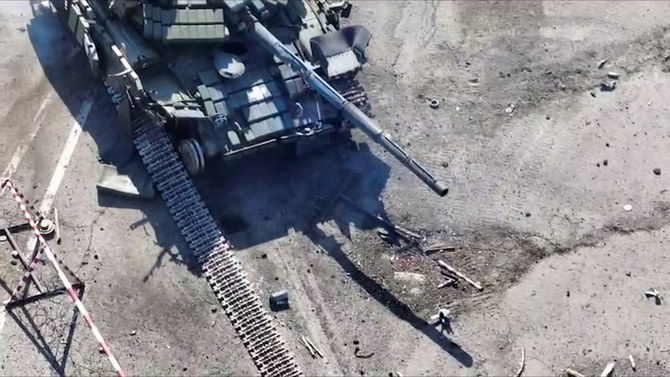
This grab taken from a handout footage released by the Russian Defence Ministry reportedly shows a destroyed military vehicle of the Ukrainian troops in the border area between Russia and Ukraine. (FILE/AFP)
Short Url
Updated 23 October 2025
Follow

Putin says goal of Ukraine’s attacks on Russia is to interfere with election, RIA reports as drones hit refinery

The main goal of Ukraine’s recent attacks on Russian regions is to interfere with the upcoming presidential election, President Vladimir Putin said in remarks published on Wednesday.
“The main goal, I have no doubt about it, is to - if not to disrupt the presidential elections in Russia - then at least somehow interfere with the normal process of expressing the will of citizens,” Putin told Russia's RIA state news agency and Rossiya-1 state television in a wide-ranging interview.
Putin, who launched a full-scale invasion of Ukraine two years ago, is nearly certain to win the March 15 to 17 presidential vote.

His comments came as drone strikes targeted Russia’s oil refineries for the second day in a row on Wednesday, with one sparking a fire and injuring several people after it struck a facility in the Ryazan region, officials said.
“The Ryazan oil refinery was attacked by a drone,” Pavel Malkov, the governor of the Ryazan region that lies some 200 kilometres southeast of Moscow, wrote on Telegram.
“According to preliminary information, there are injuries”, he wrote.
A fire broke out at the refinery following the strike and "all rescue services are working at the scene,” Malkov said.
A drone targeting another oil refinery in the Leningrad region near the second city of Saint Petersburg in northwest Russia was shot down, Alexander Drozdenko, the regional governor wrote on Telegram, adding there was no damage or victims.
On Tuesday, Ukraine launched one of its most significant drone strikes on Russia so far.
Two Russian energy sites, including one of the largest oil refineries some 800 kilometres from the border, were hit in the strikes, Russian officials said.
A major oil refinery in Kstovo, just outside the city of Nizhny Novgorod, was hit by a drone early on Tuesday morning, the regional governor said.
Another drone crashed into a fuel depot and started a fire in Oryol, around 160 kilometres from the border, according to the regional governor.

(With agencies)


EU parliament approves 90-bn-euro loan for Ukraine amid US cuts

Updated 5 sec ago
Follow

EU parliament approves 90-bn-euro loan for Ukraine amid US cuts

  • awmakers voted by 458 to 140 in favor of the loan, intended to cover two-thirds of Ukraine’s financial needs for 2026 and 2027

The EU parliament on Wednesday approved a 90-billion-euro loan for Ukraine, providing a financial lifeline to cash-strapped Kyiv four years into Russia’s invasion.
Lawmakers voted by 458 to 140 in favor of the loan, intended to cover two-thirds of Ukraine’s financial needs for 2026 and 2027 and backed by the EU’s common budget — after plans to tap frozen Russian central bank assets fell by the wayside.

Military aid to Ukraine hit its lowest level in 2025 as the US pulled funding, leaving Europe almost alone in footing the bill and averting a complete collapse, the Kiel Institute said Wednesday.
Kyiv's allies allocated 36 billion euros ($42.9 billion) in military aid in 2025, down 14 percent from 41.1 billion euros the previous year, according to Kiel, which tracks military, financial and humanitarian assistance pledged and delivered to Ukraine since Russia's full-scale invasion.
Military aid in 2025 was even lower than in 2022, despite the invasion not taking place until February 24 that year.
US aid came to a complete halt with President Donald Trump's return to the White House in early 2025.
Washington provided roughly half of all military assistance between 2022 and 2024.
European countries have thus made a significant effort to plug the gap, increasing their collective allocation by 67 percent in 2025 compared with the 2022-2024 average.
Without that effort, the US cuts could have been even more damaging, the institute argued.
However, the think tank points to "growing disparities" among European contributors, with Northern and Western European countries accounting for around 95 percent of military aid.
The institute calculated that Northern European countries (Denmark, Estonia, Finland, Iceland, Latvia, Lithuania, Norway, and Sweden) provided 33 percent of European military aid in 2025, despite accounting for only eight percent of the combined GDP of European donor countries.
Southern Europe, which accounts for 19 percent of the combined GDP of European donors, contributed just three percent.
To help fill the gap left by the United States, NATO launched the PURL programme, under which European donors purchased US weapons for Ukraine, worth 3.7 billion euros in 2025.
Kiel called the initiative a "notable development", which had enabled the acquisition of Patriot air-defense batteries and HIMARS multiple-launch rocket systems.
European allies are also increasingly placing orders with Ukraine's own defence industry, following a trend started by Denmark in 2024.
War-torn Ukraine's defence production capacity has "grown by a factor of 35" since 2022, according to Kiel, but Kyiv lacks the funds to procure enough weapons to keep its factories working at full capacity.
Orders from 11 European donor countries helped bridge that gap last year.
In the second half of 2025, 22 percent of weapons purchases for Ukraine were procured domestically, a record high.