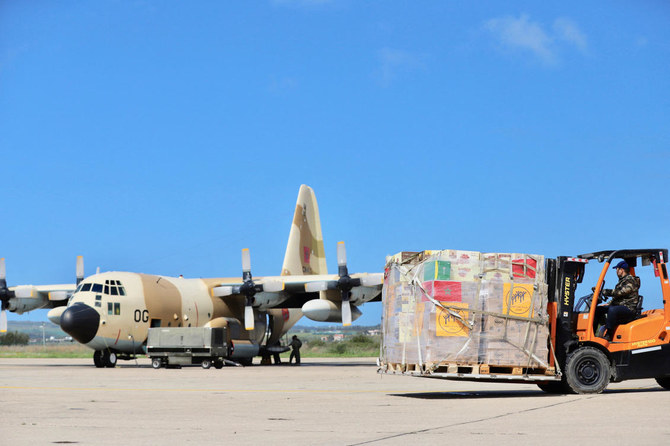
RABAT: Morocco has sent 40 tons of humanitarian supplies for Gaza via an Israeli airport, a diplomatic source said Tuesday, the latest bid to diversify aid routes into the war-battered territory.
The food aid has arrived at Ben Gurion airport near Tel Aviv before being transferred to the Palestinian Red Crescent at the Kerem Shalom crossing between Israel and Gaza, the Moroccan diplomatic source told AFP on condition of anonymity.
Rabat’s foreign ministry said in a statement that “Morocco is the first country to transport its humanitarian aid via this unprecedented land route.”
Since the war began on October 7, aid trucks have generally entered the Gaza Strip via Egypt.
Israeli officials were unable to immediately confirm whether the Moroccan initiative was the first such land route for foreign aid through Israeli territory.
The diplomatic source said Morocco’s ties with Israel, formalized in a US-brokered normalization pact in 2020, helped the operation go ahead.
“Morocco has always said that its relationship with Israel is intended to serve peace in the region and the interests of the Palestinians,” the source said.
The United Nations has repeatedly warned of looming famine in Gaza, under an Israeli siege imposed in the wake of Hamas’s October 7 attack that triggered the war, now in its sixth month.
Most aid enters through Rafah, on the Hamas-ruled territory’s southern border with Egypt, but UN and other relief agencies say only a fraction of the supplies needed to sustain Gaza’s population of 2.4 million people has made it in.
A Spanish charity boat carrying 200 tons of food aid to Gaza set sail on Tuesday from Cyprus in hopes of opening a maritime corridor to alleviate the dire humanitarian crisis.
Also on Tuesday, four US Army vessels left the United States, carrying equipment to build a temporary port on Gaza’s shores for aid deliveries.
The war started with the October 7 attack that resulted in about 1,160 deaths in Israel, mostly civilians, according to an AFP count based on official figures.
Israel’s retaliatory bombardment and ground offensive have killed 31,184 people in Gaza, mostly women and children, according to the territory’s health ministry.


![]()

Morocco inaugurates Gaza aid route via Israel
Short Url
https://arab.news/ghnf6
Morocco inaugurates Gaza aid route via Israel
- The food aid has arrived at Ben Gurion airport near Tel Aviv before being transferred to the Palestinian Red Crescent
- Rabat’s foreign ministry said in a statement that “Morocco is the first country to transport its humanitarian aid via this unprecedented land route”


Latest updates




© 2026 SAUDI RESEARCH & PUBLISHING COMPANY, All Rights Reserved And subject to Terms of Use Agreement.