

Bypassing Pakistan, Taliban set sights on Iranian port for access to international markets

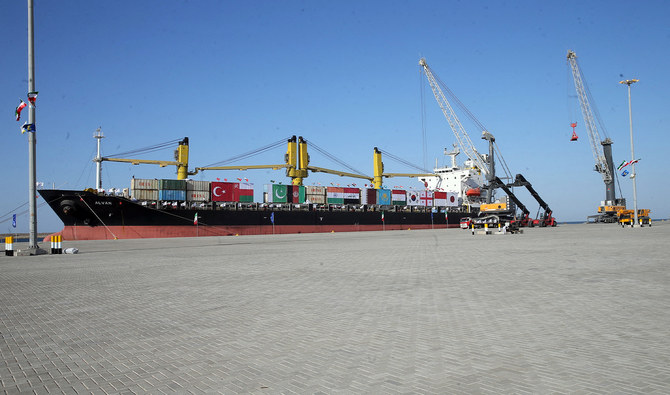
A handout picture provided by the office of Iranian President Hassan Rouhani on December 3, 2017 shows a ship bearing various flags parked at Chabahar (Shahid Beheshti) Port during the inauguraition of the first phase in the southern Iranian coastal city of Chabahar. (AFP/File)
Short Url
Updated 12 March 2024
Follow

Bypassing Pakistan, Taliban set sights on Iranian port for access to international markets

  • Taliban announced $35m investment in Chabahar port in February
  • Chabahar would decrease Afghanistan’s reliance on Pakistan’s Karachi

KABUL: Landlocked Afghanistan is setting its sights on the Iranian port of Chabahar for access to international markets, giving up on another neighbor, Pakistan, as its main trade route.

The Taliban administration in Kabul announced in late February a $35 million investment in the southern Iranian port, which next to Pakistan’s Gwadar and Karachi is for Afghanistan the closest access point to the Indian Ocean.

“Chabahar port is a vital point in trade and relations between Iran and Afghanistan and plays an important role in the development of economic, trade, and cultural cooperation between the two neighboring countries,” Abdul Salam Jawad Akhundzada, spokesperson of the Taliban-run Ministry of Industry and Commerce, told Arab News.

Iran does not officially recognize the Taliban administration in Kabul, but has sustained commercial and trade ties, in which Chabahar can become a vital feature.

The Taliban are hopeful it would help revive the economy that has been reeling under international sanctions since mid-2021 when they took power as US-led forces left Afghanistan after two decades of war.

“Afghanistan can use the Chabahar port for exports of agricultural products, foods, and industrial raw materials, while using it for transit for goods to and from neighboring countries and the wider region,” Akhundzada said.

“The use of this port can develop the transportation industry in Afghanistan. This includes the development of transportation infrastructure, increasing the efficiency and quality of transportation services, and increasing the ability to transit goods to other countries. Also, the use of Chabahar port can help attract foreign and domestic investment in various industries.”

The Taliban administration’s interest in Chabahar comes amid tensions with Pakistani authorities. The administration in Kabul has been accusing Pakistan of granting access to its port of Karachi as a political leverage.

“Most of our exports and imports were previously through Karachi port. Depending on a country that has been heavily involved in Afghanistan’s affairs in such a critical area was not the right thing for Afghanistan, particularly that the economy of the other country is closely tied with politics,” a close aide of Mullah Abdul Ghani Baradar Akhund, the deputy prime minister for economic affairs, told Arab News.

Relying on Karachi has also become more costly, due to various duties slapped on Afghan traders by Pakistani authorities. The turn to Chabahar would also reshape Afghanistan’s economic relations in the region, as India — Pakistan’s arch-rival — is one of the main investors in the port’s development.

“Pakistan increased the taxes on export, frequently delayed Afghan traders’ goods in the entry points, and regularly imposed fines on Afghan traders causing damage to their business,” Shafiqullah Elhami, former economic adviser to the Afghan presidential office, said.

“The shift from Karachi to Chabahar will mean that Iran becomes the first economic partner with Afghanistan’s market, preceding Pakistan. Chabahar will also increase India’s presence in the Afghan market, also in regional politics.”


Pakistan concludes 60-hour joint military exercise featuring 19 states, including Saudi Arabia, US

Updated 8 sec ago
Follow

Pakistan concludes 60-hour joint military exercise featuring 19 states, including Saudi Arabia, US

  • Exercise also featured participation from Turkiye, Uzbekistan, Bangladesh, Egypt, Jordan and Qatar, says military’s media wing
  • Says exercise is designed to enhance professional military skills through exchange of innovative ideas, tactical experiences

ISLAMABAD: A 60-hour-long joint military exercise organized by Pakistan’s army concluded this week at the eastern city of Kharian, featuring participation from 19 countries including Saudi Arabia and the US, the military’s media wing said. 

The 9th International Pakistan Army Team Spirit (PATS) Competition is a 60-hour-long patrolling exercise, which the Pakistani military says is designed to enhance professional military skills through the exchange of innovative ideas, tactical experiences and best practices among participating teams. 

The exercise was held from Feb. 5-9 in the semi-mountainous terrains of Pakistan’s eastern Punjab province, providing participants a “realistic and challenging operational environment.” Pakistan’s Chief of Defense Forces (CDF) Field Marshal Syed Asim Munir attended the closing ceremony of the exercise on Monday and presented awards to participants.

“Over the years, PATS has evolved into a prestigious and highly competitive military exercise, recognized for promoting professional excellence and mutual learning among participating nations,” the Inter-Services Public Relations (ISPR), the military’s media wing, said in a statement. 

“The forum continues to strengthen military-to-military cooperation and understanding, while fostering camaraderie and team spirit in a demanding operational setting.”

This year’s exercise featured participants from 19 countries including Saudi Arabia, Bahrain, Bangladesh, Belarus, Egypt, Iraq, Jordan, Malaysia, Maldives, Morocco, Nepal, Qatar, Sri Lanka, Turkiye, USA and Uzbekistan, the ISPR said.

Indonesia, Myanmar and Thailand attended the exercise as observers while 16 domestic teams from the Pakistan Army and Pakistan Navy, along with observers from the Pakistan Air Force also participated in the event.

Munir appreciated participating teams for their “exceptional professionalism, physical and mental endurance, operational competence and high morale” displayed during the exercise, the military’s media wing said.

“He emphasized the importance of such multinational engagements in enhancing collective preparedness and adapting to the evolving character of modern warfare,” the ISPR added. 

Pakistan routinely holds joint air, ground and sea exercises with regional countries and traditional allies to foster interoperability to counter threats to global peace.