

Despite price hikes, buyers throng to Pakistan’s largest and oldest dates market ahead of Ramadan

The picture taken on March 11, 2024 shows a shopkeeper selling dates ahead of holy month of Ramadan in Karachi, Pakistan. (AN photo)
Short Url
Updated 12 March 2024
Follow

Despite price hikes, buyers throng to Pakistan’s largest and oldest dates market ahead of Ramadan

  • Dealers say prices up by around 10% due to rain-related supply disruption, imposition of high duties by Iran
  • More than 90% of Pakistan’s date business depends on Ramadan when consumption increases substantially

KARACHI: Buyers were showing up in huge numbers to Pakistan’s largest and oldest dates market in Karachi ahead of the holy month of Ramadan, traders said, despite soaring prices and high tariffs imposed by neighboring Iran.

Nestled in the historic quarters of Lyari Town, the century-old Khajjoor Market, quiet through the year, becomes a hive of activity as Ramadan approaches. More than 90 percent of the date business in Muslim-majority Pakistan depends on Ramadan, with dates considered the most essential part of iftar, the first meal at sunset after fasting through the day. 

But this year, prices have been unusually high, mainly due to rains in Pakistan’s southwest that affected crops, currency devaluation and the imposition of high duties by Iran, a key supplier of dates to Pakistan, according to importers and dealers.

“This year, the dates prices are higher because of the rain-related destruction in Balochistan and freight charges have increased and at [Pakistan-Iran] border, GD [Goods Declaration] that is being converted in dollar, due to which its rates have increased,” Hanif Baloch, an importer and dealer, told Arab News. 

“The third reason is that Iran has increased tax to 200 percent, that is why its cost has increased,” Baloch added, saying the cost of dates had gone up by 10 percent compared to last year.

“CUT DOWN BUYING”

Pakistan is a major producer of dates, with annual production estimated to be around 500,000 metric tons. The main areas for date cultivation in Pakistan are Khairpur, Sukkur, and Nawabshah districts in the southern Sindh provinces, and Turbat, Panjgur, and Kech in the southwestern Balochistan province.
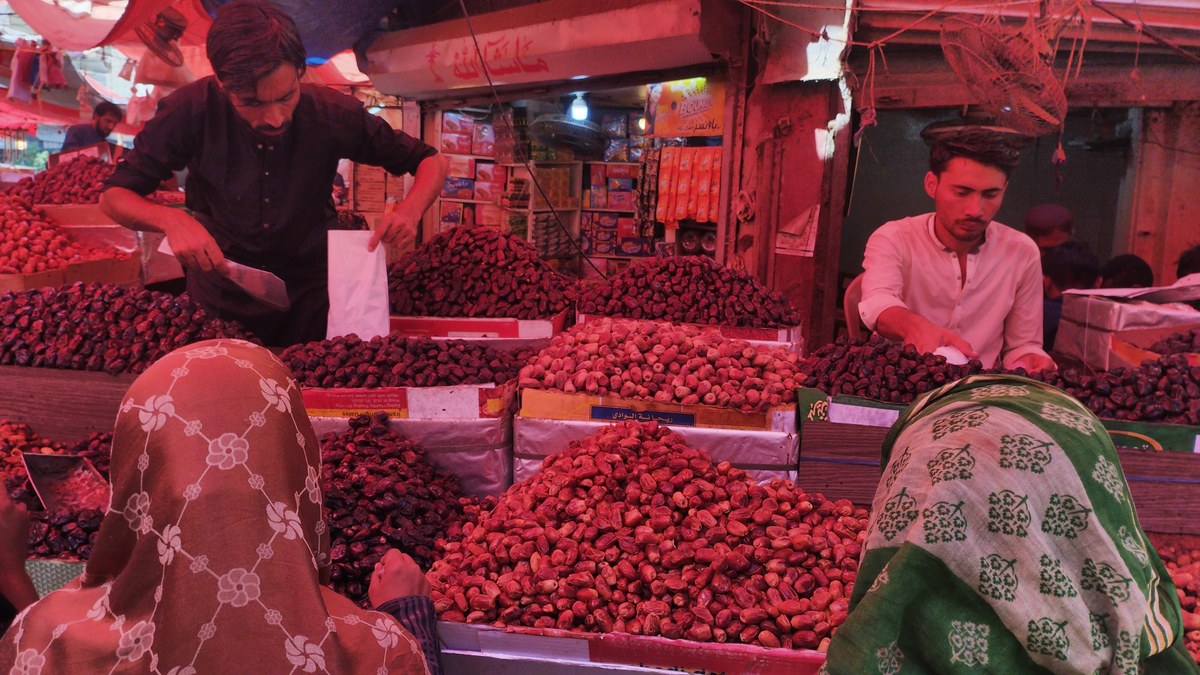


Women buy dates ahead of holy month of Ramadan in Karachi, Pakistan, on March 11, 2024. (AN photo)

But date producing parts of Sindh are still reeling from the effects of devastating floods in 2022, which destroyed large tracts of infrastructure and prime farmland and crops.

“That is why goods [dates] which were available for Rs20,000 have gone up to Rs26,000 per 40 kilograms,” Muhammad Sabir, chairman of the Khajjoor Market Association, told Arab News. 

Traders said the closure of the Pakistan-Iran border due to recent torrential rains in Pakistan’s southwest had also caused a shortage of dates in the market and driven up prices. 

“If the border is opened, it is hoped that yellow dates, Zahidi and Rabai [varieties that are widely grown in Iran] will start coming into Pakistan,” Sabir said.

Some popular date varieties and their per kilogram prices are Mazafati (Rs500-Rs600), Rabai (Rs600), Bayaram (Rs700), Zahidi (Rs400), and Basra (Rs350), according to the dealers.

Buyers at the market said they had cut down on buying to adjust to the price hikes.

“We have cut down our buying,” Nasreen Khatoon, a housewife, told Arab News. “We will wait for the market to cool down to buy more dates after the middle of Ramadan.”

Niaz Khan, a cloth merchant, said rates had increased significantly as compared to last year.

“I have checked the market and the rates have gone up,” Khan said. “The reasons are obvious,” he added, referring to the state of Pakistan’s economy. 

Pakistan, a nation of over 241 million people, is reeling from the impact of inflation that hit a historic high of 38 percent in May last year, but eased to 23.1 percent in February this year, still on the higher side mainly due to the high costs of energy and food.


Pakistani, Bangladeshi officials discuss trade, investment and aviation as ties thaw

Updated 28 December 2025
Follow

Pakistani, Bangladeshi officials discuss trade, investment and aviation as ties thaw

  • Pakistan and Bangladesh were once one nation, but they split in 1971 as a result of a bloody civil war
  • Ties between Pakistan, Bangladesh have warmed up since last year and both nations have resumed sea trade

ISLAMABAD: Pakistan's High Commissioner to Bangladesh Imran Haider on Sunday met Chief Adviser Muhammad Yunus in Dhaka, the latter's office said on, with the two figures discussing trade, investment and aviation.

Pakistan and Bangladesh were once one nation, but they split in 1971 as a result of a bloody civil war, which saw the part previously referred to as East Pakistan seceding to form the independent nation of Bangladesh.

Ties between Pakistan and Bangladesh have warmed up since former prime minister Sheikh Hasina’s ouster as a result of a student-led uprising in August 2024. Relations remain frosty between Dhaka and New Delhi over India’s decision to grant asylum to Hasina.

Pakistan has attempted to forge closer ties with Bangladesh in recent months and both South Asian nations last year began sea trade, followed by efforts to expand government-to-government commerce.

"During the meeting, both sides discussed ways to expand cooperation in trade, investment, and aviation as well as scaling up cultural, educational and medical exchanges to further strengthen bilateral relations between the two South Asian nations," Yunus's office said in a statement on X.

In 2023-24 Pakistan exported goods worth $661 million to Bangladesh, while its imports were only $57 million, according to the Trade Development Authority of Pakistan. In Aug. this year, the Pakistani and Bangladeshi commerce ministries signed a memorandum of understanding to establish a Joint Working Group on Trade, aiming to raise their bilateral trade volume to $1 billion in the financial year that began in July.

The Pakistani high commissioner noted that bilateral trade has recorded a 20 percent growth compared to last year, with business communities from both countries actively exploring new investment opportunities, according to the statement.

He highlighted a significant increase in cultural exchanges, adding that Bangladeshi students have shown strong interest in higher education opportunities in Pakistan, particularly in medical sciences, nanotechnology, and artificial intelligence. Haider also said that Dhaka-Karachi direct flights are expected to start in January.

"Chief Adviser Professor Muhammad Yunus welcomed the growing interactions between the two countries and emphasized the importance of increased visits as well as cultural, educational and people-to-people exchanges among SAARC (South Asian Association for Regional Cooperation) member states," the statement read.

"Professor Yunus also underscored the need to further boost Bangladesh–Pakistan trade and expressed hope that during Mr. Haider’s tenure, both countries would explore new avenues for investment and joint venture businesses."