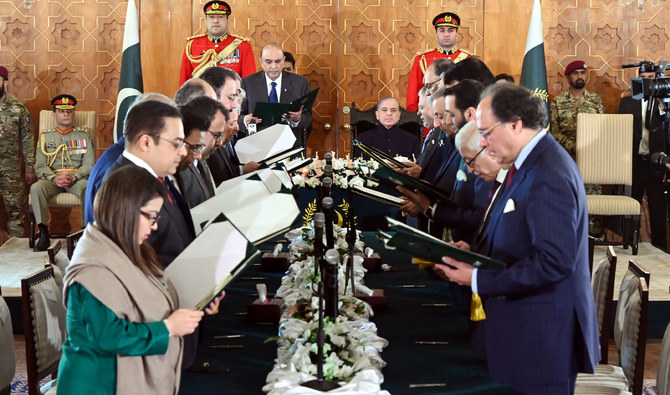

ISLAMABAD: Prime Minister Shehbaz Sharif’s new cabinet with 19 members took oath on Monday, tasked with running the South Asian country of 241 million people facing profound economic, political and security challenges.
Cash-strapped Pakistan has grappled with the Feb. 8 general election that threw up a hung National Assembly and delayed the formation of a coalition government until Sharif was sworn in last Monday.
“That, as Federal Minister (or Minister of State), I will discharge my duties, and perform my functions, honestly, to the best of my ability, faithfully in accordance with the Constitution of the Islamic Republic of Pakistan and the law, and always in the interest of the sovereignty, integrity, solidarity, well- being and prosperity of Pakistan,” the ministers said in an oath administered by President Asif Ali Zardari.
“That I will not allow my personal interest to influence my official conduct or my official decisions.”
Among those who took oath are senior members of Sharif’s Pakistan Muslim League-Nawaz (PML-N) party, including Khawaja Muhammad Asif, Ahsan Iqbal, Azam Nazeer Tarar, Ishaq Dar and Shaza Fatima Khawaja.
Former finance minister Dar, one of the most trusted aides of the Sharif family, is widely tipped to be appointed the country’s new foreign minister while Asif will get the defense portfolio.
Prominent banker Muhammad Aurangzeb, the president of HBL, Pakistan’s largest bank, is expected to become the new finance chief while Sharif loyalist Ataullah Tarar will lead the information ministry and Azam would handle the law ministry. Shaza Fatima Khawaja, who served as a special assistant to PM Sharif on youth affairs during his last term, will be IT minister as the only woman-member of the new set-up.
Media mogul Syed Mohsin Raza Naqvi, the current chief of the cricket board and a former chief minister of Punjab who is widely believed to be close to Pakistan’s all-powerful army chief, is slated to become the minister for interior. He had no political experience before being appointed CM Punjab for 13 months in January 2023.
“CHALLENGES”
Sharif’s new government will have to immediately get down to negotiating a bailout deal with the International Monetary Fund (IMF) as the current agreement expires this month. A new IMF program would mean committing to steps needed to stay on a narrow path to recovery, but which will limit policy options to provide relief to a deeply frustrated population and cater to industries that are looking for government support to spur growth.
The new government will also have to tackle a surge in militancy, with Balochistan and Khyber Pakhtunkhwa worst hit by attacks. The escalation in militant violence has led to a deterioration in Pakistan’s ties with neighboring Afghanistan, which borders KP, as Islamabad urges Kabul to rein in militants it says use Afghan soil to launch attacks in Pakistan. Afghanistan denies Pakistan’s allegations.
The government’s toughest challenge, however, would be on the political front.
Independent candidates backed by Khan gained the most seats, 93, after the elections, but Sharif’s Pakistan Muslim League-Nawaz (PML-N) and the Pakistan Peoples Party (PPP) of the Bhutto dynasty agreed to an alliance to form a coalition government. No single party won a majority.
The Sunni Ittehad Council backed by Khan alleges that the election was rigged against it and has called for an audit of the polls. Lowering political temperatures will thus be a key challenge for the new government as Khan maintains mass popular support in Pakistan, and a continued crackdown on his party and his remaining in jail would likely stoke tensions at a time when stability is needed to attract foreign investment to shore up the economy.
For now, the Khan-led opposition has signaled it would “cooperate” with the new government on issues of public concern but keep protesting the alleged manipulation of election results. Protests over the weekend saw over a hundred PTI leaders and supporters arrested, according to the party.
Sharif will also have to manage ties with the all-powerful military, which has directly or indirectly dominated Pakistan since independence. Unlike his elder brother, former PM Nawaz Sharif who has had a rocky relationship with the military in all his three terms, the younger Sharif is considered more acceptable and compliant by the generals, most independent analysts say. The military denies it interferes in political matters.