LONDON: A pro-Palestinian activist slashed a painting of the early 20th-century British foreign minister Arthur Balfour at Cambridge University on Friday, saying his 1917 declaration was the reason the Palestinians had lost their homeland to Israel.
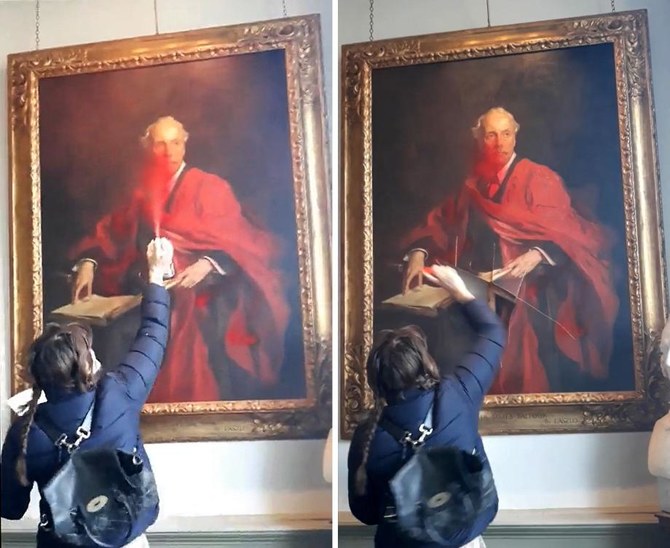
A video posted on social media by the Palestine Action protest group showed a woman spraying red paint over the life-size portrait before cutting it repeatedly with a knife — the latest in a flurry of protests prompted by the Israel-Hamas war.
Balfour’s declaration, made as Ottoman rule was crumbling in the Middle East and Britain a global power, said London would “view with favor the establishment in Palestine of a national home for the Jewish people” and work toward it — albeit without prejudicing “the civil and religious rights of existing non-Jewish communities.”
It was the first time a major power had publicly expressed support for a Jewish homeland, gave a boost to the growing worldwide Zionist movement — and shaped what was to become interim British “mandate” rule of Palestine from 1918 onward.
Palestinians have long demanded that Britain apologize for the 67-word statement.
British oversight of Palestine ended traumatically in 1947-48 with war between Jews and Arabs, the declaration of the State of Israel and the exodus of some 750,000 Palestinians who were forced out or fled.
“Balfour’s declaration began the ethnic cleansing of Palestine by promising the land away — which the British never had the right to do,” Palestine Action said in a caption accompanying the clip.
Last week, Prime Minister Rishi Sunak called for tougher policing of protests in light of an increase in hate speech.
His government has particularly alleged threatening behavior by some of those attending a wave of protests against the thousands of civilian deaths and the humanitarian crisis caused by Israel’s assault on the Gaza Strip.
Sunak said people had the right to protest, but could not use support for Gaza’s Palestinians to justify backing Hamas, the armed movement that rules Gaza, which Britain considers a terrorist group.
More than 30,000 Palestinians have been killed by Israel’s military since Oct. 7, when Palestinian militants led by Hamas killed 1,200 people in southern Israel and abducted 253, by Israeli counts.
Cambridge’s Trinity College said it regretted the damage, and that support was available for college members.


![]()

Activist slashes painting of British author of Jewish homeland declaration
Short Url
https://arab.news/2n4t9
Activist slashes painting of British author of Jewish homeland declaration
- A video posted on social media by the Palestine Action protest group showed a woman spraying red paint over the life-size portrait before cutting it repeatedly with a knife
- It was the first time a major power had publicly expressed support for a Jewish homeland


Latest updates


© 2026 SAUDI RESEARCH & PUBLISHING COMPANY, All Rights Reserved And subject to Terms of Use Agreement.