KARACHI: Senior female executives in Pakistan’s business sector said on Friday career continuity challenges were common for working women in the country, adding it was important for them to display perseverance and resilience amid obstacles to carry on with their professional journeys and fulfil their aspirations.
Much like the rest of the world, Pakistan observes International Women’s Day on March 8 to celebrate the social, economic, cultural and political achievements of women while calling for action to accelerate gender parity and women’s rights.
According to the Global Gender Gap Report of 2022, the South Asian nation of 241 million has a female population of about 49 percent, though only 4.5 percent of women are in senior managerial and legislative roles.
Pakistan has taken measures to bridge the gender divide by providing women access to banking services and encouraging their inclusion in the workforce. A survey conducted last year by Karandaaz, a nonprofit company promoting financial inclusion for individuals, showed the registration of businesses led by women with more than 10 employees increased to 44 percent.
Despite such government facilitation, Pakistani women business leaders say a number of challenges continue to persist.
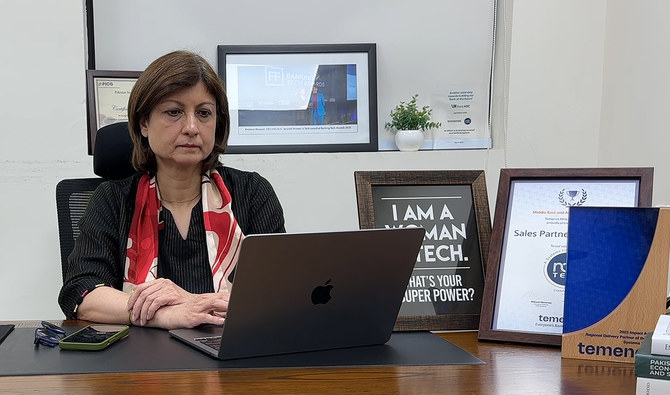
“Women give up their careers very easily,” Ammara Masood, who works as general manager with one of the country’s largest software export companies called Systems Limited, told Arab News. “Women often suffer in [maintaining the] continuity of their careers and sometimes they give up in between and then they never have the chance [to come back].”
With over 30 years of professional experience, Masood founded NdcTech, a technology company that was acquired by Systems Limited in 2022, a milestone she called “very significant.”
She said that she pursued a versatile career path that led her to explore information technology and consulting businesses along with entrepreneurship across three continents, including North America and Europe.
She maintained women had to work very hard to get recognition, especially at senior organizational levels.
Based on her experience, Masood advised Pakistan women to continue their professional journeys and never give up investing in their careers.
“My advice to women is that you have to stick it out and continue your career,” she added. “Your parents have invested in your education. You have invested so much in building up what you are and the economy needs you to grow.”
Sadaffe Abid, the founding CEO of another tech organization called CIRCLE, agreed that women in Pakistan faced many barriers including lack of Internet access in many cases.
“Men tend to be gatekeepers and we make the case to families that going digital is actually good for the family because when a woman starts earning, when she is setting up these nano, micro, small businesses and [leverages] Facebook, Instagram, WhatsApp for business, it’s generating income and better quality of life for everyone,” she said. “Pakistan faces one of the widest digital gender divides.”
CIRCLE is providing digital literacy, technology and entrepreneurship to women and so far helped about 15,000 women from places ranging from Chitral, Gilgit and Hunza to Jhang, Khanewal, Hyderabad and Rahim Yar Khan.
Maleeha Mimi Bangash, an expert in the banking and financial industry, emphasized the necessity for women to maintain a delicate balance between their professional endeavors and personal lives to thrive in the business world.
“I think every woman who is working has a home life,” she said, adding that women sometimes needed to prioritize their work and sometimes they had a pressing need to step away.
Bangash said the real challenges came during the mid- to senior-level of career progression, where despite achieving considerable success and recognition, a glass ceiling becomes apparent, hindering the advancement of many equally capable female colleagues who, despite their qualifications, find it harder to ascend to higher positions compared to their male counterparts.


![]()
![]()

Pakistani female executives highlight career challenges, advocate for resilience on Women’s Day

Short Url
https://arab.news/zv9v5
Pakistani female executives highlight career challenges, advocate for resilience on Women’s Day
- Only 4.5 percent women are in senior managerial and legislative roles in Pakistan despite 49 percent female population
- Female executives say women often give up their careers easily and later find it difficult to return to the same level
Latest updates







© 2026 SAUDI RESEARCH & PUBLISHING COMPANY, All Rights Reserved And subject to Terms of Use Agreement.