



TOKYO: Hiroshima and Nagasaki will forever be infamous as the first cities to be targeted by atomic weapons. Nearly 80 years since the world entered the nuclear age, however, both are keen to promote the more positive parts of their histories and some of their unique attractions.
There is no getting around the fact, however, that Hiroshima and Nagasaki are on travelers’ maps today largely because they were nearly wiped off them completely in 1945.
Hiroshima — less than five hours south-west of Tokyo by bullet train — is spread across the delta of the Ota River. A distinctive T-shaped bridge on the northern tip of one of the delta’s long, slender islands was the target of “Little Boy,” the bomb dropped by the Enola Gay B-29 Superfortress at 8.15 am on August 6, 1945.
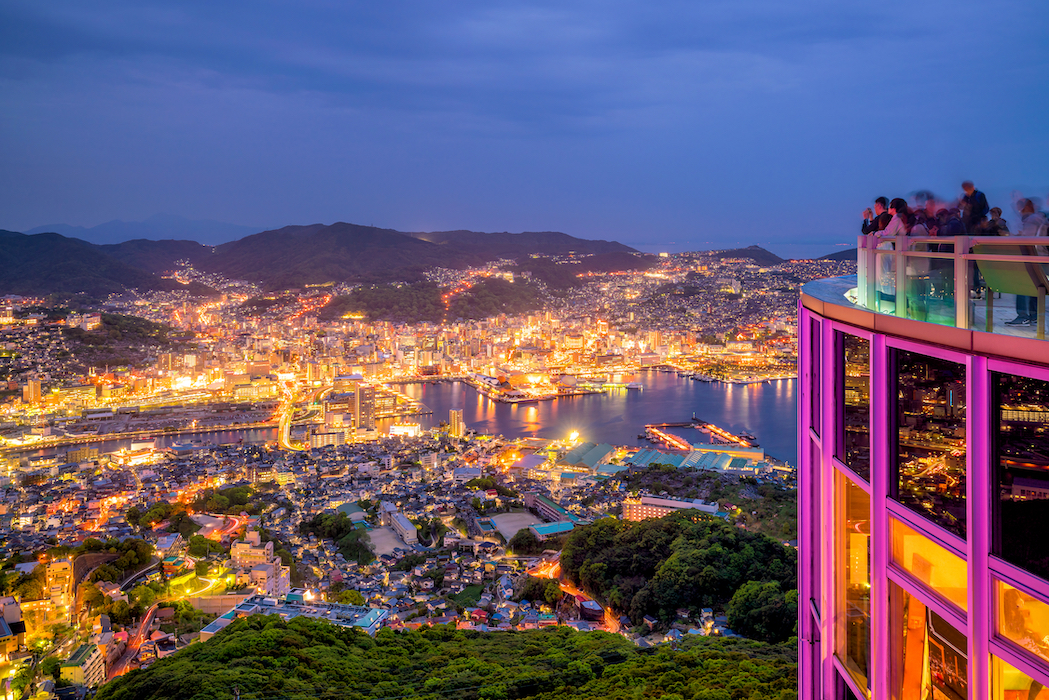
Nagasaki Skyline at night from Mount Inasa. (Shutterstock)
It detonated almost directly above the Hiroshima Prefectural Commercial Exhibition Hall, a steel-and-concrete structure that, while almost everything within the blast radius of several kilometers was destroyed, withstood the explosion. Its skeletal remains are today known as the A-Bomb Dome.
Just across one branch of the river is the Peace Memorial Park, home to the sobering Peace Memorial Museum where survivors’ tales are interspersed with artifacts such as melted glass or thick steel that was folded by the force of the blast. An eternal flame burns in a cenotaph in the gardens where commemorations are held every August.
Nearby is the famous Children’s Peace Monument, which depicts a girl with her arms outstretched and an origami paper crane above her. The model for the statue was Sadako Sasaki, who survived the bomb but was diagnosed with leukemia in 1954. In hospital, before her death in 1955, she folded more than 1,000 paper cranes which, according to Japanese lore, would grant her a wish.
Hiroshima Castle, once the base of local warlord Terumoto Mori, is well worth visiting, even if it is a reconstruction, the original having been destroyed by the bomb. Its spacious grounds are the best place in the city to enjoy the cherry blossoms during the brief spring “hanami” season.
A short boat journey away is the island of Itsukushima, a UNESCO World Heritage Site dotted with shrines and pagodas dating back centuries. It is most famous for the bright orange “torii” gate that stands in front of Itsukushima Shrine and appears to float above the water at high tide.
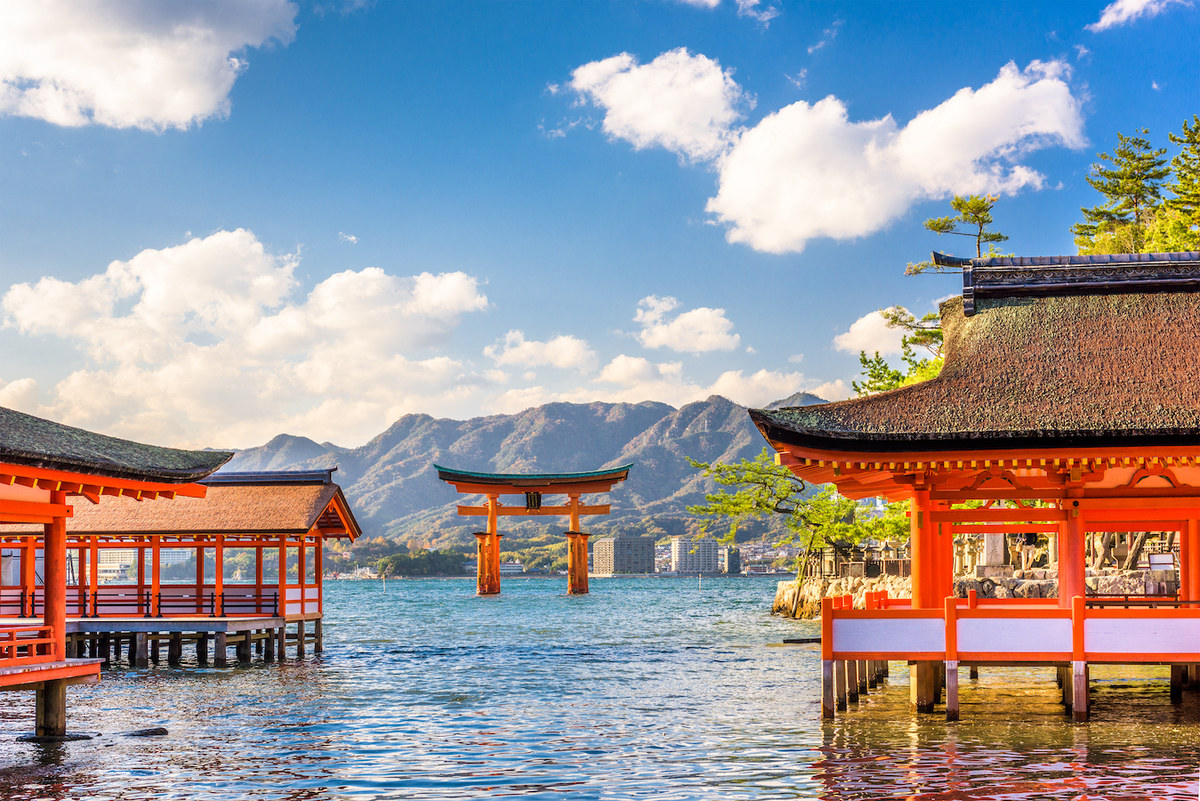
The 'floating' gate in front of Insukushima Shrine. (Shutterstock)
Around 400 kilometers to the west of Hiroshima, on the island of Kyushu, is Nagasaki, which — under the national-isolation policy of the Tokugawa shogunate — was once the only port in Japan where Portuguese and Dutch traders were permitted to come ashore and trade. This enabled Christian missionaries to gain a foothold in the mid-1500s, which led to hundreds of Japanese converts being executed.
As trade grew, so did Nagasaki’s importance. When Japan emerged from a second bout of isolation in the mid-1850s, Western concepts, engineering and technology flowed through the city and it became Japan’s center of shipbuilding, thanks in part to Scottish merchant Thomas Glover, who arrived in 1859, and swiftly became involved in the construction of ships and railways, and the import of, among other commodities, guns.
Glover’s luxurious former home sits on a bluff overlooking the harbor and the Mitsubishi Heavy Industries dockyards that are direct descendants of his ventures. A number of other historic buildings from the city’s foreign community have been preserved, giving a glimpse into the luxury in which expats lived at the time.
Nagasaki also has a thriving Chinatown district, which gets particularly raucous during New Year festivities, while Dejima has undergone extensive archeological investigation and reconstruction to return it to the fan-shaped isle that was built on the orders of the shogun in 1636, linked to the mainland by a footbridge to limit the early foreign traders’ interactions with locals.
A cable car can take you the 333 meters to the top of Mount Inasa, on the west side of the inlet, where the view is particularly spectacular at night. Further along the inlet, after it has become the Urakami River, is the spot that will forever connect Nagasaki to Hiroshima. Here stands a towering 10-meter statue of a man with his left hand extended in a gesture of peace while his other hand points to the skies.
The plutonium bomb, “Fat Man,” detonated 500 meters above this spot just after 11 a.m. on the morning of August 9, 1945. The man’s eyes are closed. The sculptor wanted him to appear to be in prayer for the dead.


