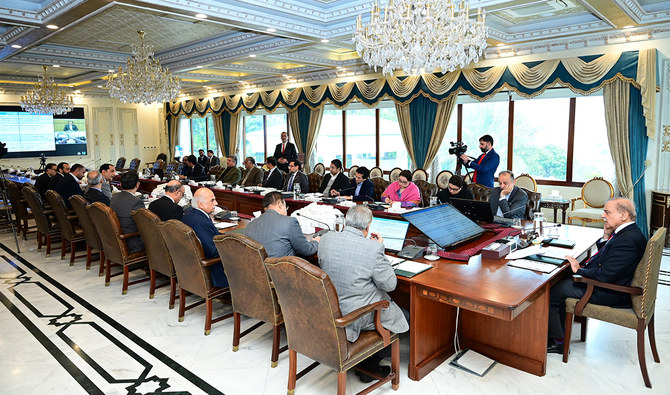

ISLAMABAD: Pakistani Prime Minister Shehbaz Sharif said on Thursday there was no room for more delays in the privatization process, as he met with officials of the Privatization Commission and the Ministry of Privatization to discuss the slated sale of loss-making public entities.
In the past, elected governments have shied away from undertaking unpopular reforms, including the sale of entities like Pakistan International Airlines, the flag carrier. But Pakistan, in deep economic crisis, agreed in June to overhaul loss-making state-owned enterprises under a deal with the International Monetary Fund (IMF) for a $3 billion bailout.
In September, the then caretaker government of Prime Minister Anwaar-ul-Haq Kakar vowed to improve governance at state-owned companies and earmarked 10 for privatization or turnaround efforts.
“There is already too much delay in this matter, no room for further delay,” PM Sharif was quoted as telling officials in a statement from his office. “Steps and goals should be presented with a clear time frame.”
He ordered the setting up of a review committee on the proposal to hand over loss-making power companies to provincial governments, and said it should submit its recommendations directly to the prime minister.
Sharif said the “entire responsibility” of the privatization process rested with the Privatization Commission and the Ministry of Privatization.
“If there are any problems, it is also the responsibility of the Ministry and the Privatization Commission to remove them. If there are capacity and efficiency issues, they should be addressed immediately,” the PM said.
“Transparency of the privatization process should be ensured at the institutional level and effective and tried and tested methods of international standards of monitoring should be adopted so that no one can lift a finger.”
At the meeting, the PM was briefed on the privatization of PIA, the House Building Finance Corporation, First Woman Bank, Roosevelt Hotel, Heavy Electrical Complex, power plants and distribution companies, Pakistan Steel Mills Corporation and other loss-making institutions.
“Progress made so far and the obstacles were reviewed in detail,” the PMO statement said.
PIA had liabilities of 785 billion Pakistani rupees ($2.81 billion) and accumulated losses of 713 billion rupees as of June last year. Its CEO has said losses in 2023 were likely to be 112 billion rupees.
Progress on privatization will be a key issue if the Sharif government goes back to the IMF once the current bailout program expires this month. Then Finance Minister Shamshad Akhtar told reporters last year that Pakistan would have to remain in IMF programs after the expiry.
Besides operational and technical measures for PIA’s divestment, the last caretaker government also amended a 2016 law that had blocked selling off its majority shares, according to a draft posted on the Pakistan parliament’s website.
In a report in mid-January, the IMF expressed satisfaction over measures initiated by the caretaker government to accelerate reforms of state-owned enterprises, specifically mentioning the amendment to the PIA privatization law.