

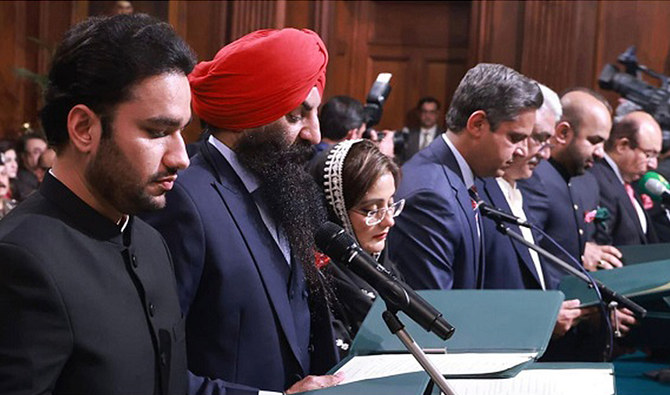
Pakistan appoints first Sikh minister as Ramesh Singh Arora takes oath

Pakistan Muslim League-Nawaz (PML-N) lawmaker Ramesh Singh Arora (2nd L) takes oath as a minister at the Provincial Assembly in Lahore, Pakistan on March 6, 2024.
Short Url
Updated 07 March 2024
Follow

Pakistan appoints first Sikh minister as Ramesh Singh Arora takes oath

  • 48-year-old hails from Narowal’s Kartarpur, is president of Pakistan Sikh Gurdwara Management Committee
  • Singh has been an MP three times before but this is the first time he has been given a ministerial portfolio

ISLAMABAD: Pakistan Muslim League-Nawaz (PML-N) lawmaker Ramesh Singh Arora was given the minorities portfolio in Punjab province this week, making him the first Sikh to be appointed a minister in Pakistan.

Arora, a three-time Member of the Provincial Assembly (MPA) from Narowal, on Wednesday joined the cabinet of recently sworn in Punjab Chief Minister Maryam Nawaf Sharif and was appointed as the provincial minister for minorities. 

Born in the city of Nakana Sahib in 1974, Arora has a postgraduate degree in entrepreneurship and SME Management from the Government College University and before joining politics had worked for the World Bank’s Poverty Reduction Programme in Pakistan. In 2008, he founded the Mojaz Foundation, which works to uplift the underprivileged and poor in Pakistan. He was recently also elected as chief of the Pakistan Sikh Gurudwara Parbandhak Committee (PSGPC).

“For the first time since partition [1947] a Sikh has been inducted into the cabinet of the Punjab province,” Arora said in an interview to the Indian Express. 

“I won’t just work for the safety and well-being of Sikhs but all minorities, including Hindus and Christians living in Pakistan.”

Explaining his plans as a minister for minorities he said:

“I have several plans for the welfare of minorities in Pakistan, especially Punjab. Though the Sikh Marriage Act was passed here, it is yet to be implemented. We will get it implemented. We will also bring a new Interfaith Harmony Policy so that all minorities, including Sikhs, Hindus, Christians and others, feel safe and secure. We will also ensure that the two percent quota for minority students in educational institutions of Pakistan is implemented in letter and spirit.”

Arora said his family had chosen to stay back in Pakistan instead of moving to India after partition.

“I was born in Nankana Sahib but later we moved to Narowal. My grandfather had chosen to stay back in Pakistan during the partition at the insistence of his dear friend,” the minister said. “Just for the sake of friendship, he had chosen to stay back.”

In Feb. 8 elections, Arora was re-elected as an MPA from Narowal, his hometown where Gurdwara Sri Kartarpur Sahib, the final resting place of Sikhism’s founder Guru Nanak, is located. Last year, he was also appointed as the “Ambassador at large” for the Kartarpur Corridor. 

Arora said it was unfortunate that over four years since the launch of the Kartarpur Corridor in November 2019 to facilitate pilgrims from India with visa-free access to the Gurdwara Sri Kartarpur Sahib, “the response has been lukewarm”.

“We will take all possible steps to encourage more people from India to visit Kartarpur via the corridor,” he said. 


Pakistan stresses increasing trade, economic engagement with Europe amid EU-India deal 

Updated 09 February 2026
Follow

Pakistan stresses increasing trade, economic engagement with Europe amid EU-India deal 

  • Deputy PM Ishaq Dar chairs meeting to review measures to strengthen Pakistan-EU economic and trade cooperation
  • Free trade agreement grants Indian exporters sweeping tariff-free access to EU, Pakistan’s second-largest export market

ISLAMABAD: Pakistan’s Deputy Prime Minister and Foreign Minister Ishaq Dar on Monday stressed the importance of deepening trade and economic engagement with the European Union (EU) amid the bloc’s recent free trade agreement with India. 

India and EU last month announced they had successfully concluded negotiations for a free trade agreement with the EU, which Indian Prime Minister Narendra Modi described as the “mother of all trade deals.” The agreement grants Indian exporters sweeping tariff-free access to the EU, Pakistan’s second-largest export market. European Commission President Ursula von der Leyen said the deal created a free trade zone of two billion people.

The main concern for Pakistan is that the India-EU deal may significantly reduce Islamabad’s tariff advantage under the EU’s Generalized Scheme of Preferences Plus, which allows duty-free access for many Pakistani exports in return for commitments on labor rights, human rights and governance. Pakistan’s foreign office, however, has said it continues to view its trade relationship with the EU, particularly under the GSP Plus framework, as mutually beneficial.

Dar chaired a high-level inter-ministerial meeting to review measures aimed at strengthening Pakistan’s economic and trade cooperation with EU on Monday, the foreign ministry said. 

“DPM/FM underscored the importance of deepening and expanding trade and economic engagement with the EU, noting that the EU remains a key economic partner for Pakistan, particularly under the GSP Plus framework,” the statement said. 

He highlighted that Pakistan has successfully completed four biennial GSP Plus reviews, reaffirming Islamabad’s commitment to fully meeting its obligations under the scheme to expand mutually beneficial trade opportunities.

The meeting was attended by the federal minister of law and senior officials as well as Pakistan’s ambassador to the EU. 

The development takes place as Pakistan’s exports dwindle. After rising 5 percent to $32.1 billion last fiscal year, the Pakistan Bureau of Statistics reported that exports fell 9 percent to $15.2 billion in the first half of the current year through December. 

Pakistani industrialists and financial analysts have urged the government to reduce domestic production costs, particularly high power tariffs. EU accounts for a substantial share of Pakistan’s exports, particularly textiles and garments. 

“The EU-India FTA will have a definite impact on Pakistan’s textile exports to the EU,” said Shankar Talreja, the head of research at Karachi-based Topline Securities Ltd, told Arab News last month. 

“Pakistani companies’ competitive advantage to compete against a giant like India needs to be restored in the form of regionally aligned energy tariffs and policy certainty.”