

US says welcomes ‘productive and peaceful’ India-Pakistan talks on Kashmir

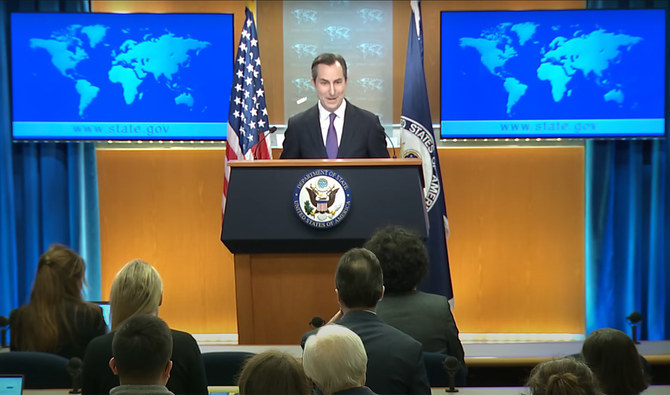
US State Department Spokesperson Matthew Miller addresses a press briefing at the Department of State, in Washington, US, on February 12, 2024. (US State Department)
Short Url
Updated 07 March 2024
Follow

US says welcomes ‘productive and peaceful’ India-Pakistan talks on Kashmir

  • Pakistan and India have fought two wars, engaged in numerous clashes over the Himalayan region since 1947
  • Relations have been particularly tense since 2019 when Modi’s government revoked the special status of Kashmir

ISLAMABAD: The US State Department said on Wednesday it welcomed “productive and peaceful talks” between Islamabad and New Delhi on disputed Kashmir, after Indian Prime Minister Narendra Modi congratulated Shehbaz Sharif on taking oath as Pakistan’s new premier.

Kashmir is claimed in full, but controlled only in part, by nuclear-armed India and Pakistan, which have fought two wars and engaged in numerous clashes over the Himalayan region since 1947.

Relations have been particularly tense since 2019 when Modi’s government revoked the special status of Kashmir and split the region into two federally administered territories, provoking outrage in Pakistan and the downgrading of diplomatic ties and suspension of bilateral trade.

“The United States values its relationship with both India and Pakistan, and we want to see them have a productive and peaceful relationship,” US State Department Spokesman Matthew Miller said when questioned about Modi’s congratulatory message for Sharif.

When asked if the US would welcome future talks between India and Pakistan on all issues, including Kashmir, Miller added:

“Of course we would welcome productive and peaceful talks between India and Pakistan, but the pace, scope, and character of any dialogue is a matter for India and Pakistan to determine.”

Media has widely reported that the two governments have re-opened a back channel of diplomacy since 2021, aimed at a modest roadmap to normalizing ties.

Both countries have reasons to seek a rapprochement. India has been locked in a border stand-off with China and does not want the military stretched on the Pakistan front.

China-ally Pakistan, mired in economic difficulties and on an IMF bailout program that expires this month, can ill-afford heightened tensions on the Kashmir border for a prolonged period, especially as it also faces problems of cross-border militants on its frontiers with Afghanistan and Iran. 


Pakistan says responding to Afghan ‘offensive operations’ after border fire as tensions escalate

Updated 26 February 2026
Follow

Pakistan says responding to Afghan ‘offensive operations’ after border fire as tensions escalate

  • Afghan Taliban spokesperson says “large-scale offensive operations” launched against Pakistani military bases
  • Pakistan says Afghan forces opened “unprovoked” fire across multiple sectors along shared border

ISLAMABAD: Afghanistan’s Taliban authorities said on Thursday they had launched “large-scale offensive operations” against Pakistani military bases and installations, prompting Pakistan to say its forces were responding to what it described as unprovoked fire along the shared border.

The escalation follows Islamabad’s weekend airstrikes targeting what it said were Tehreek-e-Taliban Pakistan (TTP) and Daesh militant camps inside Afghanistan in response to a wave of recent bombings and attacks in Pakistan. Islamabad said the strikes killed over 100 militants, while Kabul said dozens of civilians were killed and condemned the attacks as a violation of its sovereignty.

In a post on social media platform X, Afghan government spokesperson Zabihullah Mujahid said Afghanistan had launched “large-scale offensive operations” in response to repeated violations by the Pakistani military.


Pakistan’s Ministry of Information said Afghan forces had initiated hostilities along multiple points of the frontier.

“Afghan Taliban regime unprovoked action along the Pakistan–Afghanistan border given an immediate, and effective response,” the ministry said in a statement.

The statement said Pakistani forces were targeting Taliban positions in the Chitral, Khyber, Mohmand, Kurram and Bajaur sectors, claiming heavy Afghan casualties and the destruction of multiple posts and equipment. It added that Pakistan would take all necessary measures to safeguard its territorial integrity and the security of its citizens.


Separately, security officials said Pakistani forces had carried out counterattacks in several border sectors.

“Pakistan’s security forces are giving a befitting reply to the unprovoked Afghan aggression with full force,” a security official said, declining to be named. 

“The Pakistani security forces’ counter-attack destroyed Taliban’s hideouts and the Khawarij fled,” they added, referring to TTP militants. 

The claims from both sides could not be independently verified.

Cross-border violence has intensified in recent weeks, with Pakistan blaming a surge in suicide bombings and militant attacks on militants it says are based in Afghanistan. Kabul denies providing safe havens to anti-Pakistan militant groups.

The clashes mark the third major escalation between the neighbors in less than a year. Similar Pakistani strikes last year triggered weeklong clashes before Qatar, Türkiye and other regional actors mediated a ceasefire in October.

The 2,600-kilometer (1,600-mile) frontier, a key trade and transit corridor linking Pakistan to landlocked Afghanistan and onward to Central Asia, has faced repeated closures amid tensions, disrupting commerce and humanitarian movement. Trade between the two nations has remained closed since October 2025.