Chief of Pakistan’s largest bank likely to be included in new finance team

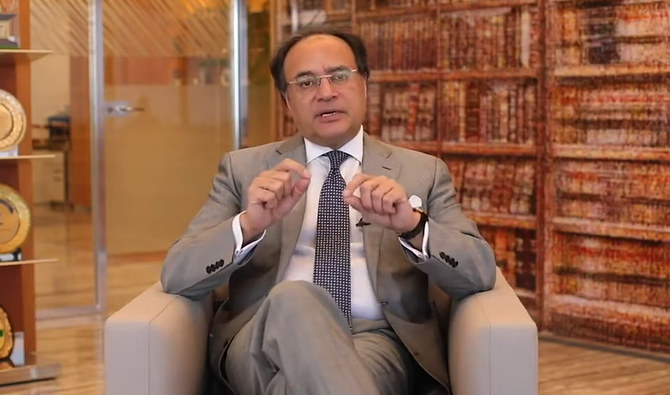
In this screengrab, taken on March 5, 2024 from Pakistan Expo 2020’s YouTube video posted on October 5, 2021, Pakistani banker Muhammad Aurangzeb speaks on about investment opportunities in the country in Karachi. (Photo courtesy: YouTube/ @PakistanExpo)
Short Url
Updated 05 March 2024
Follow

Chief of Pakistan’s largest bank likely to be included in new finance team

  • Pakistan urgently needs a fresh IMF deal to shore up its struggling economy, suffering from high inflation, low reserves and financing needs
  • Muhammad Aurangzeb, currently CEO of HBL, is likely to be appointed Special Assistant to the Prime Minister on Finance, two sources say

ISLAMABAD: The chief executive officer of Pakistan’s largest bank, HBL, is likely to be tapped for a top position in the finance team of newly elected Prime Minister Shehbaz Sharif, two sources told Reuters, ahead of talks with the IMF for a fresh bailout deal.
Pakistan urgently needs a fresh IMF agreement to shore up its struggling $350 billion economy which is suffering from high inflation, low reserve and high external financing needs.
Muhammad Aurangzeb, currently the CEO of HBL, is likely to be appointed Special Assistant to the Prime Minister on Finance, two sources said — one in the finance ministry and the other with direct knowledge of discussions.
A final decision is yet to be taken. Sharif has to pick a cabinet after being sworn in on Monday — most importantly a finance team, with Pakistan’s current $3 billion, nine-month IMF program expiring next month.
Spokespeople for Sharif’s party and HBL did not immediately respond to requests for comment.
Local broadcaster Geo News also reported that Aurganzeb would get the post of finance minister, citing sources close to the prime minister, but the banker does not have a seat in parliament which is required by law to become a full minister.
It was not immediately clear if Aurangzeb, even as special assistant, would be the de facto finance tsar with Sharif or someone else holding the additional portfolio of finance minister.
Aurangzeb had also served as the CEO of JP Morgan’s Global Corporate Bank based in Asia, and has extensive experience working with global markets.
Besides the IMF deal, Pakistan also needs to attract foreign investment to bring in funds to shore up its low reserves, which are critical to meeting a large external financing needs, as well as kick starting its flagging economy.
After taking the oath, Sharif immediately met finance officials and advisers, directing them to open talks with the IMF for an Extended Fund Facility — a long tenure package which analysts say is mandatory to save the country from default.
Aurangzeb was a part of that meeting, a video of the gathering shared with journalists by the government’s information team showed.


Pakistan army chief says future warfare will rely on technology over battlefield maneuvers

Updated 8 sec ago
Follow

Pakistan army chief says future warfare will rely on technology over battlefield maneuvers

  • Asim Munir cites drones, electronic warfare and surveillance as central to future war operations
  • Remarks follow Pakistan’s 2025 military conflict with India that highlighted role of technology

ISLAMABAD: Pakistan’s army chief said on Thursday future conflicts would be shaped more by technology than traditional battlefield maneuvers, as the military accelerates its shift toward drone warfare, electronic systems and networked command structures, according to a statement issued by the Pakistan military.

Field Marshal Syed Asim Munir, who also serves as Chief of Defense Forces, made the remarks while visiting the Bahawalpur Garrison in southern Punjab, where he observed a high-intensity field exercise focused on integrating new technologies into conventional military operations, the Inter-Services Public Relations (ISPR) said.

The exercise, titled Steadfast Resolve, involved unmanned aerial systems, advanced surveillance assets, electronic warfare capabilities and modern command-and-control mechanisms, reflecting what the military described as a move toward “technology-enabled multi-domain operations.”

“Character of war has evolved massively, with technological advancements driving the evolution, dictating huge mental transformation at all tiers,” Munir said while addressing troops, according to the ISPR statement.

“In future, technological maneuvers will replace physical maneuvers and will fundamentally alter the way offensive and defensive operations are undertaken,” he added.

Militaries worldwide are reassessing combat doctrine as drones, electronic warfare and real-time data increasingly shape outcomes on modern battlefields. In South Asia, those shifts gained renewed attention following military exchanges between Pakistan and India in May 2025, when both sides employed surveillance, electronic countermeasures and precision capabilities alongside conventional forces, underscoring the growing role of non-kinetic domains.

Munir said the Pakistan army was “embracing and absorbing technology at a rapid pace,” adding that “innovation, indigenization and adaptation shall remain fundamental” as the military prepares for future battlefield and security challenges.

The army chief also reiterated that Pakistan’s armed forces remained prepared to defend the country’s sovereignty and territorial integrity, while emphasizing the need to maintain readiness as warfare increasingly expands across physical, cyber and electronic domains.