JERUSALEM: Israeli defense minister Yoav Gallant said on Tuesday the continuing tension with Iran-backed Hezbollah at the border with Lebanon was moving the situation nearer to a military escalation.
Israel and Hezbollah have been trading fire since the Palestinian group Hamas attacked Israel on Oct. 7, fueling concern about the danger of all-out war between the heavily armed adversaries.
“We are committed to the diplomatic process, however Hezbollah’s aggression is bringing us closer to a critical point in the decision-making regarding our military activities in Lebanon,” Gallant said in a statement after meeting US envoy Amos Hochstein, who is seeking a mediated end to that conflict.
Hezbollah has indicated it will cease fire if Israel’s offensive in the Gaza Strip stops, describing its campaign as aimed at supporting Palestinians under fire in Gaza.
But visiting Beirut on Monday, Hochstein warned that a truce in Gaza would not necessarily bring an automatic end to hostilities across Lebanon’s southern border.
He said a temporary ceasefire was not enough and a limited war was not containable.
Mediators have been seeking to clinch a 40-day ceasefire in the Gaza war in time for the Ramadan Muslim fasting month, which begins at the start of next week.
Much of the violence between Israel and Hezbollah has played out near the border, with notable exceptions including a Feb. 26 Israeli airstrike in the Bekaa Valley, and a Jan. 2 Israeli drone strike in Beirut that killed a top Hamas leader.
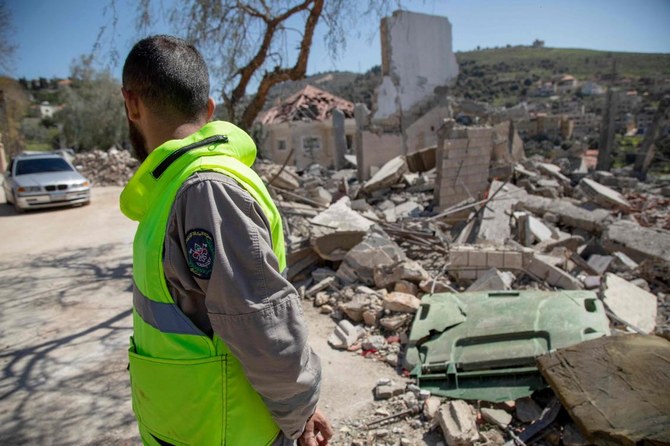
In violence on Monday, an Israeli strike killed three emergency workers from a group affiliated with Hezbollah, the Lebanese government said, and a civilian was killed in northern Israel by an attack from Lebanon.
Israeli strikes since October have killed more than 200 Hezbollah fighters and some 50 civilians in Lebanon, while attacks from Lebanon into Israel have killed a dozen Israeli soldiers and six civilians. Tens of thousands of Israelis and Lebanese have fled villages on both sides of the frontier.

Israeli defense minister says Hezbollah aggression bringing critical point nearer
https://arab.news/43ncu
Israeli defense minister says Hezbollah aggression bringing critical point nearer
- “Hezbollah’s aggression is bringing us closer to a critical point in the decision-making regarding our military activities in Lebanon,” Gallant said
- Hezbollah has indicated it will cease fire if Israel’s offensive in the Gaza Strip stops
First responders enter devastated Aleppo neighborhood after days of deadly fighting
- The US-backed SDF, which have played a key role in combating the Daesh group in large swaths of eastern Syria, are the largest force yet to be absorbed into Syria’s national army
ALEPPO, Syria: First responders on Sunday entered a contested neighborhood in Syria’ s northern city of Aleppo after days of deadly clashes between government forces and Kurdish-led forces. Syrian state media said the military was deployed in large numbers.
The clashes broke out Tuesday in the predominantly Kurdish neighborhoods of Sheikh Maqsoud, Achrafieh and Bani Zaid after the government and the Syrian Democratic Forces, the main Kurdish-led force in the country, failed to make progress on how to merge the SDF into the national army. Security forces captured Achrafieh and Bani Zaid.
The fighting between the two sides was the most intense since the fall of then-President Bashar Assad to insurgents in December 2024. At least 23 people were killed in five days of clashes and more than 140,000 were displaced amid shelling and drone strikes.
The US-backed SDF, which have played a key role in combating the Daesh group in large swaths of eastern Syria, are the largest force yet to be absorbed into Syria’s national army. Some of the factions that make up the army, however, were previously Turkish-backed insurgent groups that have a long history of clashing with Kurdish forces.
The Kurdish fighters have now evacuated from the Sheikh Maqsoud neighborhood to northeastern Syria, which is under the control of the SDF. However, they said in a statement they will continue to fight now that the wounded and civilians have been evacuated, in what they called a “partial ceasefire.”
The neighborhood appeared calm Sunday. The United Nations said it was trying to dispatch more convoys to the neighborhoods with food, fuel, blankets and other urgent supplies.
Government security forces brought journalists to tour the devastated area, showing them the damaged Khalid Al-Fajer Hospital and a military position belonging to the SDF’s security forces that government forces had targeted.
The SDF statement accused the government of targeting the hospital “dozens of times” before patients were evacuated. Damascus accused the Kurdish-led group of using the hospital and other civilian facilities as military positions.
On one street, Syrian Red Crescent first responders spoke to a resident surrounded by charred cars and badly damaged residential buildings.
Some residents told The Associated Press that SDF forces did not allow their cars through checkpoints to leave.
“We lived a night of horror. I still cannot believe that I am right here standing on my own two feet,” said Ahmad Shaikho. “So far the situation has been calm. There hasn’t been any gunfire.”
Syrian Civil Defense first responders have been disarming improvised mines that they say were left by the Kurdish forces as booby traps.
Residents who fled are not being allowed back into the neighborhood until all the mines are cleared. Some were reminded of the displacement during Syria’s long civil war.
“I want to go back to my home, I beg you,” said Hoda Alnasiri.