World Health Organization: child malnutrition ‘particularly extreme’ in north Gaza

1 / 2
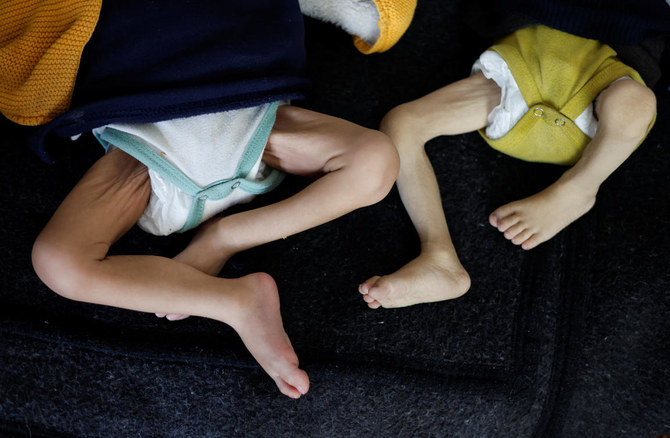
Palestinian children suffering from malnutrition receive treatment at a healthcare center, amid widespread hunger, as the conflict between Israel and Hamas continues, in Rafah, in the southern Gaza Strip. (Reuters)
2 / 2
Palestinian boy Ahmed Qannan, who is suffering from malnutrition, is attended to at a healthcare center, amid widespread hunger, as the conflict between Israel and Hamas continues, in Rafah, in the southern Gaza Strip. (Reuters)
Short Url
Updated 05 March 2024
Follow

World Health Organization: child malnutrition ‘particularly extreme’ in north Gaza

  • One-in-six children acutely malnourished in northern Gaza, WHO says
  • Infectious diseases posing an increasing risk among Gaza’s children

GAZA: United Nations organizations said on Tuesday that child malnutrition levels in northern Gaza were “particularly extreme” and about three times higher than in the south of the Palestinian enclave where more aid has been available.
Richard Peeperkorn, WHO representative for Gaza and the West Bank, said that one-in-six children under two years of age were acutely malnourished in northern Gaza.
“This was in January. So the situation is likely to be greater today,” Peeperkorn added, referring to when the data was recorded.
UNICEF spokesperson James Elder said malnutrition rates for children under five in northern Gaza, where access to aid has been highly limited since the start of the war between Israel and Hamas on Oct. 7, were three times higher than those in Rafah in the south
Elder said this showed that “when that trickle of aid can come in, it does make a life saving difference.”
At least 15 children have died over the past few days from malnutrition and dehydration at Kamal Adwan hospital in northern Gaza, the health ministry in Gaza said on Sunday.
Calls for Israel to do more to address the humanitarian crisis have grown louder since the deaths of Palestinians lining up for aid in Gaza last month.
Gaza health authorities said 118 people were killed, attributing the deaths to Israeli fire and calling it a massacre. Israel, which says many people were trampled or run over, has pledged to investigate.
Adding to hunger, there is a growing risk from infectious diseases, with nine-in-10 children under the age of five — around 220,000 — falling sick over the last weeks, according to Elder.
“That becomes the spiral that we are so fearful of: infectious diseases, lack of food, a desperate lack of clean water and ongoing bombardment and incredulously still discussion of an offensive into Rafah, which is a city of children,” Elder told reporters in Geneva, referring to Israel’s stated aim of rooting out Hamas battalions it says are hiding there.
“Rafah has about three quarters of a million children living there,” Elder said.
Israel last month intensified its bombardment of Rafah, where about 1.5 million people are estimated to be crammed, most of them having fled their homes further north to escape Israel’s military onslaught.
The UN Office for the Coordination of Humanitarian Affairs has said that a quarter of the population — 576,000 people — are one step from famine, nearly five months after Israel’s assault on Gaza began.


Trump says ‘hopefully’ no need for military action against Iran

Updated 30 January 2026
Follow

Trump says ‘hopefully’ no need for military action against Iran

  • US president said he is speaking with Iran and left open the possibility of avoiding a military operation
  • An Iranian military spokesman warned Tehran’s response to any US action would not be limited

PARIS: US President Donald Trump said on Thursday he hoped to avoid military action against Iran, which has threatened to strike American bases and aircraft carriers in response to any attack.
Trump said he is speaking with Iran and left open the possibility of avoiding a military operation after earlier warning time was “running out” for Tehran as the United States sends a large naval fleet to the region.
When asked if he would have talks with Iran, Trump told reporters: “I have had and I am planning on it.”
“We have a group headed out to a place called Iran, and hopefully we won’t have to use it,” the US president added, while speaking to media at the premiere of a documentary about his wife Melania.
As Brussels and Washington dialed up their rhetoric and Iran issued stark threats this week, UN chief Antonio Guterres has called for nuclear negotiations to “avoid a crisis that could have devastating consequences in the region.”
An Iranian military spokesman warned Tehran’s response to any US action would not be limited — as it was in June last year when American planes and missiles briefly joined Israel’s short air war against Iran — but would be a decisive response “delivered instantly.”
Brig. Gen. Mohammad Akraminia told state television US aircraft carriers have “serious vulnerabilities” and that numerous American bases in the Gulf region are “within the range of our medium-range missiles.”
“If such a miscalculation is made by the Americans, it will certainly not unfold the way Trump imagines — carrying out a quick operation and then, two hours later, tweeting that the operation is over,” he said.
An official in the Gulf, where states host US military sites, said that fears of a US strike on Iran are “very clear.”
“It would bring the region into chaos, it would hurt the economy not just in the region but in the US and cause oil and gas prices to skyrocket,” the official added.
‘Protests crushed in blood’
Qatar’s leader Sheikh Tamim bin Hamad Al-Thani and Iran’s President Masoud Pezeshkian held a call to discuss “efforts being made to de-escalate tensions and establish stability,” the Qatar News Agency (QNA) reported.
The European Union, meanwhile, piled on the pressure by designating the Islamic Revolutionary Guard Corps (IRGC) a “terrorist organization” over a deadly crackdown on recent mass protests.
“’Terrorist’ is indeed how you call a regime that crushes its own people’s protests in blood,” said EU chief Ursula von der Leyen, welcoming the “overdue” decision.
Though largely symbolic, the EU decision has already drawn a warning from Tehran.
Iran’s military slammed “the illogical, irresponsible and spite-driven action of the European Union,” alleging the bloc was acting out of “obedience” to Tehran’s arch-foes the United States and Israel.
Iranian officials have blamed the recent protest wave on the two countries, claiming their agents spurred “riots” and a “terrorist operation” that hijacked peaceful rallies sparked over economic grievances.
Rights groups have said thousands of people were killed during the protests by security forces, including the IRGC — the ideological arm of Tehran’s military.
In Tehran on Thursday, citizens expressed grim resignation.
“I think the war is inevitable and a change must happen. It can be for worse, or better. I am not sure,” said a 29-year-old waitress, speaking on condition of anonymity for fear of reprisals.
“I am not in favor of war. I just want something to happen that would result in something better.”
Another 29-year-old woman, an unemployed resident of an upscale neighborhood in northern Tehran, said: “I believe that life has highs and lows and we are now at the lowest point.”
Trump had threatened military action if protesters were killed in the anti-government demonstrations that erupted in late December and peaked on January 8 and 9.
But his more recent statements have turned to Iran’s nuclear program, which the West believes is aimed at making an atomic bomb.
On Wednesday, he said “time is running out” for Tehran to make a deal, warning the US naval strike group that arrived in Middle East waters on Monday was “ready, willing and able” to hit Iran.
Conflicting tolls
The US-based Human Rights Activists News Agency (HRANA) said it has confirmed 6,479 people were killed in the protests, as Internet restrictions imposed on January 8 continue to slow verification.
But rights groups warn the toll is likely far higher, with estimates in the tens of thousands.
Iranian authorities acknowledge that thousands were killed during the protests, giving a toll of more than 3,000 deaths, but say the majority were members of the security forces or bystanders killed by “rioters.”
Billboards and banners have gone up in the capital Tehran to bolster the authorities’ messages. One massive poster appears to show an American aircraft carrier being destroyed.