

Scientists reveal secrets of Earth’s magnificent desert star dunes

1 / 2
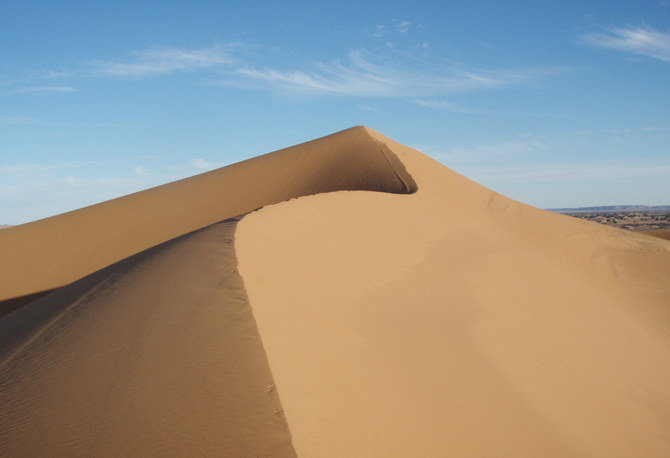
A view of the Lala Lallia star dune of the Sahara Desert, in Erg Chebbi, Morocco, as seen in an undated handout image from 2008 and obtained by Reuters on March 1, 2024. (REUTERS)
2 / 2
A view of the Lala Lallia star dune of the Sahara Desert, in Erg Chebbi, Morocco, as seen in an undated handout image from 2008 and obtained by Reuters on March 1, 2024. (REUTERS)
Short Url
Updated 05 March 2024
Follow

Scientists reveal secrets of Earth’s magnificent desert star dunes

  • The researchers used ground-penetrating radar to peer inside the dune and employed luminescence dating to determine how long Lala Lallia has taken to form, a method based on the amount of energy trapped inside the grains of sand

WASHINGTON: They are among the wonders of our deserts: star dunes, the vaguely pyramid-shaped sand formations up to about 1,000 feet (300 meters) tall with arms stretching out from a central peak to give them a star-like appearance when viewed from above.
Scientists on Monday unveiled the first in-depth study of a star dune, revealing the internal structure of these geological features and showing how long it took for one of them to form — more quickly than expected but still a process unfolding over many centuries.
The study focused upon a star dune in eastern Morocco called Lala Lallia, meaning “highest sacred point” in the local Berber language, situated within the Sahara Desert in a small sand sea called Erg Chebbi about 3 miles (5 km) from the town of Merzouga, close to the border with Algeria.


A view of the Lala Lallia star dune of the Sahara Desert, in Erg Chebbi, Morocco, as seen in an undated handout image from 2008 and obtained by Reuters on March 1, 2024. (REUTERS)

Lala Lallia rises about 330 feet (100 meters) above the surrounding dunes and is approximately 2,300 feet (700 meters) wide, containing about 5-1/2 million metric tons of sand.
The researchers used ground-penetrating radar to peer inside the dune and employed luminescence dating to determine how long Lala Lallia has taken to form, a method based on the amount of energy trapped inside the grains of sand. The answer: about 900 years, accumulating roughly 6,400 metric tons annually as wind relentlessly blows sand through the desert.
Star dunes make up just under 10 percent of the dunes in Earth’s deserts and are the tallest ones, surpassing other types such as crescent-shaped barchan dunes and straight and lengthy linear dunes. They also have been spotted on Mars and on Saturn’s large moon Titan.
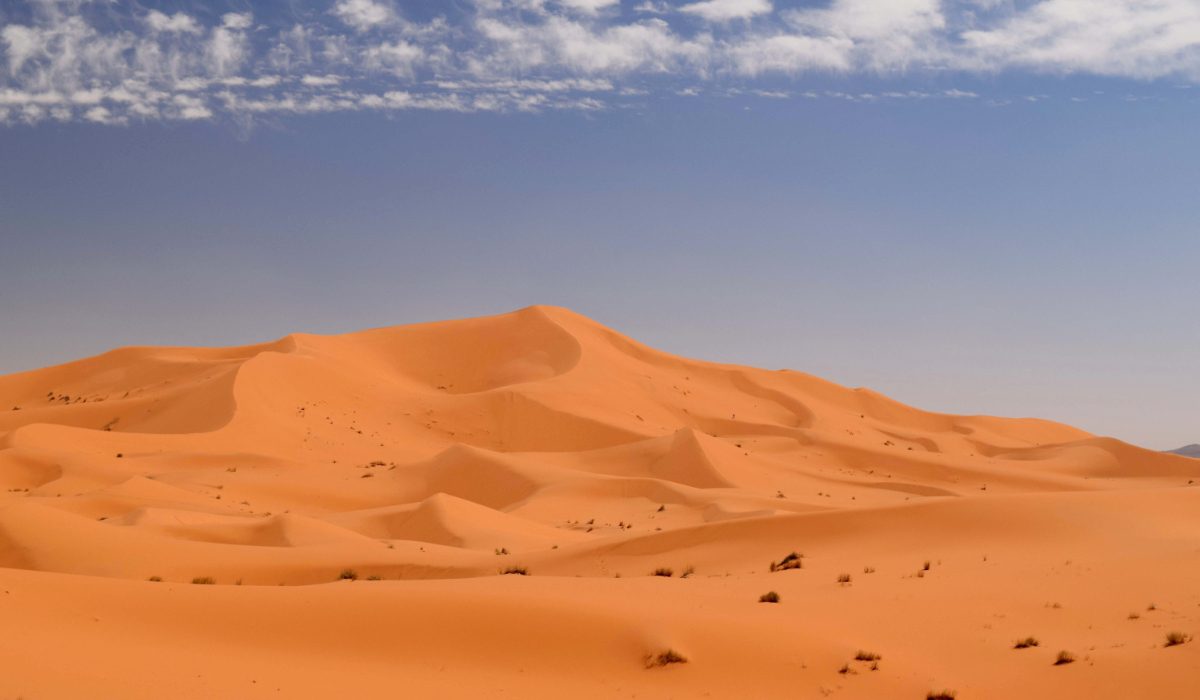


A view of the Lala Lallia star dune of the Sahara Desert, in Erg Chebbi, Morocco, as seen in an undated handout image from 2008 and obtained by Reuters on March 1, 2024. (REUTERS)

“I first encountered star dunes in Namibia 20 years ago, and was instantly amazed at the size of them. I have a vivid memory of the long climb to the top, struggling up very loose sand in the heat of the day,” said geographer Geoff Duller of Aberystwyth University in Wales, co-author of the study published in the journal Scientific Reports.
“I find desert dunes very beautiful,” Duller added. “The sight of the sinuous curves, and the way that the light and shadow changes with the sun mean that they always look different, whether that is in the cool of the morning, the midday sun or near sunset. The different colors of sand in different deserts are also very striking, with yellow, white, red and even black dunes in different parts of the world.”
The ground-penetrating radar revealed the layers within the Lala Lallia dune, showing how it was constructed over time through accumulating sand and how parts of its internal structure resembled other types of dunes.
“Star dunes are formed in areas with complex wind regimes, which means winds blowing from different directions, and net sand accumulation, points within the desert where big piles of sand can be blown around to form giant dunes,” said Birkbeck University of London sedimentologist and study co-author Charlie Bristow.
The researchers also determined that Lala Lallia is moving westerly at a speed of about 1.6 feet (0.5 meters) annually.
While many star dunes are known today, only a single ancient one has been found preserved as sandstone in the geological record, dating to about 250 million years ago, in Scotland. By revealing their internal structure, the researchers said their findings provide a guide for geologists to identify more sandstone remnants of ancient star dunes.
Earth’s largest star dunes are found in the Badain Jaran desert in western China. Star dunes also are found in places including the Namib Sand Sea in Namibia, large sand seas in Algeria such as the Grand Erg Oriental and Grand Erg Occidental, and Rub’ al Khali in Saudi Arabia. In North America, Great Sand Dunes National Park in Colorado contains a series of them.
“They form extraordinary and awe-inspiring landscapes,” Bristow said. “From the ground they can be intimidating, mobile mountains of sand.”


Filipinos master disaster readiness, one roll of the dice at a time

Updated 29 December 2025
Follow

Filipinos master disaster readiness, one roll of the dice at a time

  • In a library in the Philippines, a dice rattles on the surface of a board before coming to a stop, putting one of its players straight into the path of a powerful typhoon

MANILA: In a library in the Philippines, a dice rattles on the surface of a board before coming to a stop, putting one of its players straight into the path of a powerful typhoon.
The teenagers huddled around the table leap into action, shouting instructions and acting out the correct strategies for just one of the potential catastrophes laid out in the board game called Master of Disaster.
With fewer than half of Filipinos estimated to have undertaken disaster drills or to own a first-aid kit, the game aims to boost lagging preparedness in a country ranked the most disaster-prone on earth for four years running.
“(It) features disasters we’ve been experiencing in real life for the past few months and years,” 17-year-old Ansherina Agasen told AFP, noting that flooding routinely upends life in her hometown of Valenzuela, north of Manila.
Sitting in the arc of intense seismic activity called the “Pacific Ring of Fire,” the Philippines endures daily earthquakes and is hit by an average of 20 typhoons each year.
In November, back-to-back typhoons drove flooding that killed nearly 300 people in the archipelago nation, while a 6.9-magnitude quake in late September toppled buildings and killed 79 people around the city of Cebu.
“We realized that a lot of loss of lives and destruction of property could have been avoided if people knew about basic concepts related to disaster preparedness,” Francis Macatulad, one of the game’s developers, told AFP of its inception.
The Asia Society for Social Improvement and Sustainable Transformation (ASSIST), where Macatulad heads business development, first dreamt up the game in 2013, after Super Typhoon Haiyan ravaged the central Philippines and left thousands dead.
Launched six years later, Master of Disaster has been updated this year to address more events exacerbated by human-driven climate change, such as landslides, drought and heatwaves.
More than 10,000 editions of the game, aimed at players as young as nine years old, have been distributed across the archipelago nation.
“The youth are very essential in creating this disaster resiliency mindset,” Macatulad said.
‘Keeps on getting worse’ 
While the Philippines has introduced disaster readiness training into its K-12 curriculum, Master of Disaster is providing a jolt of innovation, Bianca Canlas of the Department of Science and Technology (DOST) told AFP.
“It’s important that it’s tactile, something that can be touched and can be seen by the eyes of the youth so they can have engagement with each other,” she said of the game.
Players roll a dice to move their pawns across the board, with each landing spot corresponding to cards containing questions or instructions to act out disaster-specific responses.
When a player is unable to fulfil a task, another can “save” them and receive a “hero token” — tallied at the end to determine a winner.
At least 27,500 deaths and economic losses of $35 billion have been attributed to extreme weather events in the past two decades, according to the 2026 Climate Risk Index.
“It just keeps on getting worse,” Canlas said, noting the lives lost in recent months.
The government is now determining if it will throw its weight behind the distribution of the game, with the sessions in Valenzuela City serving as a pilot to assess whether players find it engaging and informative.
While conceding the evidence was so far anecdotal, ASSIST’s Macatulad said he believed the game was bringing a “significant” improvement in its players’ disaster preparedness knowledge.
“Disaster is not picky. It affects from north to south. So we would like to expand this further,” Macatulad said, adding that poor communities “most vulnerable to the effects of climate change” were the priority.
“Disasters can happen to anyone,” Agasen, the teen, told AFP as the game broke up.
“As a young person, I can share the knowledge I’ve gained... with my classmates at school, with people at home, and those I’ll meet in the future.”