

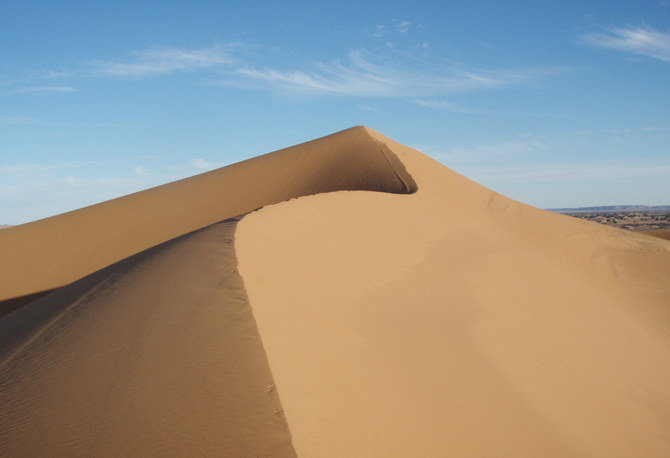


WASHINGTON: They are among the wonders of our deserts: star dunes, the vaguely pyramid-shaped sand formations up to about 1,000 feet (300 meters) tall with arms stretching out from a central peak to give them a star-like appearance when viewed from above.
Scientists on Monday unveiled the first in-depth study of a star dune, revealing the internal structure of these geological features and showing how long it took for one of them to form — more quickly than expected but still a process unfolding over many centuries.
The study focused upon a star dune in eastern Morocco called Lala Lallia, meaning “highest sacred point” in the local Berber language, situated within the Sahara Desert in a small sand sea called Erg Chebbi about 3 miles (5 km) from the town of Merzouga, close to the border with Algeria.

A view of the Lala Lallia star dune of the Sahara Desert, in Erg Chebbi, Morocco, as seen in an undated handout image from 2008 and obtained by Reuters on March 1, 2024. (REUTERS)
Lala Lallia rises about 330 feet (100 meters) above the surrounding dunes and is approximately 2,300 feet (700 meters) wide, containing about 5-1/2 million metric tons of sand.
The researchers used ground-penetrating radar to peer inside the dune and employed luminescence dating to determine how long Lala Lallia has taken to form, a method based on the amount of energy trapped inside the grains of sand. The answer: about 900 years, accumulating roughly 6,400 metric tons annually as wind relentlessly blows sand through the desert.
Star dunes make up just under 10 percent of the dunes in Earth’s deserts and are the tallest ones, surpassing other types such as crescent-shaped barchan dunes and straight and lengthy linear dunes. They also have been spotted on Mars and on Saturn’s large moon Titan.
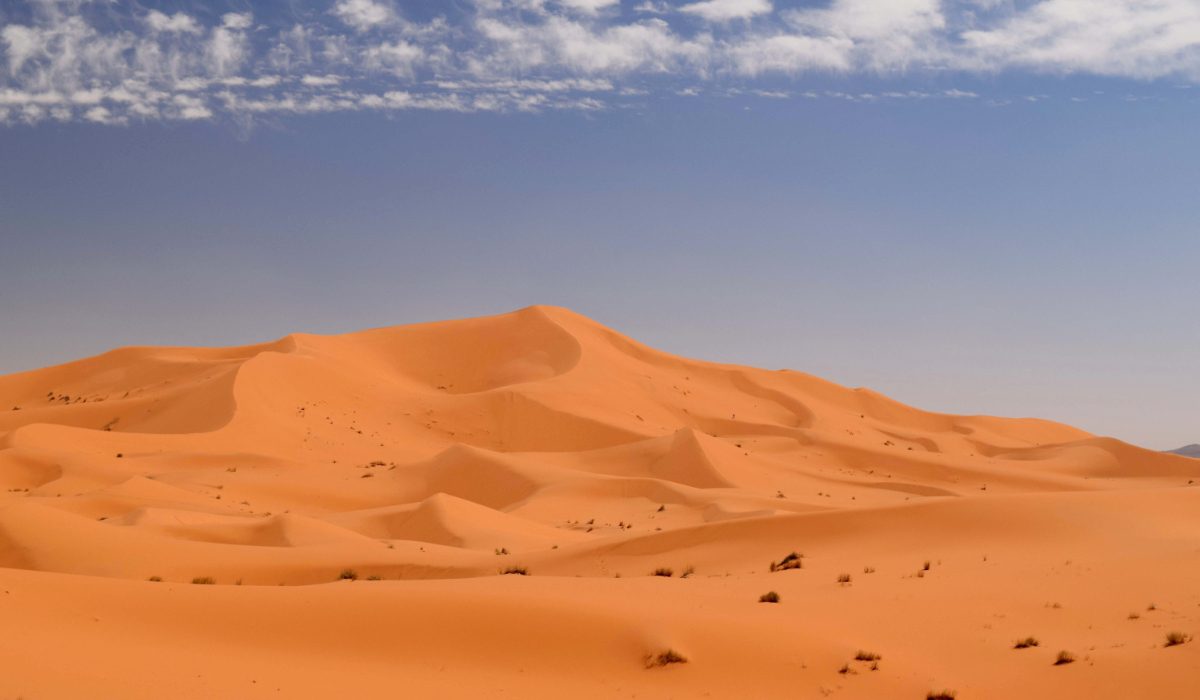
A view of the Lala Lallia star dune of the Sahara Desert, in Erg Chebbi, Morocco, as seen in an undated handout image from 2008 and obtained by Reuters on March 1, 2024. (REUTERS)
“I first encountered star dunes in Namibia 20 years ago, and was instantly amazed at the size of them. I have a vivid memory of the long climb to the top, struggling up very loose sand in the heat of the day,” said geographer Geoff Duller of Aberystwyth University in Wales, co-author of the study published in the journal Scientific Reports.
“I find desert dunes very beautiful,” Duller added. “The sight of the sinuous curves, and the way that the light and shadow changes with the sun mean that they always look different, whether that is in the cool of the morning, the midday sun or near sunset. The different colors of sand in different deserts are also very striking, with yellow, white, red and even black dunes in different parts of the world.”
The ground-penetrating radar revealed the layers within the Lala Lallia dune, showing how it was constructed over time through accumulating sand and how parts of its internal structure resembled other types of dunes.
“Star dunes are formed in areas with complex wind regimes, which means winds blowing from different directions, and net sand accumulation, points within the desert where big piles of sand can be blown around to form giant dunes,” said Birkbeck University of London sedimentologist and study co-author Charlie Bristow.
The researchers also determined that Lala Lallia is moving westerly at a speed of about 1.6 feet (0.5 meters) annually.
While many star dunes are known today, only a single ancient one has been found preserved as sandstone in the geological record, dating to about 250 million years ago, in Scotland. By revealing their internal structure, the researchers said their findings provide a guide for geologists to identify more sandstone remnants of ancient star dunes.
Earth’s largest star dunes are found in the Badain Jaran desert in western China. Star dunes also are found in places including the Namib Sand Sea in Namibia, large sand seas in Algeria such as the Grand Erg Oriental and Grand Erg Occidental, and Rub’ al Khali in Saudi Arabia. In North America, Great Sand Dunes National Park in Colorado contains a series of them.
“They form extraordinary and awe-inspiring landscapes,” Bristow said. “From the ground they can be intimidating, mobile mountains of sand.”


