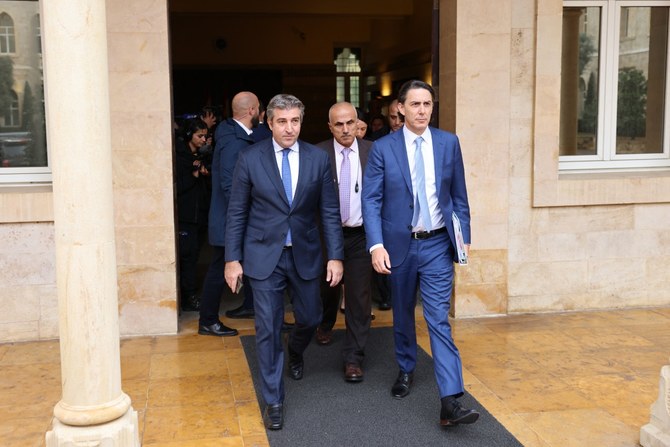

BEIRUT: Senior US envoy envoy Amos Hochstein said during a visit to Beirut on Monday that a diplomatic solution is the key to ending nearly five months of hostilities between Hezbollah and Israel that broke out after the start of the war in Gaza.
Hochstein, a senior advisor to President Joe Biden, held meetings with Nabih Berri, the speaker of the Lebanese Parliament, caretaker Prime Minister Najib Mikati, and several other political figures.
His visit came amid escalating Israeli threats of a war against Lebanon to force Hezbollah to retreat, and to press Lebanese authorities to implement the provisions of UN Security Council Resolution 1701, which was adopted in 2006 with the aim of resolving the war that year between Israel and Hezbollah.
It also came amid further escalations in fighting along the southern Lebanese front, including reported attempts by Israel to infiltrate Lebanese territory and resultant confrontations with Hezbollah.
Hezbollah said “a hostile Israeli force attempted to infiltrate Lebanese territory in the Qatamoun Valley area opposite Rmeish on Sunday night and was targeted with rockets.”
An Israeli unit of the Golani Brigade reportedly tried to enter Lebanon from the direction of Khirbet Zarit, near the Lebanese town of Ramia, and Hezbollah responded by targeting the unit with a large explosive device.
Meanwhile, Hezbollah intensified strikes against Israeli sites. An attack on the Margaliot settlement left one person dead and 10 injured, two of them critically. According to the Israeli ambulance service, an anti-tank missile was fired at the settlement from Lebanon. Israeli media reported that the dead and injured were foreign workers.
In a separate incident, Hezbollah said they targeted “Zarait Barracks and its surroundings” early on Monday with artillery fire.
Elsewhere, the Israeli army reportedly fired shots in the air in the vicinity of farmers spraying crops near the town of Wazzani in Marjayoun district. Israeli forces also targeted the towns of Hula and Markab, overlooking Wadi Hunayn and the Margaliot settlement, with phosphorus and smoke bombs, and Israeli warplanes carried out raids on the outskirts of the town of Shihin.
Hochstein previously visited Beirut in January as part of US efforts to broker ceasefires in the Gaza Strip and southern Lebanon. Lebanese authorities him to return in February, when he visited Tel Aviv, but that did not happen.
In the meantime there have been no dramatic shifts in the balance of military power in southern Lebanon, despite the growing intensity of confrontations and expansions of targets by both the Israeli army and Hezbollah.
Lebanese authorities have said Israel must fully implement the provisions of UN Resolution 1701 by halting attacks, addressing disputed border points, of which six remain, withdrawing from the occupied Shebaa Farms and Kfarchouba hills, and respecting international borders. Hezbollah has also linked the end of hostilities on the southern front to the end of Israeli attacks in the Gaza Strip.
On Monday, Hochstein noted that the friction along the border between Israel and Lebanon had increased in recent weeks.
“Escalation of violence is in no one’s interest and there is no such thing as a limited war,” he said after his meeting the Berri, who is an ally of Hezbollah. “A temporary ceasefire is not enough. A limited war is not containable.”
A truce in Gaza would not automatically trigger peace in southern Lebanon, he said, but he added that he remains “hopeful” that a diplomatic solution to the border conflict can be achieved.
“It does not necessarily happen that when you have a ceasefire in Gaza, it just automatically extends” to Lebanon, Hochstein said.
The US “remains committed to advancing lasting security solutions, achieved through a diplomatic process that will allow Lebanese residents to safely return to their homes, as well as allowing Israelis to return to their homes safely in northern Israel,” he added.
The aim of his visit was “to find a diplomatic solution to end the conflict on Lebanon’s southern borders” he said, adding: “Our position on the hostilities has been consistent and remains clear.”
Washington “believes a diplomatic solution is the only way to end the current hostilities along the Blue Line that will achieve a lasting, fair security arrangement between Lebanon and Israel,” Hochstein said.
“The people of Lebanon and Israel have the right to live in peace and prosperity. Let me acknowledge the global unity of this position.
“An important part of any understanding will include international support for Lebanon, for the Lebanese people and for strengthening its institutions, military, civilian and the economy. But this can only start when we can reach a way forward.”
The US continues to work with the government in Lebanon in pursuit of such a diplomatic solution that allows for prosperity and security, Hochstein said.
“What we want to see is a diplomatic solution here on the border … to ensure that there is a cessation of hostilities and that precautions are made so that everybody, on both sides of the line, can return to their homes safely and securely and have a future that is free of fear.”