

A chunk of Republican primary and caucus voters say they wouldn’t vote for Trump as the GOP nominee

1 / 2
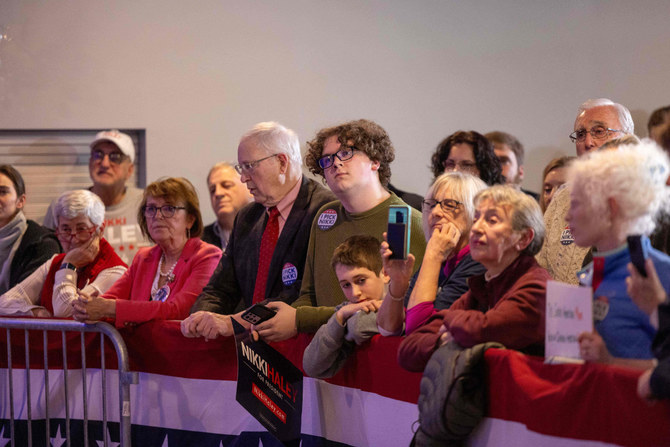
Supporters of Republican presidential candidate Nikki Haley attend a campaign rally at the Portland Elks Club on March 3, 2024 in Portland, Maine. (Getty Images/AFP)
2 / 2
Supporters of Republican presidential candidate Nikki Haley attend a campaign rally at the Portland Elks Club on March 3, 2024 in Portland, Maine. (Getty Images/AFP)
Short Url
Updated 04 March 2024
Follow

A chunk of Republican primary and caucus voters say they wouldn’t vote for Trump as the GOP nominee

  • 2 in 10 Iowa voters, one-third of New Hampshire voters, and one-quarter of South Carolina voters would be so disappointed by Trump’s renomination that they would refuse to vote for him in the fall
  • Anywhere between one-half and two-thirds of the staunchly anti-Trump voters in the early contests said they had voted for Biden in 2020

WASHINGTON: A small but substantial chunk of Republican primary and caucus voters say they would be so dissatisfied if Donald Trump became the party’s presidential nominee that they would not vote for him in November’s general election, according to AP VoteCast.

An analysis of the data shows that many of those voters were unlikely to vote for Trump, some even before this year, but it still points to potential problems for the former president as he looks to consolidate the nomination and pivot toward an expected rematch with Democratic President Joe Biden.
According to AP VoteCast surveys of the first three head-to-head Republican contests, 2 in 10 Iowa voters, one-third of New Hampshire voters, and one-quarter of South Carolina voters would be so disappointed by Trump’s renomination that they would refuse to vote for him in the fall.
This unwillingness to contemplate a presidential vote for Trump isn’t confined to voters in the earliest states.
Lee and Bill Baltzell defected from the Republican Party to register as independents a year ago. They attended a rally for supporters of Trump’s last major rival, former UN Ambassador Nikki Haley, last week in Centennial, Colorado, to encourage her to keep running against Trump.
“We don’t know that Trump will run into more legal problems and be disqualified, and I’d rather not see Biden in there for another four years,” said Bill Baltzell, 60.
If it’s between Biden and Trump, Lee Baltzell, 58, said she would consider writing in an alternative.
“I don’t know. I did not vote for Biden the last time; I don’t know that I could do it this time. But I don’t know if I could vote for Trump.”
Opposition from voters like the Baltzells hasn’t slowed Trump’s march toward the nomination, but it could be an issue for him later on. It’s not clear how much of a problem, though, because a dive into the numbers shows that many of the “never-Trump” voters in the early states were unlikely to vote for him in the general election to begin with.
Many of the voters who said they wouldn’t vote for Trump as the nominee aren’t Republicans at all. In the first three head-to-head contests, anywhere from 17 percent to 31 percent of the voters who said they wouldn’t support Trump in the general election identified as Democrats, and between 14 percent and 27 percent identified as independents.
Even for some of those Republicans, voting for Trump was already a tough sell. Anywhere between one-half and two-thirds of the staunchly anti-Trump voters in the early contests said they had voted for Biden in 2020.
Then there is the fact that primaries tend to draw out the people with the most passionate opinions. Voter turnout in primaries and caucuses, particularly ones that are relatively uncompetitive, is typically lower than it would be in a general election.
Still, about 1 in 10 early contest voters who said they supported Trump in the 2020 general election said they wouldn’t be doing so this year.
One question, though, is whether that means they would vote for Trump’s opponent instead.
“I won’t vote for Trump, I’ll just say that. I voted for him twice; I could never vote for him again,” said Linda Binkley, 74, a registered Republican who isn’t pleased by the prospect of a Trump vs. Biden matchup. She added, “I’m not sure I can vote for Biden.”
If Trump becomes the nominee, he will likely need to win over some of the moderates who supported Biden in 2020 if he wants to return to the White House. From that perspective, even a small amount of opposition from within his own party — not to mention broader skepticism among independents — could be a problem in the future.

AP VoteCast is a series of surveys conducted among 1,597 Republican caucus voters in Iowa, 1,989 New Hampshire voters who took part in the Republican primary and 2,466 Republican primary voters in South Carolina. The surveys were conducted by The Associated Press-NORC Center for Public Affairs Research.


Ukraine president to meet European allies after Trump criticism

Updated 4 sec ago
Follow

Ukraine president to meet European allies after Trump criticism

  • Talks between Ukrainian and US officials in Miami ended on Saturday with no apparent breakthrough
  • President Donald Trump accuses Ukrainian leader of not reading the US proposal to end the war with Russia

LONDON: Ukrainian leader Volodymyr Zelensky was due to meet with European allies in London on Monday, after President Donald Trump accused him of not reading the US proposal to end the war with Russia.

It comes after days of talks between Ukrainian and US officials in Miami ended on Saturday with no apparent breakthrough, with Zelensky committing to further negotiations.

The Ukrainian president will be received in London by British Prime Minister Keir Starmer, along with the German chancellor and French president to discuss the negotiations.

British Foreign Secretary Yvette Cooper is meanwhile expected in Washington on Monday, where she will meet her American counterpart Marco Rubio.

“The UK and US will reaffirm their commitment to reaching a peace deal in Ukraine,” the Foreign Office in London said, announcing Cooper’s visit.

Moscow has meanwhile continued to strike its neighbor, wounding at least nine people overnight Sunday to Monday, according to Ukrainian officials.

‘Disappointed’

Zelensky said he joined his negotiators for a “very substantive and constructive” call with US envoys Steve Witkoff and Jared Kushner during the Miami negotiations.

“Ukraine is committed to continuing to work honestly with the American side to bring about real peace,” Zelensky said on Telegram, adding that the parties agreed “on the next steps and the format of the talks with America.”

But Trump criticized his Ukrainian counterpart on Sunday, telling reporters “I have to say that I’m a little bit disappointed that President Zelensky hasn’t yet read the proposal, that was as of a few hours ago.”

Witkoff and Kushner had met Russian President Vladimir Putin at the Kremlin last week, with Moscow rejecting parts of the US proposal.

French President Emmanuel Macron ahead of Monday’s talks slammed what he called Russia’s “escalatory path.”

“We will continue these efforts with the Americans to provide Ukraine with security guarantees, without which no robust and lasting peace will be possible,” Macron wrote on X.

He added: “We must continue to exert pressure on Russia to compel it to choose peace.”

Hot and cold

Washington’s initial plan to bring an end to the almost four-year war involved Ukraine surrendering land that Russia has not been able to win on the battlefield in return for security promises that fall short of Kyiv’s aspirations to join NATO.

But the nature of the security guarantees that Ukraine could get has so far been shrouded in uncertainty, beyond an initial plan saying that jets to defend Kyiv could be based in Poland.

Trump has blown hot and cold on Ukraine since returning to office in January, initially embracing Putin and chastising Zelensky for not being grateful for US support.

But he has also grown frustrated that his efforts to persuade Putin to end the war, including a summit in Alaska, have failed to produce results and he recently slapped sanctions on Russian oil firms.